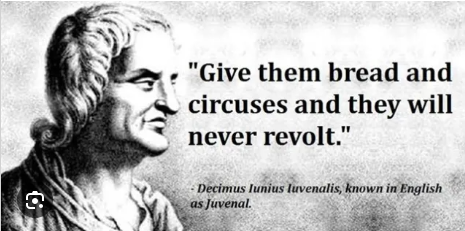
- “…duas tantum res anxius optat, panem et circenses.” * (“…it anxiously wishes for two things only: bread and circuses.”)
We use the phrase nonchalantly.. football on a Sunday, a reality show, a rally, a stadium built with money the city did not have. ‘Panem et circenses’ as a ‘whatever’ about other people’s taste. The original was nastier than that. It was about a citizenry that had traded the vote for the grain dole, and had stopped noticing the exchange rate.
Two things happened yesterday that won't make any front pages.
The first: a Russian special-purpose submarine called Khabarovsk went to sea for the first time, on trials in the White Sea. Built on a Borei hull, shortened because it carries no ballistic missiles. What it carries instead is Poseidon, a nuclear-powered nuclear-armed autonomous torpedo designed to cross an ocean and detonate against a coastline. Construction started in July 2014, four years before Putin announced the program existed. A second-strike weapon, designed for use after the exchange of warheads has already happened (The Barents Observer). A doomsday device left the dock and the tape did not blink.
The second: the US diesel crack settled at a record $102.20 a barrel. First time in history above $100. Pump diesel hit $5.47 a gallon, up eight percent in a month, closing on the all-time high of $5.81 (FT).
One of those is the circus. The other is the bread.
And there is a third item, which is the joke inside the joke. Cantor Fitzgerald is opening Kalshi’s prediction markets to roughly three thousand institutional clients, brokering block trades in event contracts, with Susquehanna making prices. Hedge funds want to trade iPhone unit sales rather than Apple stock. Family offices want to hedge crop output and oil prices. Institutions can commission bespoke markets on request (WSJ). The circus is being institutionalized into a clearing house with a liquidity provider attached.
Pardon my French, but what the actual f…
Bread up eight percent. Circuses now block-tradeable. Nobody watching the torpedo.
The 90-day rolling correlation between Brent and the US 10-year yield is 0.643. Highest since 1988. It has been beaten once in thirty-eight years, in March 2020, and that time both were collapsing rather than rising.
So the long end of the world’s benchmark bond curve is now driven, more tightly than at any point in almost four decades, by a war over a shipping lane.
Into that, the price of insurance against the long end moving is below its long-run median.
Both of those are facts. Put them next to each other and somebody is being paid to be wrong.
**REGIME.**Three of four safe havens bid, the dollar offered alone. Yesterday’s de-gross ended overnight. The dollar problem did not.**THE SEAM.**Oil drives the long end at the tightest correlation since 1988, and rates gamma trades below its long-run median. Own it. Do not sell it.**THE BOOK.**Crude refuses to pay. Products already did. Long refining against E&P, keep the tanker, and hold the fee complex against the credit tail.**I’M WRONG IF.**Brent settles above $95. Flat price finally paying turns this back into an ordinary crude supply shock and my framing is dead.
Gold, bonds and the yen are all bid this morning and the dollar is not, which reverses the whole-book de-gross of the last two sessions without touching the reason for it. Crude will not pay for the war. On a session when the UAE severed all economic ties with Tehran, three China-linked supertankers turned around inside the Strait, a Russian refinery burned and the SPR printed its lowest level since December 1982, Brent is up a third of a percent and a dollar off its own high.
The products market has already paid: the diesel crack settled at a record $102.20 and pump diesel is $5.47. The inflation impulse the bond market is chewing on is a refining-margin impulse, not a barrel impulse, and it transmits through freight and food rather than through the gasoline line every strategist watches.
Rates volatility, at the same time, sits below median into FOMC minutes, a 20-year auction at the highest yield since the tenor came back, PCE, Nvidia and a Jackson Hole from a chair who has withheld forward guidance.
Own gamma. Own the crack, not the barrel.
Inside financials the two-session subsector spread ran 348 basis points and the AI credit complex is repricing ahead of AI equity, which is where the sector’s real risk is sitting.
Start with the number that reframes everything else.
0.643. Oil and the long bond have not moved together this tightly in thirty-eight years, and the one exception was a crash in which both were plunging. Today they are both rising. The transmission is inflation expectations plus a term premium that has to price a supply shock with no political solution.
Fine. Consensus has that much. The Journal’s editorial page spent Tuesday arguing the whole repricing is just yields reverting to a pre-2008 normal, and that the last two decades were the anomaly (WSJ). Correct as far as it goes. French tens at 4.1%, the highest since 2008. Bunds at 3.26%, back to 2011. JGBs at 2.93%, highest since 1996. Normalization, yes.
Now the second number.
USD 3m10y swaption vol: 73. Long-run median: roughly 100. EUR 65 against a median near 78. GBP 82 against a median near 90. One-month realized vol on the 2-year swap rate is running 3.6 basis points a day against 5.4 implied, and the 30-year is 4.0 against 4.1. Selling gamma has been the winning trade since April and it has earned its reputation honestly (Bloomberg Intelligence).
Look at what that trade is short into.
FOMC minutes at two o’clock, from the 29 July meeting whose press conference took 2.2% out of the S&P in an afternoon. A $16bn 20-year auction at one o’clock, on course to price at the highest yield since the tenor was reintroduced in May 2020 (Bloomberg). July PCE next Wednesday. Nvidia the same afternoon. Jackson Hole the 27th to the 29th, first keynote from a chair who has explicitly declined to give forward guidance.
Removing forward guidance is itself a term premium input. Here is that mechanism with a picture on it.
Term premium dropped hard into the first meeting under the new chair, rebuilt through July, and has been printing at the top of its 2026 range since the second. The 10s2s curve bear-steepened from the high twenties to fifty-plus in the same window. A chair who withholds guidance is not a dove or a hawk. He is a source of variance, and variance is exactly what the swaption grid says is cheap.
So the first position is structural rather than directional: whatever the duration view, hold it in options. Convexity is on sale in the one instrument a chokepoint now controls.
Yesterday’s headline density on the war was as high as it has been. The UAE, one of Iran’s largest commercial partners, cut all trade and financial transactions until further notice after accusing Tehran of firing ballistic missiles at its territory (Bloomberg). Three China-linked supertankers turned around inside the Strait of Hormuz overnight. A Ukrainian strike set fire to a refinery at Ufa. Trump confirmed there are no talks and none scheduled. The Strategic Petroleum Reserve fell 5.3 million barrels on the week to 293.4 million, the lowest since December 1982, which removes the only demand-side lever Washington had.
Brent: $91.31. Up 0.32%. Session high $92.37, so a dollar and change below its own high with all of that on the wires.
The crude market is refusing. Third time in three weeks it has refused. I said on Monday that either the market is wrong or the bypass volumes are doing more work than transit counts imply. I now think there is a cleaner answer, and it is sitting in the product.
$102.20. Refined fuel exports through Hormuz have dwindled to almost nothing, in stark contrast to crude flows, which remain comparatively resilient (FGE NexantECA). Marathon’s Galveston Bay and Citgo are on the outage list alongside Ufa. Ukraine is systematically burning Russian refining capacity. Adnoc is trimming Murban volumes to Asia. Saudi Aramco, by contrast, has told at least three European refiners they will get full contractual crude in September.
Read that combination properly. Crude supply is being managed. Refining capacity is being destroyed. One of those recovers on a phone call. The other takes years and a construction permit.
And there is a second chokepoint nobody is pricing at all. The Caspian Pipeline Consortium moves roughly 1.4 million barrels a day of Kazakh crude to Novorossiysk on the Black Sea, and Ukrainian unmanned boats damaged one of its moorings badly enough that the operator declared further operation impossible. Washington filed a diplomatic protest with Kyiv over it, which tells you how highly the State Department rates that line (
Doomberg). Hormuz is the chokepoint everyone models. The Black Sea is the one that gets 1.4 million barrels a day to the same buyers, and it is being attritted by the side Washington arms.Which means the inflation impulse the bond market is pricing is not a barrel impulse. A margin impulse, and it enters the CPI through a different door. Diesel is the input cost of every physical good in the country: agriculture, rail, trucking, marine, heating oil ahead of winter. Gasoline is what politicians watch. Diesel is what actually moves the goods, and Cass freight shipments just made a new low for the cycle at roughly 0.96.
Volumes at cycle lows. Cost per volume at an all-time high. Margin event, not a demand event. Kenya Airways reported first-half fuel costs up 72% and named Hormuz explicitly. UK CPI went to 2.9% from 2.6% on energy charges. Iceland hiked to 8% and said the quiet part out loud: fuel cost inflation from the Iran war. Two-thirds of the 32 swap markets Bloomberg tracks are now priced for hikes over the next year.
And it is going to be a midterm issue, which brings me back to the grain dole.
Trump’s approval just printed 33% in a new Reuters/Ipsos poll. Lowest of his presidency.
The internals are worse than the headline. One in five Americans think the war in Iran has been worth it, and among Republicans that is only half.
Eighty percent expect US involvement to go on for an extended period, and the partisan spread on that question is almost nil: 87% of Democrats, 71% of Republicans.
On the economy, Democrats lead 38 to 35. Fox had that gap at 54 to 45 last month, the largest Democratic advantage on the question since 2006 (WSJ). A Democratic Socialist just won Florida’s Senate primary.
Consider the war number for a second, because it is the one that matters for the tape. Seventy-one percent of his own party expects this to run long. Nobody with a functioning whip count believes a diplomatic settlement is coming before November, which means nobody should be modeling one into the crack spread either.
Trump’s brand was cheap energy and dealmaking competence. The delivery is a six-month war of choice over a shipping lane, diesel at $5.47, a strategic reserve at a 44-year low, and a president who responded to a stalled negotiation by threatening to bomb the mediator. Peggy Noonan, hardly a hostile witness, wrote last week that he “looks as if he doesn’t know what his next move is” and quoted his own explanation for why the Iran operation would be fine: “Because it always is” (WSJ).
The entire risk model, in four words.**Things just break his way.**The other side of the war has its own tell in the deposit data. Russian households pulled roughly $3.4bn out of the banking system in the first two weeks of August, on top of $7.3bn in July and more than $4.5bn in June, a record run of outflows driven partly by the fear that the Kremlin starts seizing deposits to fund the war (Washington Post). Neither side of this conflict is financing itself out of surplus. Wars that both parties are funding out of stress do not end on a schedule, which is the same conclusion 71% of Republicans reached without a Bloomberg terminal.
I am not making a political point for its own sake. I am making a positioning point. An administration that needs the pump price down before November has three levers: the reserve, which is empty; a diplomatic settlement, which is not being negotiated; and sanctions relief on someone, anyone, with a refinery. Venezuela signed oil contracts with SLB and Hunt this week.
Watch that lever, because it is the only one left with any travel in it.
**Two o’clock, and the minutes are stale by construction.**The July meeting predates weak payrolls, soft retail sales, a subdued core CPI at 2.5% year on year, and then an Empire manufacturing print at a four-year high. The preview is that “many” participants may have favored a hike (Bloomberg Economics). RBC expects abnormally high attention given how violently the market reacted to the chair’s long-end messaging after that meeting.
Fade the text. Trade the reaction. A hawkish read flattens from the front and takes the steepener further away; it does not speak to term premium, which is the thing actually moving the long end.
A live contradiction sits inside what the rate path is supposed to be, and it needs saying plainly. Money markets price roughly a 35% chance of a September HIKE and 23 basis points of tightening by year-end. Bloomberg Intelligence has a fourth-quarter hike as its base case. Hammack says “some number” of hikes may be needed. Schmid says policy is not restrictive. Every constructive bank-NIM argument in circulation this week rests on a September CUT. The two cannot both be true, and the market is not on the side of the cut.
One o’clock, the 20-year.$16bn, at the highest yield since the tenor came back in 2020. Long-end supply into a session where the long end is the whole story. This is the more informative event of the two.**The Korea sequencing, because everyone has it backward.**On the 18 August US close, Micron fell 7.02% to $940.76, SMH fell 4.09%, XLK fell 2.47% and the US-listed Korea ETF fell 8.13%. Only afterward did Asian cash open and print Kospi minus 5.80% and Nikkei minus 3.16%. Korea did not lead this rout. Korea confirmed it, roughly fourteen hours late, and US futures this morning are pricing none of the confirmation. Flat.**The calendar.**MBA applications at seven. EIA inventories at half past ten, and after last night’s API showed a small crude draw the number that matters is distillates. Target, Lowe’s, TJX and Estee Lauder before the open. Analog Devices already out. VIX options expiration just after the bell, monthly opex Friday.
Nvidia’s five-year CDS, at 82 basis points.
Forty in May. Eighty-two now. Doubled, in a straight line since early June, while the equity chopped sideways and the street kept the buys. Credit desks are repricing counterparty risk on the most important balance sheet in the AI complex and the equity has not marked it.
So what: the AI trade is no longer an equity story with a credit footnote. AI-related borrowers are about 18% of US investment-grade issuance this year, up from 1% in 2024, and tech is roughly 40% of all IG supply at fifteen years and longer (Goldman). Alphabet just paid a shade under 7% for its debut Australian dollar bond, its highest-ever coupon. Nomura puts AI-related borrowing at $200bn year to date, about a quarter of Treasury net issuance over the same period. When the marginal borrower in the fifteen-year bucket is a hyperscaler, the term premium and the AI multiple stop being separate subjects.
The arithmetic on that: a 50 basis point shock to cost of equity, holding everything else, is worth minus 49.8% on Tesla, minus 18.9% on Amazon, minus 14.8% on Meta, minus 13.7% on Microsoft, minus 8.9% on Nvidia (Bloomberg). Long end up, AI down. Not a correlation. A discount rate.
Oracle, and the same story with a longer history.
Oracle’s CDS and its equity moved as one instrument from 2021 through 2025. Then 2026 happened…