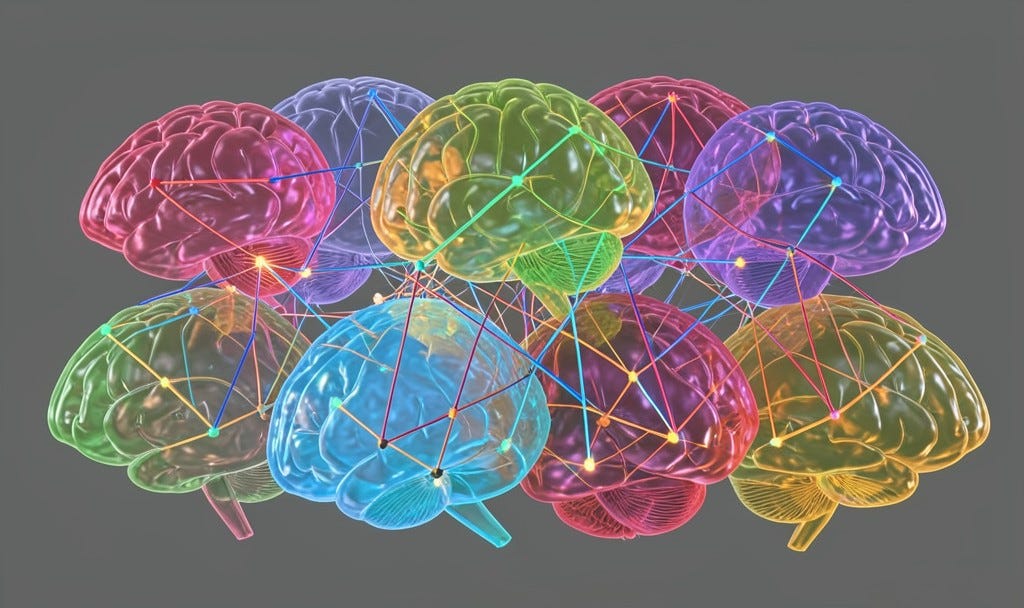
Neurocomplexity is the gestalt interplay of neurodivergent wiring across six dimensions: cognition, sensory receptivity, cellular response, attention, creativity, and intuition. Instead of stacking separate labels (ADHD plus autism *plus *giftedness), it looks at how the dimensions combine and influence each other.
Most of us don’t experience ourselves as a list of dimensions. We experience ourselves as someone who can’t stand the sound of chewing but can hyperfocus for nine hours, or someone who is “so articulate” but can’t remember how to spell “necessary.”
So let’s make it concrete. First, the six dimensions and where they come from. Then the 10 most common combinations (flavors), the stories many of us were taught about them, and where each one tends to shine or struggle in the relationships and work structures most of us live inside.
10 Common Neurocomplex Flavors, at a glance:
The Deep Processor
The Sensory Barometer
The Body That Speaks Up
The Idea Hunter
The Pattern-Seer
The Synesthetic Weaver
The Tidal Creator
The Uneven Landscape
The Under-Signaler
The Cascade
Read the diagnostic criteria for autism, ADHD, learning differences, and the chronic conditions that so often travel with them, and the same six dimensions keep appearing underneath. Some are named outright. Attention is central to ADHD criteria, learning differences are defined by how cognition processes specific skills, and the autism criteria include being over- or under-reactive to sensory input. Others, like cellular response, creativity, and intuition, are less formally named, and they’re part of what I’ve synthesized from research and lived experience. Different labels describe different slices of the same six dimensions, which is why the labels overlap so much and why so many of us collect more than one.
Each dimension can run hyper (turned up), hypo (turned down), or both, depending on the day, the setting, or the sense. You can be hyper-responsive to sound and hypo-responsive to pain, or hyperfocused on what you love and unable to start what you don’t. Neurocomplexity lives in that mix.
**Cognition:**how you think, process information, learn, and make decisions.*Hyper:*deep, rapid, or highly detailed processing.*Hypo:*slower, effortful, or uneven processing in specific areas.**Sensory receptivity:**how you take in sound, light, texture, taste, smell, movement, and the mood of a room.*Hyper:*everything comes in loud and vivid.*Hypo:*you miss signals, or crave intense input to feel anything.**Cellular response:**how your body reacts at a physical level to stress, food, weather, medication, hormones, and stimulation.*Hyper:*flares, reactions, and crashes.*Hypo:*muted or delayed body signals, like missing hunger, thirst, pain, or fatigue until they’re extreme.**Attention:**where your focus goes and how it moves.*Hyper:*intense, locked-in focus or a radar that never stops scanning.*Hypo:*difficulty engaging, starting, or staying with what doesn’t interest you.**Creativity:**how your mind generates, connects, and reshapes ideas. It’s not just art. It’s problem-solving, metaphor, systems-building, and “what if?”*Hyper:*a brain that can’t stop generating.*Hypo:*creative energy that goes quiet when the body or environment can’t support it.**Intuition:**knowing without knowing how you know.*Hyper:*strong, fast, wordless readings of people and situations.*Hypo:*a disconnect from your own gut signals, or a habit of overriding them.
Most relationship and work structures were built around one kind of wiring: steady attention, moderate sensory input, predictable energy, and reasoning that can be explained step by step. That means the same combination can be a superpower in one structure and a liability in another. The strengths and challenges below are about that fit.
The flavors aren’t diagnoses, and they aren’t boxes. Most of you will recognize yourselves in several, which adds stars to your complexity constellation and helps you identify what aspects of your human functioning actually need support.
**Combination: Cognition (hyper) + Attention (hyper and hypo)**Often seen in: ADHD, autism, giftedness