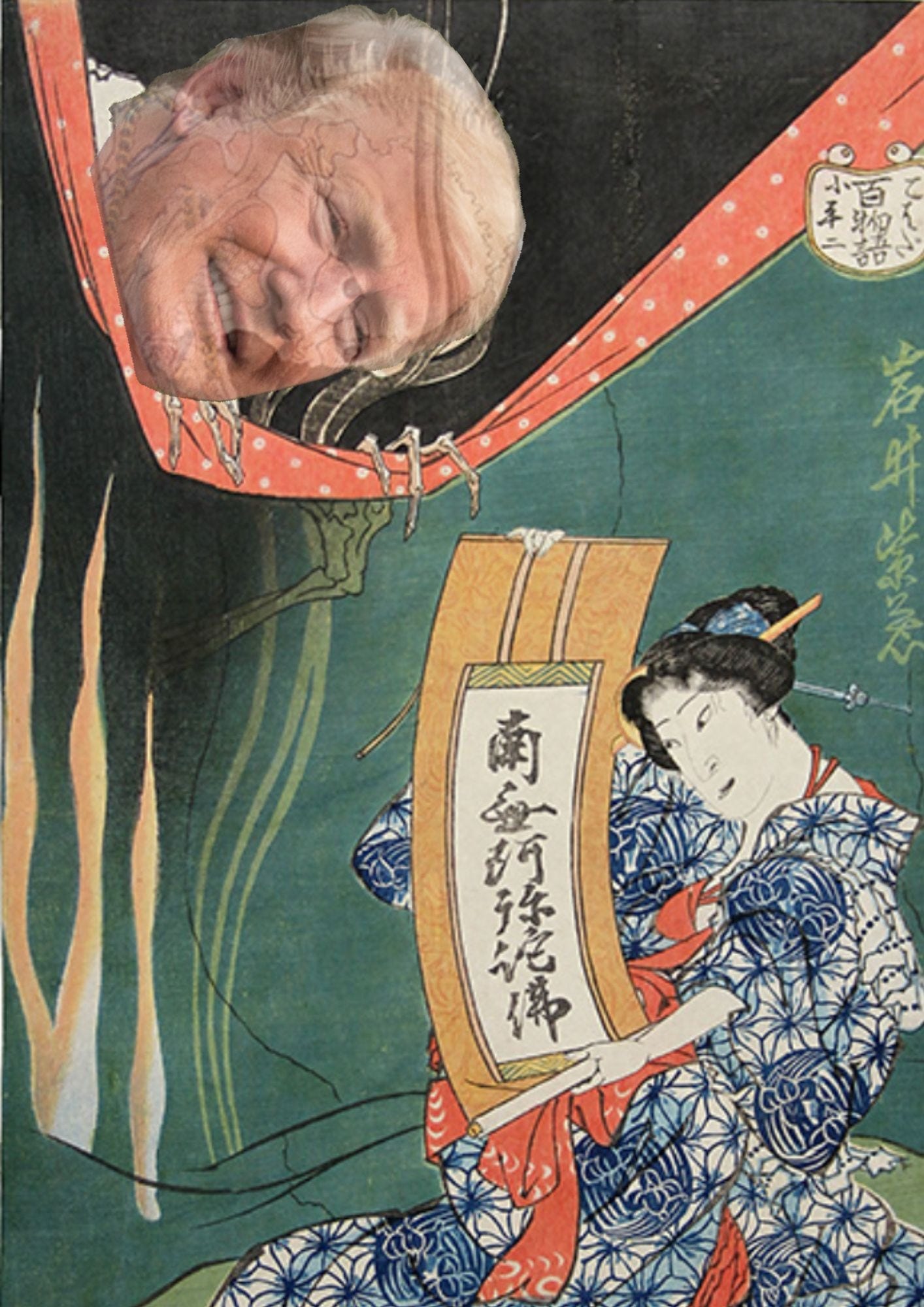
In the spooky season, the Japanese had a tradition of telling each other ghost stories by candlelight. The scariest thing I can think of is what has happened to the US in the last decade due to voter apathy. Learn about Hokusai’s 100 Ghost Stories through American history.
Hokusai wanted to depict 100 Ghost Stories, but only completed 5 images. Unfinished dreams certainly reflect US history. Freedom and liberty for * all* are yet to come. In 19th-century Japan, telling ghost stories was fun but also edifying, reinforcing cultural norms. These stories might also help us see what ghosts of American life exist amongst the MAGA-scorched ethos of our society.
What happens when people don’t deserve their job? Trump and his ilk were obsessed with DEI. In their mind, a system where white men were not winning was broken.
The story of Kohada Koheiji was the story of an acting student who was pretty bad, but then given a bit part as a ghost because his pallor worked. He does well in the role, but his wife’s lover offed him.
Unlike Koheiji, who rose to the challenge he lucked into, our nation is living with the ghost of meritocracy. Let me tell you about a young man, a bigly stupid man. Like Koheiji, young Don was not good at his training. He showed no promise and ended up second-to-last among the students at Wharton. He was given a chance to take over the family business, something he was not qualified for. Unlike Koheiji, young Don did not rise to the challenge. Instead, Don sank the family business despite living in the Reagan era of tax breaks for the wealthy. But, like Koheiji, Trump ended up in show business, and he succeeded, but only because of the producers doing a good job with their editing. People believed he was a good businessman, when he wasn’t. Sadly, his wife had no lover, so the really scary part was that we, as a nation, were stuck with a man who was never good at much. He’s even worse at being president.
Moral: If the moral of the story of Koheiji is that cheaters don’t prosper, sadly, right now the Trump admin is showing they do. But hopefully, we’ll also learn that the real problem is hyping up untalented men. The biggest proof that DEI made our country better is the Trump Administration. People were hired for their skin color, and in the case of the press secretary, their dye jobs. As it turns out, roles that require using your brain cannot be fake—though the Trump administration does it daily. The roots of meritocracy in the US ethos go back to Puritans who vilified laziness and framed hard work as Godly. These early settlers are also the ancestors of all our presidents except Trump and Kennedy. The reality of meritocracy is that for everyone but the minority of Americans, they could work as hard as they want and will still find they’re boxed in by a broken system.
This print by Hokusai shows a horned female demon grinning wildly, pointing at the bloody, severed head of an infant in her other hand. The image is a mash-up of a couple of female demons. Hannya is a classic horned female demon, seen in Noh. She’s usually a jealous, heartbroken, man-centered woman. Partly, this draws on the Buddhist tale of an ogre, Hariti, who terrorized people by eating their babies. She learned of the pain when the Buddha hid one of her children.
In this scary story, there was once a woman who knew she was hardworking, but she believed Black and brown people weren’t. She just wanted them to live like her, doing it all for herself. She didn’t want to hurt them. But they’re lazy in their cities, unlike her out on her farm. She worked constantly. Sure, she was on workers’ comp. Her husband a farmer got money from Biden. But they really were taking SOCIALISM. They were getting what they were owed for their hard work. Plus, those people might use their government for a birthday cake. She didn’t do that. They did get soda for their subsidies because she needed it for her headaches, but it’s just not the same. After voting for Trump 3 times and buying his products, she’s now angry. It’s not fair. Her program is saying she needs to work. What do they think she was doing on the farm? Well, now she lost that farm, so that doesn’t count.
Moral: Many historical folk tales teach people empathy by making them feel what they’re causing others. Recent data show that a very large portion of Evangelicals think empathy is wrong. The way the right has weaponized connecting with others is not surprising. Their high-control faith needs people to align without question. Empathy can make people change their original positions by connecting with others. The moral in these tales of a woman who refuses to see the problem until it impacts her is at the heart of the American political crisis. Scores of white women voted for Trump, supporting a man who had already been found guilty of rape. The Japanese ghost stories show women as jealous or conniving, and sadly, the Republican Party often does too. But historically, Japanese women often told these stories of broken women, and today women often vote against their self-interest. The real moral should be that people need to see beyond their own situation and find the humanity in others. Sadly, I fear the moral is what American history has taught us. People change when they experience it themselves.
Once upon a time, a government official wasn’t sure what to do. He passed by a lonely hut, and inside was the internet, which told him again and again: no matter what, do not get into a war in the Middle East. But the official couldn't shake his belief that he and his pastor were smarter than everyone else. He ignored warnings from everyone who had lived through a Republican administration, along with many sources online. And so that official, Pete Hegseth, opened the door to a war in Iran. Behind it, he saw death and despair, and he thought, “Great. I did what I was supposed to.” Rather than finish the war, Hegseth fled to any government space where he could pretend to work out and look strong.
Moral: The original tale is about a priest who is warned by an old woman not to look in the back room, and he looks anyway. Its moral is that you should heed warnings. As with all my other little lessons here, sadly, we as a nation rarely heed warnings. After the Civil War, many people said the South should be punished. It wasn’t, and now we have MAGA. Many people said we had to do everything we could to keep Trump from taking office a second time because Project 2025 was so dangerous, and many people didn’t listen. And sadly, every Republican administration I’ve lived through has gotten us into wars we shouldn’t have been in. The real moral should be that we need to face the truth. Unlike the priest in the Japanese tale, who showed no restraint, we as a society refuse to see the patterns we keep repeating. Looking more closely behind the doors and under the hood would have been good for us as a country. We would have gained some restraint, along with much-needed anti-racist thought.
One of the most commonly told Japanese ghost stories is the tale of Oiwa, a beautiful young woman. Her husband was a petty man who valued only his wife’s looks. Another woman, Oume, tricked Oiwa into using a poisoned cream that disfigured her face. The once-beautiful woman takes her own life, and with her last breath she curses her husband. On his wedding day to the woman who poisoned his wife, Oiwa appears as a lantern. The husband goes mad, and in the end he is killed.
Moral: This story is what first made me think about how much of American history could be told through ghost stories. MAGA has been a poison on our country, disfiguring how we look. Until we deal with the poisoners, like Fox News and Trump, that terror will stay in our midst and haunt us. These Japanese ghost stories are about retribution and making sure society has moral rectitude. So much of what has happened under the Trump administration, from its rampant corruption to its pardoning of criminals, shows how broken our system is. Add the fact that Congress has done nothing to check Trump’s power, and we all feel cheated. Who among us learned about checks and balances in school and now thinks, “Wow, was that a lie?”
As we look ahead, with the first test being the midterms on Tuesday, we need to look hard at the ghosts of our old society. We need to fix what was broken, like the rampant anti-intellectualism and racism. Otherwise, these specters will haunt our future.
I’m also in the middle of my series, 75 Days of Media Literacy. This post demonstrates something I’ll discuss more later this week. But today, as you go about your day, focus on free association. I started this post while writing about Japanese ghost prints, and each one reminded me of a moral Trump’s team could learn. One of the best ways to connect things is through formal elements, like this looks like that. But in this post, I’m trying to draw surprising connections. The way to do that is to know a good amount about both things you’re comparing. So, this weekend, if something feels connected, dive into it a little bit more. Push yourself to test if the comparison works. Then share your ideas with someone else.