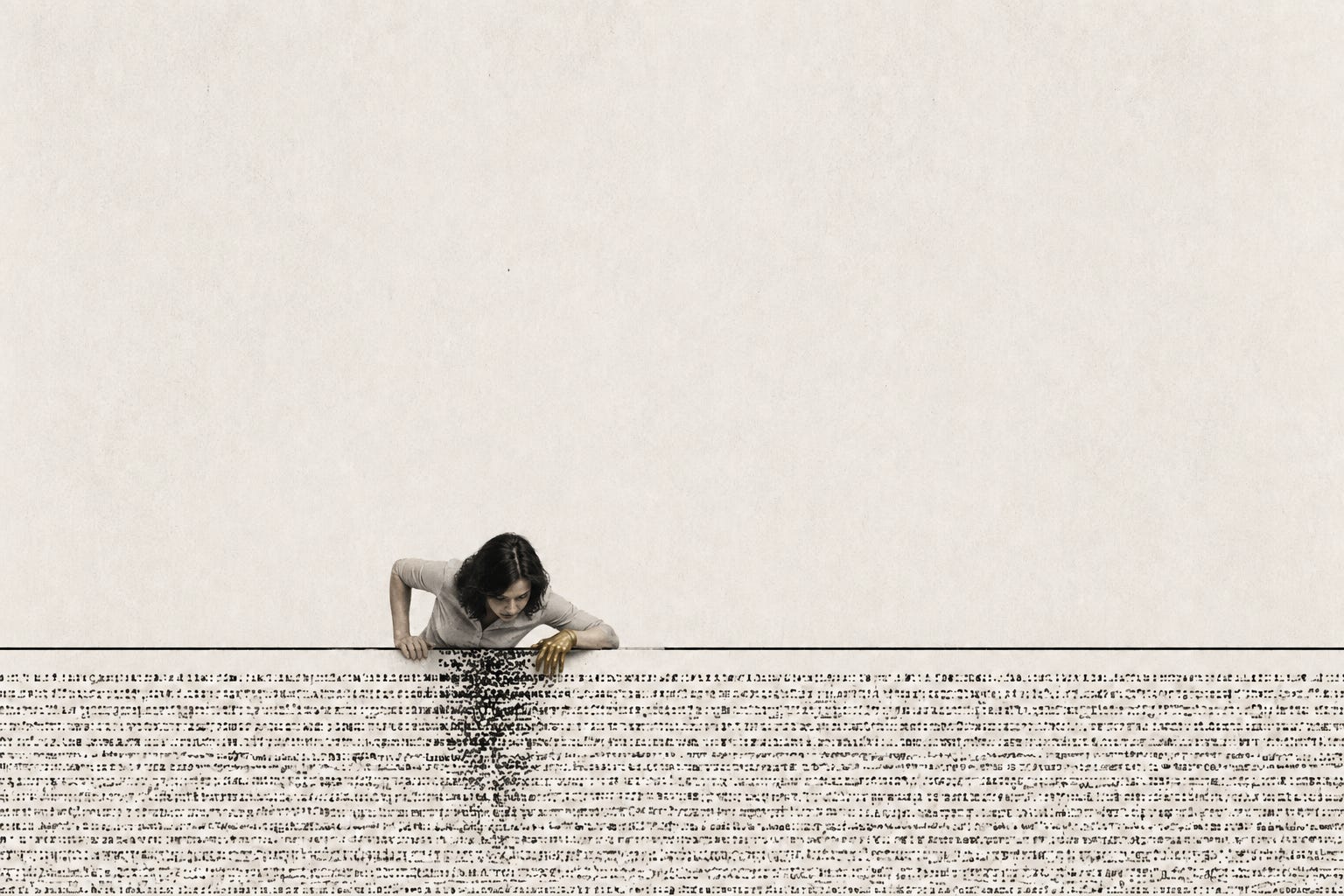
This is not a list of my most popular articles. It is a collection of the pieces that ask the most of the reader.
They will not tell you what to believe after religion, replace one system of certainty with another, or offer a formula for becoming whole. They examine the deeper losses beneath religious deconstruction: the collapse of identity, the recovery of authority, the terror of freedom, the hunger for belonging, and the difficulty of inhabiting a life without guarantees.
These articles are for those who are ready to go beyond rejecting what is false and begin confronting what is real.
Do not read them for answers.
Read them to discover which questions are still alive inside you.
Religion was more than a collection of supernatural beliefs. It gave early human communities shared stories, binding rituals, moral order, and the capacity to cooperate beyond kinship. This article examines religion as a survival technology whose evolutionary success eventually created problems it could no longer solve.
I thought leaving religion meant changing my beliefs. Thirty years later, I understand that religion had shaped my identity, relationships, nervous system, and experience of reality. Deconstruction dismantles a world. Reconstruction asks whether we can inhabit life once that world is gone.
Existential thought has often emphasized death, isolation, uncertainty, and meaninglessness. These realities belong to the human condition, though they are only half the story. Beauty, belonging, creativity, participation, and love are equally fundamental features of being alive.
Humanity’s first question was not whether God exists. It was how to survive, belong, understand suffering, face death, and live within an overwhelming world. Moving beyond the argument between theism and atheism, the article explores the human needs from which religion emerged.
We repeatedly ask mortality to determine what makes life valuable, urgent, or meaningful. This piece challenges the assumption that death must serve as the organizing center of existence and asks what life reveals when we allow it to speak for itself.
Human beings survive through more than food, shelter, and physical security. We construct worlds of meaning that make reality coherent enough to inhabit. Modern life is dismantling these structures faster than we are developing the capacity to live without them.
Modern civilization has expanded human capability while weakening our capacity to face uncertainty, frustration, loss, and limitation. A culture built around convenience, reassurance, and rescue may be producing adults with unprecedented power who remain developmentally unprepared for reality.
The human organism evolved for movement, direct experience, sensory contact, communal life, and participation in the living world. Modern civilization increasingly confines that creature to screens, schedules, abstractions, and artificial environments. Our distress may be a sane response to a life our bodies were never built to endure.
Christianity taught us why Jesus died while devoting far less attention to why he lived. This article returns to the human being before the theological system and asks what his life reveals about power, belonging, freedom, and what it means to become fully human.
We have spent centuries asking what to believe, whom to obey, and where we will go when we die. Beneath those questions waits another: What does it mean to be alive? The article brings us back to the question that religion, ideology, and modern distraction have repeatedly taught us to avoid.
The renewed interest in Druidry is more than nostalgia for a forgotten spiritual past. It reveals a contemporary hunger for place, ritual, ecological belonging, ancestral memory, and forms of sacred life that do not require submission to institutional religion.
Beneath the wish to die may be a more difficult question: Is there any way for me to remain inside this life? This article approaches suicide through the lens of existential health, asking what happens when meaning, belonging, identity, and a viable future collapse at once.
Religious ideas do not become credible merely because they once helped human beings organize fear, suffering, morality, and death. This essay releases ten inherited beliefs while taking seriously the human problems they attempted to solve.
None of us consented to existence, yet each of us must bear its demands, losses, responsibilities, and inevitable end. This piece enters the forbidden question of whether life is worth beginning without forcing existence into either gratitude or despair.
Leaving Christianity does not require us to settle Jesus once and for all. Freed from doctrines of divine status, sacrifice, and institutional ownership, his life can be encountered again as a human challenge to domination, exclusion, religious authority, and the fear that keeps us from living.
Long before contemporary deconstruction, Ludwig Feuerbach argued that human beings project their deepest powers and possibilities onto God, then bow before them as something external. His work exposes how theology can estrange us from our own humanity and how reclaiming it becomes an act of liberation.
Religious sexual ethics often leave people with shame, prohibition, and silence rather than the capacity to create intimate lives grounded in consent, honesty, responsibility, pleasure, and care. This article explores what becomes possible when sexuality is no longer governed by divine command.
Zapffe believed human consciousness evolved beyond what life can bear, leaving us trapped in an awareness we must continually suppress. He saw the problem clearly. This essay argues that our suffering may reveal unfinished human development rather than a fatal evolutionary mistake.
Systems thinking helps us understand complexity, interdependence, and unintended consequences. Understanding the system, however, does not necessarily develop the human beings living within it. The twenty-first century requires more than systemic intelligence. It requires a greater capacity for reality.
The Buddhist teaching of no-self can sound like a denial of identity, agency, or existence. It points instead toward a more fluid understanding of the person: real without being fixed, continuous without being permanent, and inseparable from the relationships and conditions through which a life takes form.
These articles cross religion, philosophy, psychology, culture, sexuality, mortality, consciousness, and human development. Beneath them runs one question: What kind of human being is capable of inhabiting reality without needing to escape it, diminish it, or surrender authority over it?
The work beyond religion asks more of us than disbelief. It asks us to recover the parts of our humanity we projected onto gods, entrusted to institutions, or neglected in the pursuit of certainty. It asks us to build forms of meaning, belonging, responsibility, and spiritual life that deepen our relationship with reality.
The old answers are losing their power. The deeper questions are still waiting.
Our task is no longer to find another world to believe in.
It is to learn how to inhabit this one.
If these articles speak to the questions you are carrying, consider becoming a paid subscriber ($50 annually). Your support makes this independent work possible and gives you full access to writing that goes beyond dismantling old answers toward the deeper work of building a life you can inhabit honestly.
Paid subscribers also receive complimentary membership in the Center for Non-Religious Spirituality, where these questions become part of an ongoing community and shared practice.
Leave the old answers behind. Stay for the work of becoming fully alive.
Thank you.