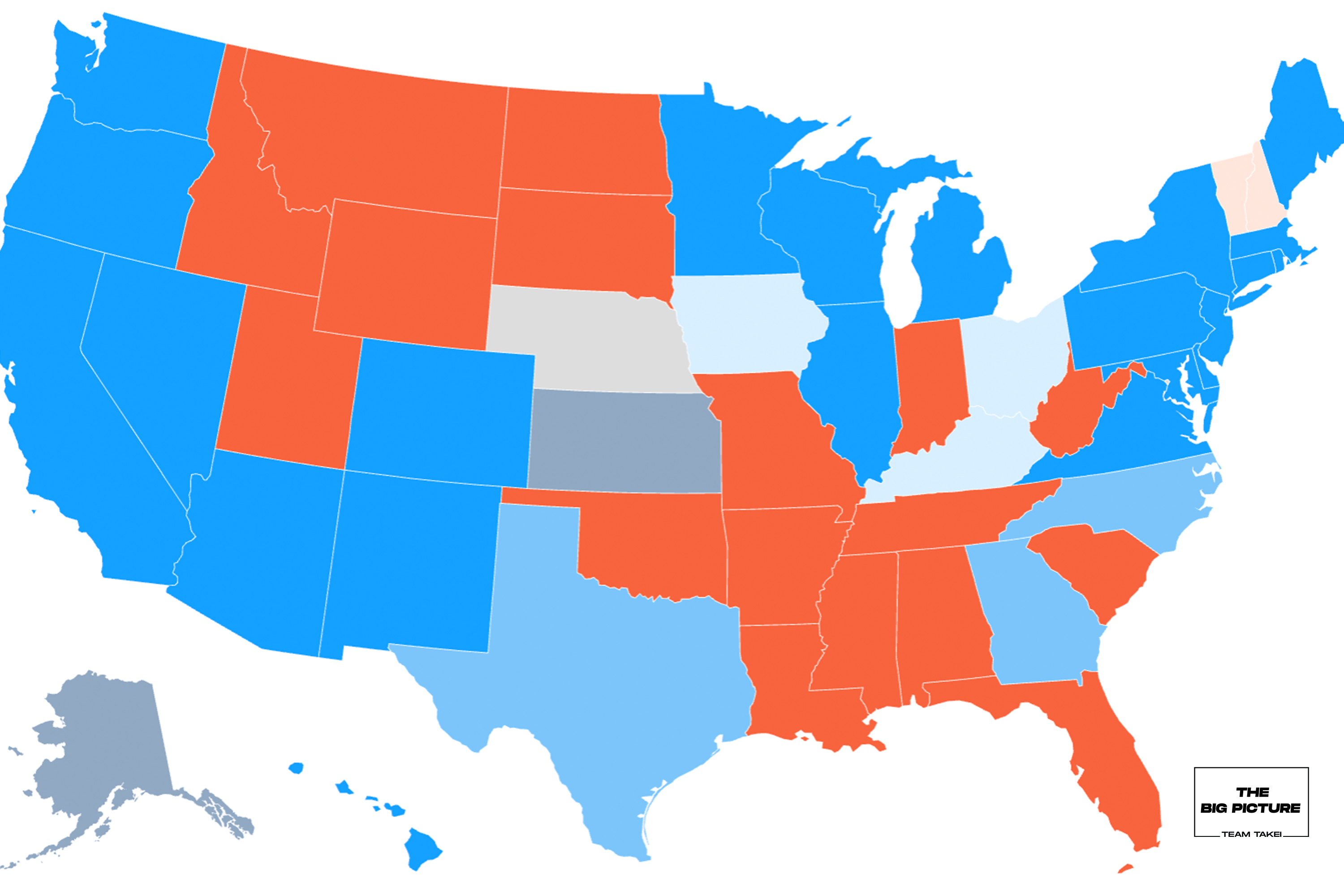
On Tuesday, a historic blue wave swept the country, triggering a political realignment whose full extent is still being assessed.
This New York Times map, which shows where voters shifted toward Democrats relative to 2024, is a stark visual representation of what happened on Tuesday.
As The Times put it
The president’s party often loses seats in a midterm election, but this is
[the largest victory]by either party in half a century.
While the headlines have focused mostly on Democratic gains in the U.S. Senate and House, where Democrats could end up with majorities beyond analysts’ most optimistic projections, an arguably bigger story is unfolding in state legislatures.
As I wrote in September, heading into Tuesday’s elections, Republicans held about 55% of the nation’s 7,386 state legislative seats. Seeing an opportunity to retake key state legislative majorities (and break GOP supermajorities), the Democratic Legislative Campaign Committee (DLCC) planned to spend $50 million targeting more than 650 seats.
By Thursday afternoon, the Democratic Legislative Campaign Committee (DLCC) announced that Democrats had flipped more than 500 state legislative seats..
Importantly, that means, 𝕏per the DLCC:
Democrats have officially won the majority of state legislative seats across the country!
With state Democrats flipping 500+ seats, this marks a massive shift in political power in our statehouses
Since their massive gains in 2010, Republican legislative majorities have used redistricting to protect their power to push through regressive model legislation in red state after red state. They have wielded this power to thwart Democratic legislative priorities for decades, even when Democrats held the governorship.
But now, after Tuesday, as Axios puts it:
Democrats poised to break GOP’s 16-year grip on statehouses
Just how big are Democrats’ state level gains? And how are Democrats likely to wield that newly gained power?
On Tuesday, 46 states held legislative elections for 6,139 (about 83%) of the nation’s 7,386 state legislative seats in 88 of the nation’s 99 state legislative chambers. (Only Louisiana, Mississippi, New Jersey and Virginia elect their legislators in odd years.)
Going into Tuesday, 28 states had Republican-controlled legislatures, 18 were controlled by Democrats and four were split.
After Tuesday, 12 chambers are poised to flip to Democrats, resulting in Democratic control in 24 states, Republican control in 22 states and split control in three states, with only Alaska still uncalled, although it appears headed to a Democratic trifecta.
According to the National Conference of State Legislatures (NCSL), the 12 chambers that flipped Tuesday are:
Arizona Senate and House: If the Democrats maintain their current edge in the Senate, it will be the first time they’ve won that chamber since the 2000 election. Democrats are also ahead in the House and currently hold the governorship. If they keep their leads in both chambers, it will be the first time Democrats have had a trifecta in Arizona since the 1960s.Georgia House: Flipped to Democrats, who last held it before the 2004 election. Democrats now hold the House and the governor’s office, moves from a Republican trifecta to a divided government.Minnesota House: Flipped to Democrats, after being tied since the 2024 election. Democrats have regained their trifecta in the state.Michigan House: Flipped to Democrats. The Michigan Senate and the governor’s office were already controlled by Democrats, once again giving the party the trifecta that it lost in the 2024 election.New Hampshire House and Senate: Flipped to Democrats. With 400 seats, the New Hampshire House often swings from one party to another. Republican Gov. Kelly Ayotte won re-election, moving the state from unified Republican to divided control.North Carolina House: Flipped to Democrats. Republicans entered the election one seat short of a supermajority in the chamber. Gov. Josh Stein is a Democrat.Pennsylvania Senate: Flipped to Democrats for the first time since before the 1994 election, giving Democrats a trifecta.Texas House: Flipped to Democrats for the first time since the 2002 election. Democrats now hold the House and the governor’s office, while Republicans maintain control of the Senate.Wisconsin Senate and House: Both legislative chambers flipped from red to blue for the first time since 2010. The governor’s office stayed in Democratic hands as well, giving the state a Democratic trifecta.
And don’t count the North Carolina State Senate out yet! In a breaking development:
But the significance of these gains goes beyond chamber control. The Associated Press notes that with these wins, Democrats
broke or prevented Republican supermajorities in nine legislative chambers in eight states: Florida, South Carolina, Indiana, Missouri, Iowa, Ohio, Kansas and North Carolina.
That means Republicans would need help from Democratic lawmakers to override a Democratic governor’s veto in Iowa, Ohio and North Carolina.
As The Down Ballot’s Stephen Wolf put it:
Democrats’ success in state legislative races can not be separated from their dominant electoral performance in Tuesday’s governors’ races.
Going into Tuesday, Republicans held a 26-24 advantage in governorships. Democrats flipped Georgia, Iowa, Nevada, Ohio, and Texas, and they will now control 28 governorships to Republicans’ 20, with a possibility of two more if Alaska and Kansas go Dem as they currently are projected to do. Democrats have not held a majority of governorships since before 2010.
As the NCSL breaks it down:
this means there are five new states with Democratic trifectas: Michigan, Minnesota, Nevada, Pennsylvania and Wisconsin. Democrats have also broken five former Republican trifectas, in Georgia, Iowa, New Hampshire, Ohio and Texas.
Assuming Democrats officially gain control of Arizona’s two chambers and Alaska maintains its Dem-led state legislative coalition, add Arizona and potentially Alaska to the new trifecta list.
Axios breaks down where state government control stands.
With this in mind, what are the policy and political implications of this shift in state control?
In August, we interviewed Ben Wikler, former chair of the Democratic Party of Wisconsin, who during his tenure had effectively un-rigged his state from the “democracy desert” left by years of Republican rule. In his book This Is the Plan: How to End America’s Meltdown and Save Democracy, Wikler laid out his plan how voters can do the same nationally. The first step: win a large share of state legislative seats and achieve Democratic trifectas.
As Wikler put it:
Blue state-level trifectas can dictator-proof their states and also pass the National Popular Vote Interstate Compact, which would make the Electoral College a ceremonial body and award the presidency to whoever wins the national popular vote.
The National Popular Vote Interstate Compact was launched in 2006 to “guarantee the Presidency to the candidate who receives the most popular votes in all 50 states and the District of Columbia.” Under its terms, the compact takes effect only once states with at least 270 electoral votes, a majority, have joined, each agreeing to award its electors to the national popular vote winner rather than to the winner of itsstate.
So far,
The Compact has been enacted by 18 states and DC (CA, CO, CT, DE, DC, HI, IL, MA, MD, ME, MN, NJ, NM, NY, OR, RI, VA, VT, WA). These places together possess 222 of the 270 electoral votes needed to activate the Compact.
Now, according to Axios:
Democrats have won control of the governorship and both legislative chambers in Pennsylvania, Michigan, Arizona, Wisconsin and Nevada, enough to push…the National Popular Vote Interstate Compact beyond the 270-vote threshold required to take effect.
Stephen Wolf broke it down on BlueSky:
Whether these states would prioritize joining the compact is unclear. As Axios notes,
Michigan failed to enact it during its previous Democratic trifecta from 2023 to 2024, and Nevada’s then-Democratic governor vetoed the compact in 2019, warning it could diminish his state’s influence over presidential elections.
It is also unclear whether the compact would survive legal challenges or require congressional approval. Axios reports,
Notre Dame law professor Derek Muller has
[argued]that the compact would be unconstitutional without congressional approval, which he contends is required under the Constitution’s Compact Clause.
Still, Tuesday’s results give Democrats enough trifectas, on paper, to push the compact past the 270-vote threshold for the first time.
Every 10 years after the census is taken, states are mandated to redraw their congressional and legislative maps to accommodate population changes. When Republicans won widespread state legislative majorities in 2010, they understood the assignment.
Take Wisconsin and North Carolina. Despite being two of the most evenly divided states, after their gains in 2010, Republicans gerrymandered their legislative and congressional districts to maximize Republican seats and entrench their majorities.
Republicans’ hold on power in both states proved remarkably resilient.
As Ben Wikler has documented, Democrats were only able to un-rig Wisconsin’s gerrymandered legislative maps after winning a majority on the Wisconsin Supreme Court in 2023. 2024 was the first year that Wisconsin voters went to the polls under fair maps. And on Tuesday, voters finished the job by giving Democrats majorities in both legislative chambers.
In North Carolina, Republican state legislators have famously tried to entrench their hold on the state’s congressional seats with brazen gerrymanders, including yet another just this year at Trump’s urging. While they entered Tuesday with a 10R-4D advantage in the partisan make-up of their congressional delegation, hoping to secure still one more. Yet going into 2027, Democrats will now hold 9 to Republicans’ 5. Best laid plans and all.
Heading into next year, Democrats will hold a trifecta in Wisconsin, one of 22 states where they will have unified control. In North Carolina, they will have the House and governor’s office (and maybe a tie in the state senate!) These gains are crucial in giving Democrats increased power to redraw their maps.
Which is why the DLCC is already preparing Democrats for the next mission:
Now that we’ve made these crucial gains, we must defend them to win 2030 redistricting.
But as for redrawing their states’ congressional maps, Democrats will likely not wait until 2030.
As MSNOW put it:
Once the new legislatures are seated in January, Republicans in Georgia, Texas and North Carolina will no longer be able to pass new congressional maps without Democratic votes. And new Democratic trifectas in Wisconsin, Pennsylvania and Minnesota give the party the power to redraw maps of its own before the 2028 elections. Greta Neubauer, the incoming Democratic majority leader in the Wisconsin Assembly, said Wednesday that Democrats would consider doing so to undo a Republican gerrymander,
[Politico reported].
After Trump pushed Republican-led states to redraw their congressional maps this cycle and the Supreme Court’s Louisiana v. Callais decision, which gutted Section 2 of the Voting Rights Act, seven blue states have already taken steps to redraw their maps next year to eliminate Republican congressional seats: New York, Illinois, Virginia, Oregon, New Jersey, Washington and Maryland.
For example, in Maryland on Tuesday, voters approved Question 3, a constitutional amendment that makes it easier for the state legislature to redraw Maryland’s congressional map potentially eliminating the state’s one remaining Republican congressional seat. After its passage, Gov. Wes Moore struck a confident tone, saying,
“I want to be clear then that the courts have spoken. The people of Maryland have spoken, and it is time to make sure that Maryland does meet this moment.”
It is fair to ask after Tuesday whether Democrats will proceed as aggressively with those plans now that they have won a massive House majority without them.
Asked whether such a move is still necessary, state Sen. Clarence Lam, who spearheaded Maryland’s redistricting effort, replied:
“In all likelihood, what I think we’ll see is that the Republicans in these Southern states will finish the job that they started a couple months ago by 2028 and redraw potentially up to 10 or 15, maybe even 20 more seats. And that’s where the seat could still come into play.”
But the biggest impact on redistricting from Tuesday’s elections may come in states with new trifectas, such as Wisconsin, or with newly divided control, such as North Carolina and Texas.
As PBS reports,
There will be pressure on Democrats in Wisconsin and other battleground states to redraw congressional maps, just as President Donald Trump successfully urged eight Republican-led states to do ahead of this election.
For Wikler though, solving the gerrymander problem is a job for Congress in 2029, when Democrats would ideally hold a federal trifecta with a Democratic president. The goal: make partisan gerrymandering illegal.
As he told us in August:
2029 is the pivotal year: the Senate has to change its rules, and then the governing trifecta has to pass a major U.S. Supreme Court reform—term limits are a leading idea; a national gerrymandering ban (and potentially proportional representation for the U.S. House.)
But asked about their priorities once they take power next year, incoming Democratic leaders across the country appear focused less on redrawing maps than on passing their legislative agendas and following through on the mandate they were given by voters on Tuesday.
In 2022, Democrats achieved a trifecta in Minnesota, and with that control they passed a slate of progressive policy reforms during the 2023 legislative session dubbed by Gov. Tim Walz as the second “Minnesota miracle,” which the Movement Voter Project calls “the most ambitious legislative agenda since the New Deal.”
According to [Cure Minnesota](https://…