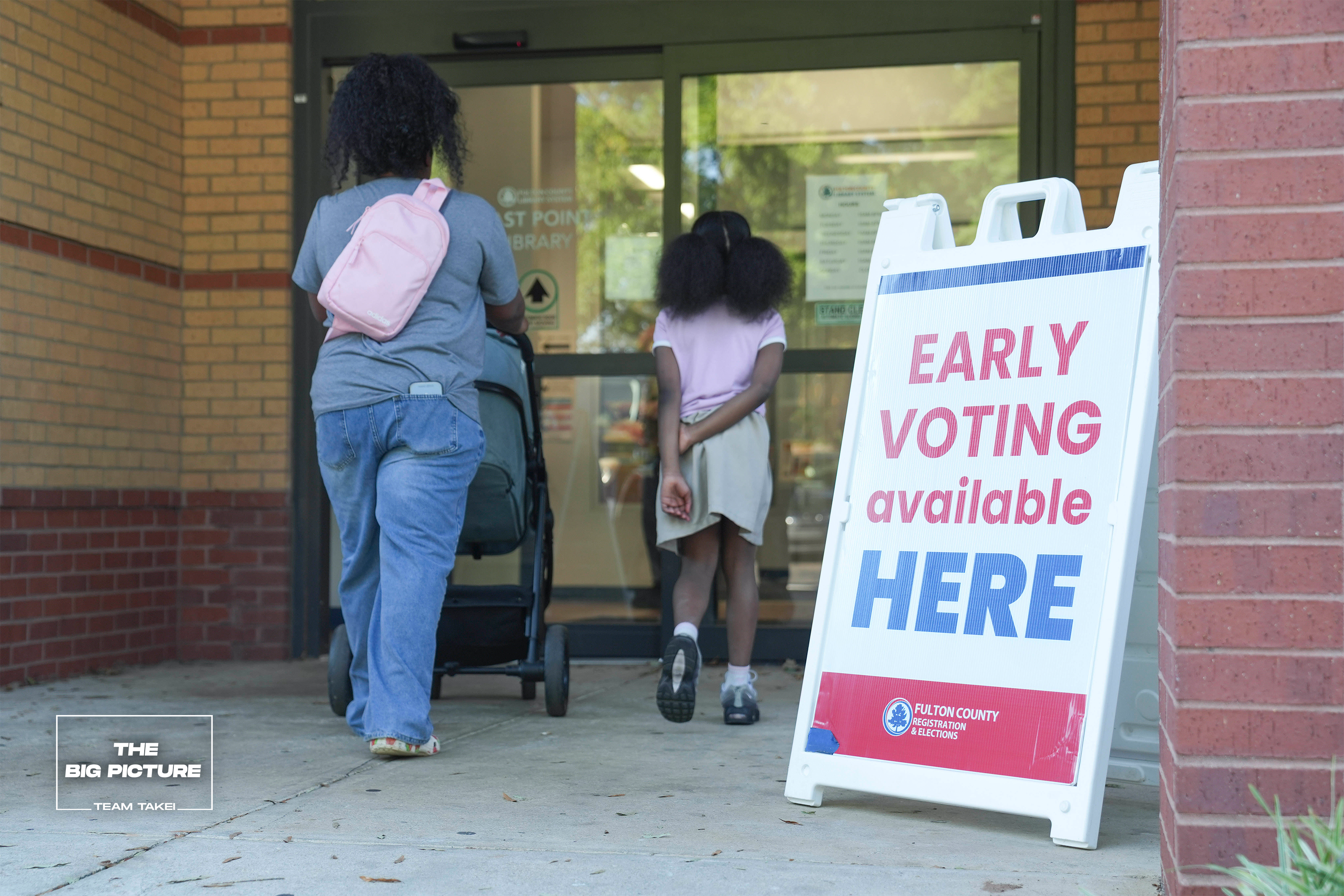
On Saturday, October 17, millions of Americans in all 50 states across more than 2,500 events, will be gathering for the final No Kings rally before the midterms.
But unlike previous rallies, ‘No Kings 4’ is not just about protesting Trump’s authoritarianism.
This one will be laser focused on something of vital importance this election season: early voting.
Indivisble’s No Kings website states,
“Efforts to undermine trust in our elections and make it harder for people to be heard are happening across the country right now. Our democracy depends on every eligible voter having the freedom to participate without intimidation, interference, or barriers.”
As of today, voters in half of all U.S. states are already able to vote early in person with even more already accepting absentee ballots by mail. And by the look of the voting trends so far, Democratic voters view banking their votes early as key to limiting interference from Donald Trump. But the picture is a complicated one.
What can we glean from the data about which voters are turning out early and where the early vote is surging? And does it provide a sense of what could happen on November 3?
According to The Center for Election Innovation and Research, 25 states currently allow in-person early voting.
And still more states already accept early absentee ballots by mail.
Before we dive in to actual early vote results, some caveats.
Early Vote data tells us who has voted, but not how.
After all, the voters who are voting early may just be voters who would have voted anyway, rather than indicating a surge of new voters.
The New York Times does a good job of laying out the dangers of relying too heavily on early vote to draw conclusions about the electorate at large. While looking at the partisan breakdown of early voters can be useful, that data is often not available. As The Times notes,
The most common way to assess the partisanship of early voters is by looking at their party registration. That method largely falls apart in the 19 states where party registration is not recorded, including battlegrounds such as Michigan, Texas and Georgia.
And even when that data is available, it’s not always a perfect proxy for how people will vote.
Additionally, trying to gauge the electorate at large from the early vote turnout is imperfect at best.
Early votes in recent years have tended to favor Democrats over Republicans in general elections. The 2024 presidential election in Pennsylvania provides a stark example: Even though Kamala Harris won the early vote by 31 percentage points, Election Day voters favored Mr. Trump by 15 percentage points. He won the state by two percentage points.
The Times explains when that early vote data can still be helpful.
Voting trends from early ballots can provide information about what to expect as votes begin to be reported.
If, for example, early votes in a particular election are overwhelmingly cast by registered Democrats, we can also expect absentee vote reports on election night to favor the Democratic candidate.
All that said, the limitations of early vote data as a predictor of the voting habits of the electorate at large has not stopped analysts from digging into the data and even modeling it to gauge trends that inform what to expect on Election Night.
From these analyses, there are two narratives emerging.
So far, the story about Early Voting in 2026 is that ballots cast are up from 2022, the last midterm election, and are generally more Democratic.
On one hand, this should not be terribly surprising, considering the data we have seen both in the special election results over the past cycle as well as public polling that tells us Democrats have the enthusiasm advantage this cycle. Considering the threats Trump has made to interfere in our elections, it tracks that anti-Trump voters would be the first to register their protests by ballot.
And that’s exactly what the analysis is showing, albeit with some interesting data regarding where the early voter surges are coming from.
For a live look at Early Vote totals, both for early in-person and absentee by mail returned ballots, take a look at University of Florida Election Lab’s early vote tracker, compiled by Dr. Michael McDonald.
As of the time of publication, a total of 6.2 million early votes have been cast, including 1.4 million early in-person votes. Among the early votes cast in states that collect partisan ID information, the breakdown is 51.1% Democratic, 28.7% Republican and 20.2% Other.
How do these numbers compare to the last midterm election? There’s 𝕏this report from JMC Analytics as of Oct. 12:
A comparison of “same point in time data” between 2022 and 2026. Bottom line: (1) turnout up 24%, and (2) in 14 states with partisan data, it’s more Dem than in 2022 (from +22 to +29 D).
This is how TargetSmart’s Tom Bonier put it on Wednesday:
This is certainly the story out of Virginia, where Early Voting began on September 18. Earlier this week, Governor Abigail Spanberger made waves by announcing what she called “extraordinary voter turnout” in early voting there relative to 2022. She reported that 450,000 Virginians have ALREADY voted, compared to just over 200,000 at this point in 2022.
One data point Spanberger made a point of noting:
“That turnout in terms of a percentage change from the last midterm election is most notable in our rural, agricultural and historically most Republican areas.”
This is a trend seen among the early voters in Ohio as well, where CNN’s headline blared:
Early voting figures suggest Democratic gains in Ohio’s most Trump-friendly counties
CNN reports:
So far, affiliated Democrats make up larger shares of pre-election voters than they did two years ago, even in the most Republican parts of the state.
At this point in 2024, Republicans had a 30-percentage point lead over Democrats in counties that voted for President Donald Trump by 20 points or more, according to data from the Ohio Secretary of State. This year, that’s shrunk to just five points.
While this CNN report is from almost a week ago, the overall trend was clear:
The data is just the latest sign of a positive midterm environment for Democrats, as former Sen. Sherrod Brown looks to defeat Republican Sen. Jon Husted, and it comes as a CNN poll finds Brown leading by six points. In the governor’s race, Democrat Amy Acton leads Republican Vivek Ramaswamy by eight points.
The overall electorate so far is about 27 points more Democratic than it was at the same point in 2024.
And MAGA is already sounding the alarm.
With Early Voting having just begun in Georgia on Tuesday, it was good news for Democrats there as well, per Prof. McDonald:
Tuesday, Oct 13 was the first day of Georgia in-person early voting. A healthy total of
[188,668 persons voted in-person]. This compares with 134,655 who voted in-person on the first day of in-person voting in 2022.
The early vote surge was so dramatic that, based on the enthusiasm exhibited in the early voter data, Secretary of State Brad Raffensperger expects the 2026 vote to exceed 2022’s total turnout.
State election data shows that the initial wave brought out roughly 190,000 total first-day voters, representing an increase of 55,000 voters compared to the first day of early voting in the 2022 midterm election.
Georgia Secretary of State Brad Raffensberger attributed the historic numbers to rapid population growth and energized voters motivated by key political issues. Raffensberger stated he expects total turnout for this election cycle to challenge or surpass the previous record set in 2022, when nearly 4 million Georgians voted.
The question is whether that increased turnout represents an electorate more favorable to Democrats.
According to Vote Hub’s Early Vote tracker, the early vote trend in Georgia is tracking to a 2024 Harris +1.2 environment, a 3-point shift toward Democrats from two years ago.
This model, based on two days of early voting data, predicts Jon Ossoff to win with between 56%-63% of the vote
G Elliott Morris believes he has found a novel way of using the early vote to model out what to expect from the electorate at large as well.
In his early vote live blog, Morris tracks “individual-level voter file data and compare changes in behavior at the person level.”
In his first post on October 12, Morris confirmed Virginia’s strong early vote showing and explained,
“If members of one party who voted early last cycle aren’t voting early now, that tends to be indicative of a turnout problem that persists through Election Day.”
Looking at who has turned out in Virginia at this comparable point in the 2024 cycle, Morris concludes:
In Virginia to date, the data pretty unambiguously show Republican turnout is lagging benchmarks compared to 2024. Accounting for election-day voters leaning Republican, my best educated guess is that Virginia is looking about 2 to 4 points more Democratic in terms of party share, or about 3 points on vote margin, compared to 2024.
And what about relative to 2025, which was a very strong year for Democrats? Interestingly, per a Cardinal News analysis, while the total Early Vote numbers in the state relative to this time last year are slightly down, looking at the raw vote totals coming out of certain areas of Virginia tells a different story.
“When we look at the raw numbers and realize that Fairfax County has cast 8,762 more early votes than last year this time, and Scott County is down 161, we get some sense of the problem likely developing for Republicans. Democrats appear to be banking more votes than they did last year, a good year for them, while Republicans appear to be casting fewer votes.
[State Navigate], the forecasting site run by Virginia Tech grad Chaz Nuttycombe, sees the early voting running 4.2 percentage points more Democratic than a year ago.”
There is one more trend worth remembering: how are unaffiliated voters voting? While analysts often like to think in terms of blue or red, in many states, it’s unaffiliated voters who are likely to make the difference in the Early Vote, as this analysis by Ohio Common Ground reminds us.
The takeaway: while Republicans in Ohio appear to be eating away at Democrats’ in-person vote lead over time, the real variable is unaffiliated/independent voters, who have the largest share of mail-in ballots.
But again, if it does come down to independent voters, Republicans should take no comfort from that.
In a year when ICE has been a constant threat to Hispanic communities, and when the Trump administration has refused to rule out deploying ICE at the polls this November, polls this year have consistently shown a shift among Hispanic voters away from the Republican Party, particularly relative to 2024 when Trump surged among those same voters.
The bad news for Republicans is that this shift in sentiment appears to be showing up in enthusiasm based on early vote turnout.
Election analyst Tom Bonier sees a surge in voters of color broadly relative to the 2022 midterms.
And that is very bad news for Republicans.
Per Bonier, the surge is more pronounced among Hispanic voters than among Black or AAPI voters.
But perhaps most important is the improvement from this point in 2024, when Trump made inroads among the Hispanic community.
The New Republic dug into this trend with Bonier, who explains it this way.
“While it’s still early, it’s incredibly unusual to see any group outperform presidential turnout at this point in the cycle,” Tom Bonier, a senior adviser at TargetSmart, told me. “Latino turnout tends to drop more in midterms. So seeing this early surge suggests we’ll potentially see historic levels of Latino engagement.”
What’s driving all this? The economy is likely the primary driver: The
[NBC poll]found 74 percent of Latinos nationally disapprove of Trump’s handling of the economy. Latinos prefer Democrats to Republicans on the issue by 21 points—a huge turnaround from 2024, when Trump narrowly led Kamala Harris among Latinos on it.But immigration also looms large. NBC finds 69 percent of Latinos disapprove of Trump’s handling of immigration and 58 percent disapprove on border security. Even the Republican pollster who helps conduct NBC’s poll
[says]the issue is a big factor driving Latinos to Democrats.
To further bolster his point, Bonier posted this chart showing a surge in Hispanic early voting relative to 2022.
As for whether this can be attributed to population growth, Bonier makes the point:
Prof. McDonald’s analysis of the first day of early voting in Georgia confirms this conclusion.
Hispanic turnout in Georgia is indeed elevated over 2022, but it is not above 2024. In 2026, 4,573 Hispanics voted, compared with less than half that raw number in 2022 of 2,075. 2024 was a higher 6,959. Georgia Hispanic registration grew by about 125,000 from 2022 to 2026 (that in itself is a big increase!), so as a rate of voter registration Hispanic turnout increased from 0.69% in 2022 to 1.07% as of the first day of 2026 in-person early voting.
We know turnout has increased overall comparing 2026 to 2022, so is Hispanic engagement greater relative to other groups? The answer is, “Yes.”
When it comes to Black voters, the story isn’t quite as clear.
Take Georgia. On day one of Early Voting, Vote Hub estimated that the share of the Black vote was up from day one in 2024, when Kamala Harris was on the ballot.
This led MSNOW’s Eric Michael Garcia to speculate that there may be a Callais effect happening, with Black voters turning out as a backlash against the Supreme Court’s gutting of the Voting Rights Act:
This analysis does not hold up entirely, however, since the Black share of the early vote is actually down relative to 2022. As Zachary Donnini, head of data science at Vote Hub, noted, this may be indicative more of a drop in the white share of early votes than particular strength among the Black vote.
That said, after looking at the second day of early voting in Georgia, Donnini 𝕏wrote:
The data shared here is very, very good for Democrats w.r.t GA turnout. Low prop Black voters are highly mobilized compared to the same day as 2024. And GA data is probably one of the strongest datapoints for Dems (after VA).
But it is too early to tell how pronounced this trend is nationwide.
As Elect Project’s John Couvillon puts it:
When trying to draw conclusions about the 2026 electorate based on early voting patterns, comparing it to the 2022 Early Vote provides the nearest apples-to-apples comparison.
But it is important to remember how much has changed since 2022, when it comes to voting patterns.
It’s instructive to look at G Elliot Morris’s analysis of Iowa’s first day of early votin…