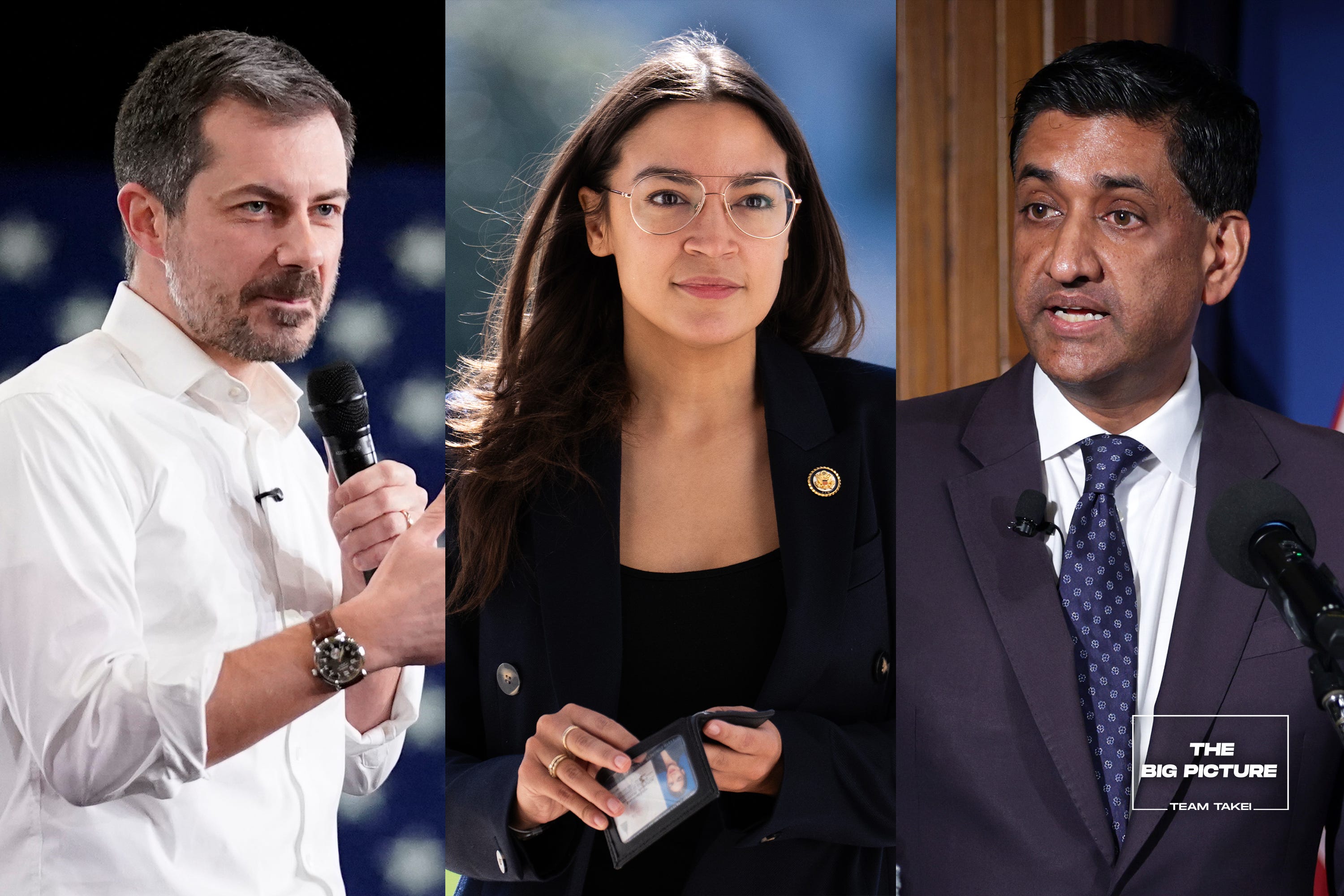
We’re less than two months away from the November midterms, which also means we’re mere months from the launch of the 2028 presidential cycle. If past is prologue, at least one Democratic 2028 campaign could go live as soon as January, particularly in a cycle with a potentially massive field of Democratic candidates.
Democratic leaders toying with the idea of a 2028 presidential run typically insist they are singularly focused on winning back congressional majorities this November. But many are already jockeying for positions on key issues that could play outsized roles in the 2028 presidential race.
The 2026 primary season, which officially comes to a close on Tuesday, has been the ultimate focus group for would-be candidates, indicating which issues carry the greatest salience among Democratic primary voters. As Usamah Andrabi of Justice Democrats aptly put it after New York City’s dramatic congressional primaries back in June,
“Every candidate considering running in 2028 should see last night’s victories as a clear sign of what the Democratic base wants.”
In Part One of this piece, I’ll discuss two “clear sign” issues: military aid to Israel and universal healthcare. For purposes of this discussion of where the 2028 Democratic hopefuls stand on these questions, I’m including those seen as most likely to be exploring 2028 presidential runs, but excluding Senator Jon Ossoff (D-GA) and State Rep. James Talarico (D-TX) whose positioning on issues are shaped more by their current 2026 campaigns. (Ossoff has also ruled out a 2028 run.)
On June 23rd, AIPAC’s backing and support for military aid to Israel played a central role in ousting two sitting Democratic Representatives in New York’s primary. Weeks later, on July 8, Rahm Emanuel delivered a speech at Tel Aviv University criticizing Benjamin Netanyahu’s conduct of the war in Gaza. Emanuel—the former Mayor of Chicago, Chief of Staff to Barack Obama, and U.S. Ambassador to Japan—is considering a run for president in 2028.
As Emanuel said in his speech:
“I want to be very clear about this. The pursuit of a so-called greater Israel is as self-destructive and fanatical as the chant from the river to the sea. Your government has been complicit in the horrors now being inflicted on innocent families in the West Bank.”
In giving that speech, Emanuel was planting a 2028 flag. He wanted to be seen as a candidate on the “right side” of the issue among Democratic primary voters, mitigating the perception that he is a more establishment and less progressive Democrat. But as a Jew himself and the son of an Israeli immigrant, Emanuel was also giving Democrats permission to distance themselves from Netanyahu and Israel without being perceived as antisemitic.
It was also an acknowledgement that, as Chris Hayes predicted earlier this summer, the issue of support for Israel’s war in Gaza has become what Hayes called “a threshold issue” in the 2028 presidential race. Hayes likened it to support for the Iraq war back in 2008, when Barack Obama leveraged his opposition to the war to peel anti-war voters away from Hillary Clinton, who had voted for it. As Hayes put it, “Support for the Israeli military’s actions in Gaza after October 7 has become a similar issue for a lot of primary voters.”
Several of the 2028 hopefuls have now weighed in on issues related to Israel and AIPAC. Senator Chris Van Hollen (D-MD), for example, gave 𝕏this blunt response the morning after the June 23 New York primary, when asked if Democrats should “reject AIPAC money”:
“Yes, because what AIPAC demands of candidates it backs is unconditional support for the actions of the government of Israel, regardless of what those actions are. We don’t do that for any other country in the world.”
But how far would Emanuel and Van Hollen go on the thornier questions of whether Israel should be cut off from all U.S. military aid and whether Israel has committed genocide in Gaza?
Polling shows support for Israel cratering among Democratic voters. As Al Jazeera reported in May,
A new poll from The New York Times/Siena has found that nearly three-quarters of voters aligned with the Democratic Party oppose US military aid to Israel, up from 45 percent three years ago, as support for Israel
[continues to drop]among US voters.The poll found that 60 percent of Democratic voters said they were more sympathetic to the Palestinians than to Israel, while just 15 percent said they were more sympathetic to Israel.
This would seem to put Democratic primary contenders on safe footing were they to call for an end to military aid to Israel, as Rep. Ro Khanna (D-CA) did during the DNC’s summer meeting in Austin last month. Khanna, who is positioning himself as a far left truth teller of the 2028 crowd, spoke before DNC delegates gathered in Austin last month:
“Zero aid to Israel,” Khanna declared Saturday. “No military sales of weapons used to kill civilians. And let me be clear: If our party cannot stand for these principles, it will never convince a generation that watched the horrors of Gaza on their iPhones that we mean what we say about justice.”
Khanna took it one step further than many Democratic contenders likely would, declaring,
“Israel has committed a
[genocide]in[Gaza], and we should have the courage to say so.”
Governor Andy Beshear (D-KY), however, rejects this tack, calling the use of the “genocide” label to define the horrors in Gaza “one of those new litmus tests that we said we would never do as a party again.” Harkening back to the 2020 primary, Beshear is concerned “It’s trying to throw out a word and, ‘Are you going to raise your hand or are you not going to?’”
In this way, Beshear, a red state governor who will likely be granted some leeway on certain issues by voters, appears to be staking out his spot as the middle ground candidate on the Democratic debate stage.
Governor Wes Moore (D-MD) on the other hand, while he would not take the bait on the “genocide” question, made waves back in May for accusing Netanyahu of committing war crimes, leveraging his own status as U.S. Army combat veteran to claim the authority to make the accusation.
It’s notable that during the DNC meeting in Austin, the delegates passed a resolution by voice vote that
…states that the DNC supports the “full, consistent, and impartial enforcement” of the so-called “Leahy Laws” to prevent military aid to Israel or any other countries that violate US
[human rights]law.These laws, named after their sponsor, former Sen. Patrick Leahy (D-Vt.), state that the US cannot provide training, weapons, equipment, or other assistance to a foreign military unit when the government has credible information that it has committed a “gross violation of human rights.”
Meanwhile, in Congress, as Common Dreams reports,
In late July,
[more than half of the House Democratic caucus]—including Minority LeaderHakeem Jeffries—voted against an amendment backed by Khanna that would have cut off $3.3 billion in US assistance to Israel, which has[repeatedly used American weapons]to commit atrocities against[Palestinians].
Not surprisingly, among the Ayes on this amendment was Rep. Alexandria Ocasio-Cortez (D-NY), who has led on the issue well before she was seriously talked about as a possible 2028 contender. As far back as 2024, AOC warned of an “unfolding genocide” in Gaza, and during a Munich security conference panel last February, when asked if the 2028 Democratic nominee should “re-evaluate military aid to Israel,” she replied,
“To me this isn’t just about a presidential election. Personally, I think that the United States has an obligation to uphold its own laws, particularly the Leahy laws.
“I think that, personally, the idea of completely unconditional aid, no matter what one does, does not make sense,” she added. “I think it enabled a genocide in Gaza, and I think that we have thousands of women and children dead … that was completely avoidable.”
In the U.S. Senate last April, two measures sponsored by Senator Bernie Sanders (I-VT) to block the sale of arms and equipment to Israel failed, with only 40 Senators in support of a bill banning the sale of bulldozers and only 36 in favor of blocking the sale of 12,000 1,000-pound bombs. It’s telling that every sitting U.S. Senator considering a 2028 run voted in favor of both measures.
It was particularly notable to see Senator Mark Kelly among the Yea votes, considering his past support for the transfer of arms to Israel. Kelly indeed appears to be a reluctant Yea, saying on the floor:
“First, let me say that I cannot and will never abandon Israel. Israel is one of our closest partners. They have a right to defend themselves, and I will always support Israel’s right to exist as a successful and prosperous nation.”
But in the end, he got to yes by couching his support for these measures in his opposition to Trump’s and Netanyahu’s war in Iran, which is much more comfortable terrain. As he said at the time,
“And we can all look at what is happening in the region right now and understand that this is not business as usual—and it is not making us safer. The United States and Israel are fighting a war against Iran without a clear strategy or goal. I’ve been clear I oppose this war in Iran and the reckless decisions being made by Prime Minister Netanyahu and President Trump.”
Kelly’s colleague Senator Elissa Slotkin adopted a similar strategy in justifying her own Yea votes for the resolutions. First, Slotkin made a distinction between the transfer of these weapons to Israel versus the transfer of “defensive weapons,” saying
“In the future, I will continue to assess U.S.-funded offensive weapons to Israel on a case-by-case basis, and I will continue to support sending Israel much-needed defensive weapons, like Iron Dome.”
Like Kelly, she ultimately pivoted to the safer terrain of opposition to the war in Iran.
That war will no doubt be another important issue on the 2028 Democratic debate stage, albeit one where there is likely to be little daylight among the candidates. On June 23rd, the U.S. Senate passed a nonbinding war powers resolution 50-48 “that rebukes President Donald Trump by calling for an end to the U.S. war against Iran.” The only Democrat who voted against the resolution was John Fetterman (D-PA).
Universal healthcare has been a flashpoint issue in many primaries around the country this year, most notably in the Michigan Senate race. Democratic nominee Abdul El-Sayed has made “Medicare for All” a core pillar of his progressive reform package.
But what exactly does El-Sayed, or any other Democrat for that matter, mean when they say they support “Medicare For All”?
For El-Sayed, that’s easy. As he reminds us on his campaign website,
I literally wrote the book on Medicare for All. And I am the only candidate for the U.S. Senate in Michigan running to guarantee healthcare for every single American.
He also lays out what exactly he means by the phrase:
I will fight to expand Medicare to cover all necessary healthcare, including vision, dental, and hearing, and extend it to every single American from cradle to grave without premiums, copays, or deductibles. Medicare should be automatic, for everyone, and accepted everywhere. Medicare for All does not have to ban additional private insurance through unions or employers, although Medicare for All should make those choices redundant and unnecessary.
Expanding Medicare and providing it to every single American would make it stronger. As a nation, Americans hold more than $225 billion in medical debt. I think it shouldn’t exist–and I erased it for upwards of 300,000 Michiganders in Wayne County. I favor abolishing it for every American immediately.
El-Sayed shares his passion for insuring every American through a government-run program with his biggest supporter and endorser, Senator Bernie Sanders, who introduced the Medicare For All Act back in April. Among the 2028 Democratic contender pool, only Senator Van Hollen has signed on as one of the bill’s 17 Senate co-sponsors. Both Reps. Ocasio-Cortez and Khanna were among the House version’s 105 original co-sponsors.
As for Democratic governors readying 2028 presidential campaigns, Gavin Newsom (D-CA) has planted his flag rhetorically in the Medicare For All camp, saying during an interview this week,
“I believe in universal healthcare, and I believe in Medicare for All, the party does overwhelmingly.”
Governor Pritzker of Illinois, on the other hand, has not gone quite as far, instead content to focus on implementing expansions of access to healthcare programs such as Medicaid to Illinoisans. At the national level, Pritzker is more comfortable speaking in terms of “Universal Healthcare,” as he did in April when he planted his “non-negotiable” flag, declaring,
When Democrats take back the White House, two things are non-negotiable:
Raising the minimum wage.
Universal healthcare.
Governor Josh Shapiro of Pennsylvania has stuck by advocating for expanding Medicaid coverage (while railing against Trump’s budget cuts to Medicaid) and extending Obamacare premiums, which Republicans ended last year. This position would appear to be the absolute minimum for any Democrat running in 2028.
Governor Wes Moore, too, has focused on expanding access and lowering costs for his constituents in Maryland rather than taking a public stand on what he would advo…