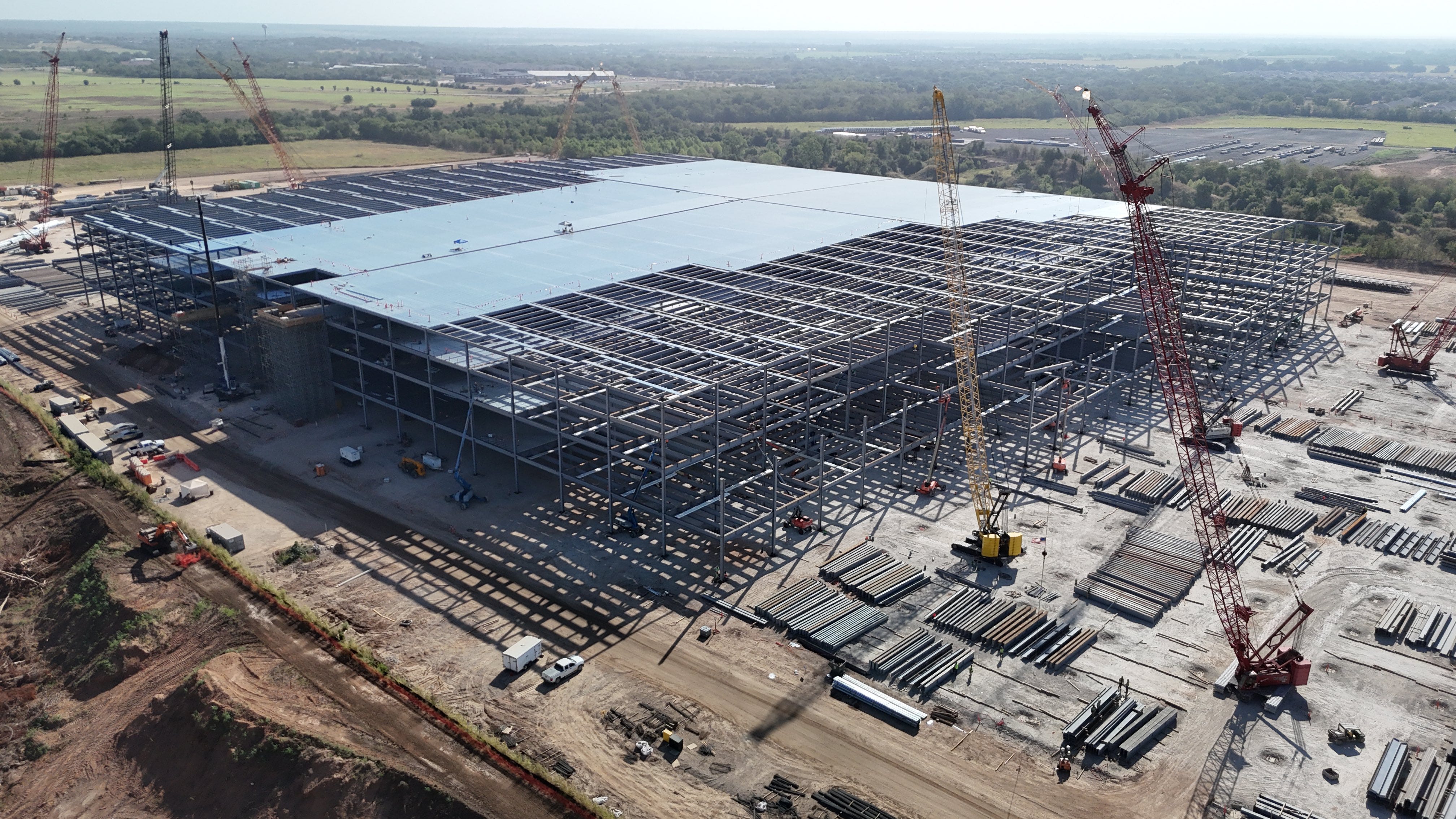
Five months ago this was bare dirt. Today it is one of the largest factory buildings on earth, and it is still going up.
Tesla broke ground on the Optimus factory at Giga Texas in March 2026. By August it has steel frames across a footprint longer than four football fields laid end to end, over a dozen cranes running simultaneously, and concrete foundations being poured in sections. Drone footage from last week shows the scale in a way that photographs cannot fully capture. This thing is enormous.
At full capacity the factory is designed to produce 27,000 humanoid robots per day. That is roughly 10 million units per year. For context, the entire global automotive industry produces about 85 million vehicles per year, combined, across every manufacturer on earth. Tesla is building a factory to produce humanoid robots at a scale that approaches one-tenth of that. In five months of construction.
The robots are not the only thing being built on this campus.
Tesla and SpaceX are jointly constructing a chip fabrication facility on the same site, specifically to prototype the AI processors that go inside Optimus, power Full Self-Driving, and support the broader autonomy stack. This is not a vendor relationship. Tesla is designing and building its own silicon, on its own land, next to the factory that will install those chips into robots.
The first Cybercab robotaxis are already rolling on campus roads. Employees are taking rides. The AI compute infrastructure on-site more than doubled in power consumption in the first half of this year alone.
Everything happening at Giga Texas right now is pointing at the same thing. The car company chapter is closing. Tesla is building the physical infrastructure for a world where AI runs on two legs, drives without a driver, and powers itself with solar energy made in its own factory.
The question is not whether this gets built. The steel is already in the ground.
The question is what happens to labor markets when the factory designed to replace human physical work starts shipping at 27,000 units per day.
What Tesla is building at Giga Texas is bigger than one robot factory.
This is the move from AI on screens to AI with bodies.
If Optimus really scales anywhere close to Tesla’s plan, the next big AI race will be about robot bodies, chips, factories, energy and the software that controls all of it.
I went much deeper on this here:
The race to build the robot body
Why Physical AI is becoming the next agent layer
Opinion AI covers AI tools, news, and the real-world stuff that actually matters.