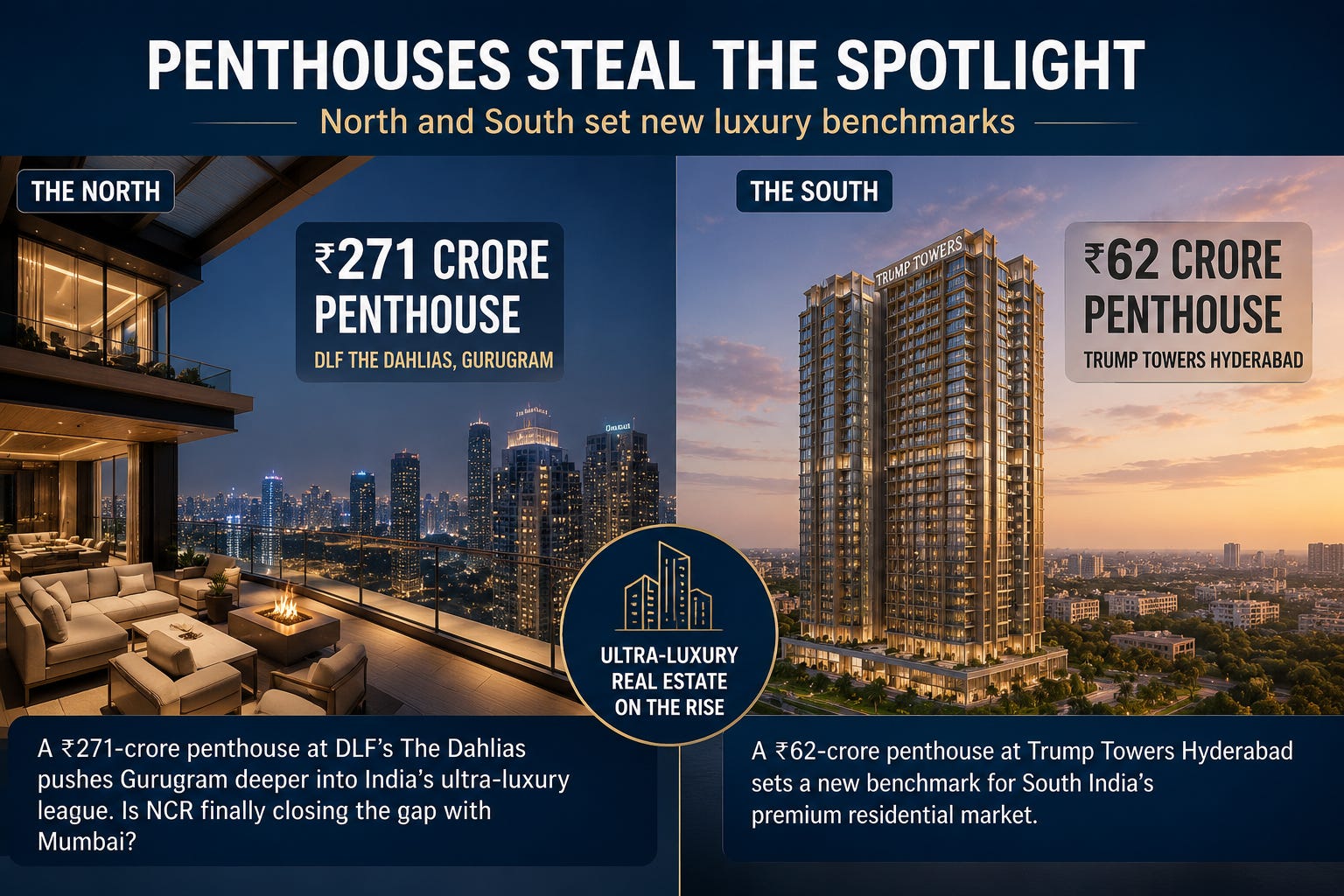
It was a week when penthouses stole the spotlight, one in the north, the other in the south. A ₹271-crore penthouse at DLF’s The Dahlias catapulted Gurugram deeper into India’s ultra-luxury real estate league, prompting a bigger question: is the NCR city finally closing the gap with Mumbai, the country’s traditional luxury housing benchmark? In Hyderabad, meanwhile, a ₹62-crore penthouse deal at the upcoming Vaastu-compliant Trump Towers Hyderabad offered another sign of the city’s growing luxury credentials, setting a new standard for South India’s premium residential market.
Faridabad entrepreneur Manav Sardana, who was associated with Imperial Auto before the company was acquired by the global private equity firm Warburg Pincus, has bought a penthouse at The Dahlias for ₹271 crore, according to sources.
The 17,200 sq ft penthouse has a carpet area of 10,500 sq ft. The transaction works out to around ₹1.57 lakh per sq ft on the super area and nearly ₹2.58 lakh per sq ft on the carpet area. The carpet-area pricing makes the transaction particularly significant, sources said.
Two people aware of the transaction said it is the country’s costliest single-unit residential deal on a per-square-foot basis. If so, Gurugram has crossed into territory traditionally associated with Mumbai’s most tightly held trophy addresses.
Mumbai, after all, continues to command the country’s highest residential prices. In Worli, Malabar Hill and other prime neighbourhoods, transactions have crossed ₹2 lakh per sq ft.
Last year, Leena Gandhi Tewari bought two sea-facing duplexes at Naman Xana in Worli for around ₹639 crore. J P Taparia acquired a 27,160 sq ft triplex in Malabar Hill for ₹369 crore a few years ago.
The ₹271-crore Dahlias deal may not match Mumbai’s biggest ticket sizes, but its per-square-foot pricing shows how quickly Gurugram’s ultra-luxury market is moving. And this isn’t an isolated transaction.
In December 2024, entrepreneur Rishi Parti bought a 16,290 sq ft penthouse at DLF’s The Camellias for ₹190 crore, translating to around ₹1.8 lakh per sq ft on carpet area.
In October 2025, Hindustan Times Real Estate reported that a Delhi-NCR industrialist had bought four apartments at The Dahlias, totalling nearly 35,000 sq ft, for around ₹380 crore. The adjoining units were reportedly to be interconnected to create one expansive residence.
During a recent investor call, DLF’s MD and chief business officer Aakash Ohri said prices in The Dahlias currently range from around ₹100 crore on lower floors to ₹160-170 crore at the higher end.
The project, located on Golf Course Road, comprises 420 residences across eight towers and 29 levels and has been positioned as one of DLF’s most ambitious super-luxury developments, with a project value of more than ₹40,000 crore.
Mumbai remains difficult to beat when it comes to absolute land scarcity, sea-facing locations and established luxury addresses. But Gurugram has a different proposition. It offers large-format residences, newer infrastructure, proximity to Delhi’s wealth centres, an expanding corporate ecosystem and increasingly ambitious luxury developments, say real estate experts.
The entry of developers such as Oberoi Realty and Lodha into Gurugram’s premium market could further intensify competition and push price benchmarks higher, they say.
The ₹271-crore deal, therefore, matters beyond a single buyer or a single project. It suggests that the gap between Mumbai and Gurugram at the very top end of the market is narrowing, they say.
The ultra-luxury story is no longer limited to Mumbai and NCR.
Hyderabad is rapidly emerging as another market where developers are testing the limits of premium pricing and global luxury branding.
Mumbai-based Tribeca Developers and Hyderabad-based Ira Realty plan to develop a Vaastu-compliant Trump-branded luxury residential project on Golden Mile Road in Kokapet. It marks the Trump brand’s first entry into South India.
The project, involving an investment of around ₹2,000 crore, including land, will feature two 65-storey towers rising about 240 metres. The developers say the towers will be among South India’s tallest residential buildings.
The project has already received an encouraging response, with eight penthouses sold for around ₹250 crore. One penthouse, comprising eight apartments, was sold for ₹62 crore. A family purchased the units and combined them into a single residence, the developers said.
The Trump project will have around 22 lakh sq ft of developable area, with 3.5BHK and 4BHK residences, double-height simplex homes and 16 penthouses.
Also, the interesting part isn’t just the height. It is the emphasis on Vaastu.
“Vaastu is extremely important in Hyderabad,” said Kalpesh Mehta, founder of Tribeca Developers. He said the challenge is to ensure that every unit is rectangular or square, with master bedrooms in the southwest and kitchens in the southeast, while still creating an iconic high-rise design.
That tells us something important about Hyderabad’s luxury market.
Here, Vaastu is more than a cultural preference. It can influence which home buyers shortlist and, in some cases, how much they are willing to pay. Developers increasingly use ‘Vaastu-compliant’ as a selling point, making it part of the city’s luxury property marketing vocabulary.
For years, Mumbai was in a league of its own in India’s ultra-luxury residential market. Delhi’s Lutyens’ bungalow market competed at the top end because of land scarcity and irreplaceable addresses.
Gurugram is now creating a new category of luxury with its large, branded, high-rise residences priced at levels that would have seemed extraordinary in the NCR market a decade ago.
Hyderabad, meanwhile, is combining global luxury brands with local preferences such as Vaastu and increasingly premium locations such as Kokapet.
The common thread across all three markets is the same: India’s wealthy are willing to pay a premium for exclusivity, branding and addresses that signal status. The question is no longer whether Mumbai has competition. It is how close the new luxury markets can get to the financial capital’s price benchmarks and how quickly.