**Six years after the pandemic, we have personalised mRNA vaccines for cancer. **Moderna, the biotech company, and Merck, which makes a cancer immunotherapy drug called Keytruda, sequenced the tumours of 1,137 melanoma patients, selected ‘neoantigens’ which teach the immune system how to attack the cancer, and then built each person their own vaccine in about six weeks. Given alongside Keytruda, fewer of them relapsed and fewer of their cancers spread than for those on Keytruda alone. It's the first time an mRNA cancer vaccine has worked in a late-stage trial. Huge.
Renewables will overtake coal in electricity generation for the first time this year. The International Energy Agency says that after reaching near parity with coal in 2025, global electricity generation from renewables will grow by more than 8% this year. Solar is the strongest driver: output is forecast to increase by the same amount in 2026 as it did during its record expansion in 2025. As a result solar will overtake wind this year to become the world's second-largest renewable source of electricity generation after hydropower.
**How did solar get so cheap anyway? **An excellent Scientific American piece traces the journey. Germany provided subsidies in the early 2000s to create a market big enough to build factories for, and China took over after 2009 (it now makes almost all the world’s polysilicon and wafers). Solar cell design got steadily better at converting light into energy, and every gain meant fewer panels, less land and less wiring for the same power. Purification got incredibly good too — the silicon in a commercial panel is now 99.9999999% pure. Today, a panel repays the energy used to build it in less than two years.
See also: ** Solar Solves Everything**, from Sam Matey-Coste.
Children’s lungs in London are getting healthier thanks to its low emissions zone. A * Lancet Public Health *study followed 3,400 children aged six to nine, comparing central London with Luton, which has no clean-air zone. London's children had been developing their lungs more slowly than Luton's, but within four years they had caught up, and the share with impaired lung function fell from 14% to 9%.
Brazil is handing land back to Indigenous people, and paying reparations to right decades of wrongs. A federal judge has ordered the state to recognise Kajkwakratxi-Tapayuna territory in Mato Grosso and pay reparations, formally labelling decades of forced displacement and poisoning (sugar laced with arsenic WTF) as genocide. “It has been a very difficult journey,” said Yaiku Suya Tapayuna, a leader of the Kajkwakratxi-Tapayuna people. “It is a decision we have dreamed about, and we are now celebrating this victory.” Mongabay
👆 It’s part of a bigger shift: Brazil’s Ministry of Indigenous Peoples has formally recognised 41 territories, covering 48,000 km², since Lula returned to office in January 2023. It hasn’t been a smooth ride: ministry staff say they are still working with “no staff, no resources and no infrastructure” across much of the country. Dialogue Earth
**In less than three years, Uganda has provided access to electricity to well over a million people, **along with 216 schools, health centres and other public institutions. When we talk about access to electricity we often focus on refrigeration for vaccines, but what’s striking here is the miracle of light itself: letting markets operate late into the evening, open-air food stalls creating community (and boosting the economy), doctors attending births after dark, students studying, and teachers marking their papers at 9pm. World Bank
**Mozambique’s Marracuene district saw its worst flood in living memory in January 2026, yet nobody died. **Nine months earlier, the African Development Bank and South Korea launched a $967,000 project where Korean instructors trained Mozambican specialists to fly drones for disaster response. A cohort of 30 were chosen from various ministries — none of them had ever flown a drone before. They were supposed to graduate in March 2026, but when the floods came in January they took their final exam in exactly the type of disaster the programme was built for, locating stranded families, mapping washed-out roads, and streaming live imagery to rescue teams. All 30 graduated with national certification in July; ten are now licensed to train the next cohort. AfDB
**Over the past five weeks, opponents of reproductive rights in the United States have suffered several significant legal setbacks. **A Texas appeals court overturned Ken Paxton’s temporary injunction closing three clinics in Houston, finding that his office had not presented sufficient evidence. In Kansas, a state judge permanently struck down a 24-hour waiting-period. A federal judge in Virginia remanded the FDA’s 2023 mifepristone restrictions for review, while a South Dakota judge temporarily blocked enforcement of the state’s ban on advertising for mifepristone. In Idaho, a federal judge held that the 14th Amendment protects abortions necessary to prevent serious and lasting harm to a patient’s health. Abortion provision has remained high since Dobbs, thanks to telehealth and shield-law providers supplying care across state lines. Against that backdrop, newly confirmed Attorney General Todd Blanche recently promised faith leaders that the administration would go after those providers.
How a small oily fish helped bring whales back to New York. The Nature Conservancy spent years pushing for tighter limits on the Atlantic menhaden catch, hoping it would help fish and seabirds. Nobody was thinking about whales — until they came back too, following the menhaden into one of the busiest waterways in the world. Now they’re there in their hundreds, a tourism industry has developed to watch them, and a new bill adding strike avoidance to boating tests is awaiting the governor’s signature.
We want these animals to come back. But we got used to doing things a certain way. We need to rethink some of the things that we’re doing.
India is refilling its aquifers with an engineering technique that long predates the arrival of the British. India holds 18% of the world’s people yet just 4% of its fresh water, so it’s now turning to its johads and stepwells, structures built to store water or slow it down until it soaks in. These long-abandoned ways of managing water are now being recognised as climate-resilient systems that functioned for over 1,000 years. BBC Future
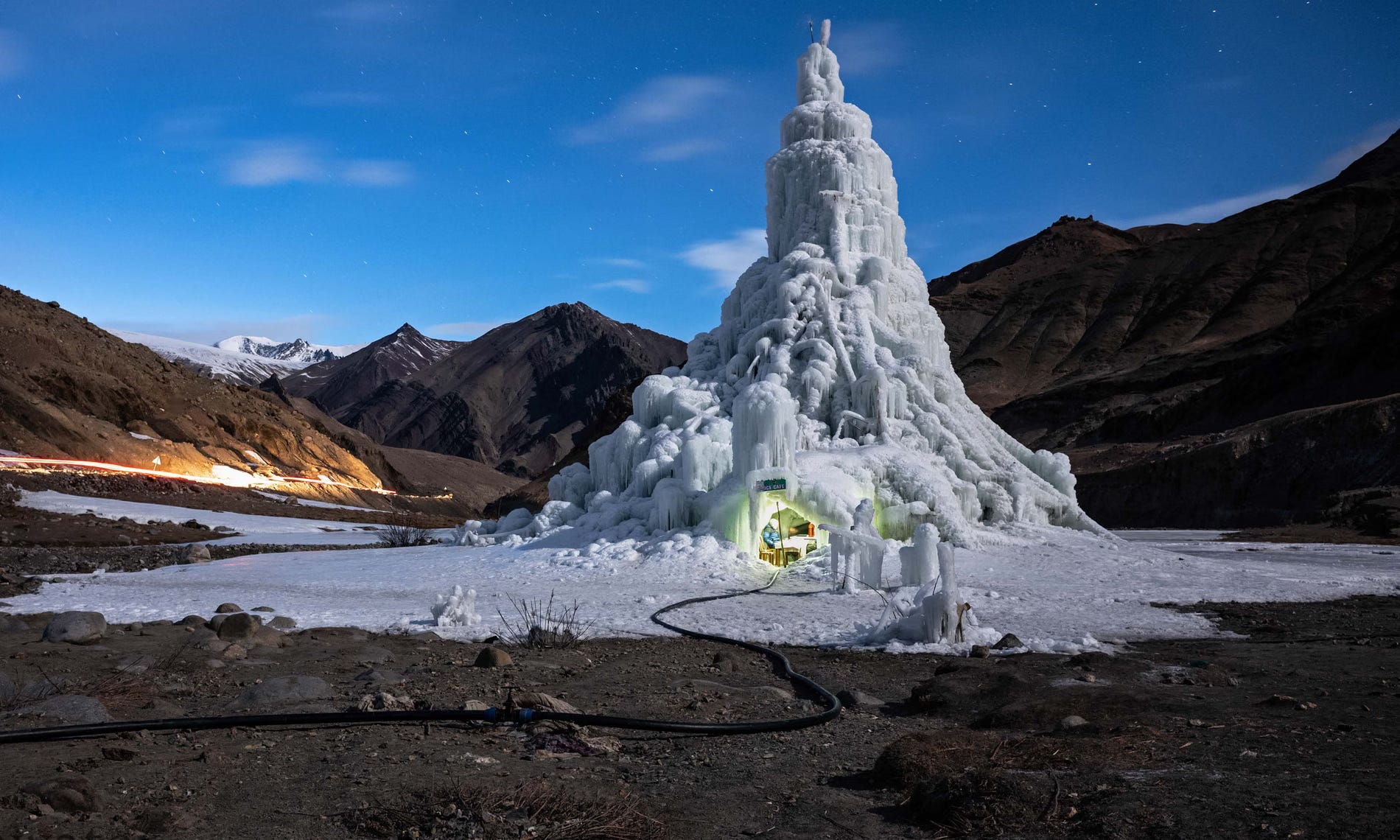
Artificial glaciers, and how (and why) farmers create them on purpose.
The city of Leh, in Ladakh, India, sits at 3,350 metres (11,000 feet) in the rain shadow of the Himalayas, and gets less than 100 mm (four inches) of precipitation a year. That means almost all its water comes from melting snow, but farmers plant in April, and the meltwater doesn’t come down the streams until July. This is not a sustainability problem, it’s a scheduling problem. The trick? Freeze the water when you have too much of it, and let it melt when you don’t.
Communities at these altitudes have grafted glaciers for hundreds of years, but Chewang Norphel, a civil engineer working out of a village near Leh, built the first artificial glacier in 1987. The design is simple. In late autumn, when the meltwater is still flowing but the nights are freezing, divert part of the stream into a shaded valley, and slow the flow with stone dams. Slow water freezes where fast water doesn’t, so over the winter the diverted flow spreads and pools into a terraced field of ice. Come spring, the field melts. Because it sits lower and gets more direct sun than a real glacier, this happens in April and May — right in time for sowing. Norphel built at least 12 of these. Villagers called him the Ice Man of Ladakh.
The catch was elevation. Norphel’s fields had to sit high in shaded valleys or the ice would melt too fast to last throughout the season, which meant only the highest villages could use them. But in 2013, engineer Sonam Wangchuk figured out how to make ice at lower elevations. Pipe meltwater from a spring uphill of the village, and let the pressure from the vertical drop — one atmosphere per ten metres — shoot the water out of an upward-pointing nozzle into the freezing night air.
No motor, no electricity, nothing to break, all the work is done by gravity itself. The water freezes as it falls back on itself, building into a tower with far less surface area than a horizontal ice field, so it melts slower and lasts much longer. Wangchuk called them ice stupas because they resembled Buddhist reliquary mounds. He won a Rolex Award in 2016.
From there, the idea started spreading. Farmers in Pakistan’s Skardu valley, roughly 200 kilometres away across a heavily patrolled border, learned of the technique through YouTube. More than 20 villages now build them every winter. As one Skardu farmer told AFP: “Before, we had to wait for the glaciers to melt in June to get water, but the stupas saved our fields.”
Chilean engineers started an Andean pilot in 2021 in the mountains near Santiago, inspired by the YouTube videos too. Swiss glaciologists have built stupas at the foot of the Morteratsch glacier, and last year the UN’s Food and Agriculture Organization began writing Kyrgyzstan a national guidance document on how to make them.
The problem, because improvements so often bring new problems, is that the stupas need a lot of maintenance. Pipes can freeze and burst, and they spray continuously all winter, so on a mild day the fountain is pouring liquid water and melting the ice you’ve already made. Marcus Nüsser, a geographer who has studied these structures for years, has noted that often, in impressive, well-trumpeted projects, when the grant money stops the ice-making stops too.
As the maintenance problem became increasingly visible, Suryanarayanan Balasubramanian, Wangchuk’s former apprentice, decided to bring some startup energy to the issue and founded Acres of Ice along with Basit Afzal, a Ladakh water-management specialist. They automated stupa-care by putting sensors on the pipelines and controllers on the valves: spray when the outside temperature is below freezing, stop above it. That means an operator only has to visit when the system reports a problem, rather than managing the fountain every day by eye.
They publish their datasets, which is not a given in climate adaptation: seven sites stored 18.4 million litres in the 2024–25 season, at roughly ₹0.28 a litre, which the company reckons is around 80 times cheaper than a cement tank. 12 sites are now active, and Acres of Ice is shopping their system to the Andes, the Alps and the wider Hindu Kush. We just sent them an email to ask if there’s a way we can help.