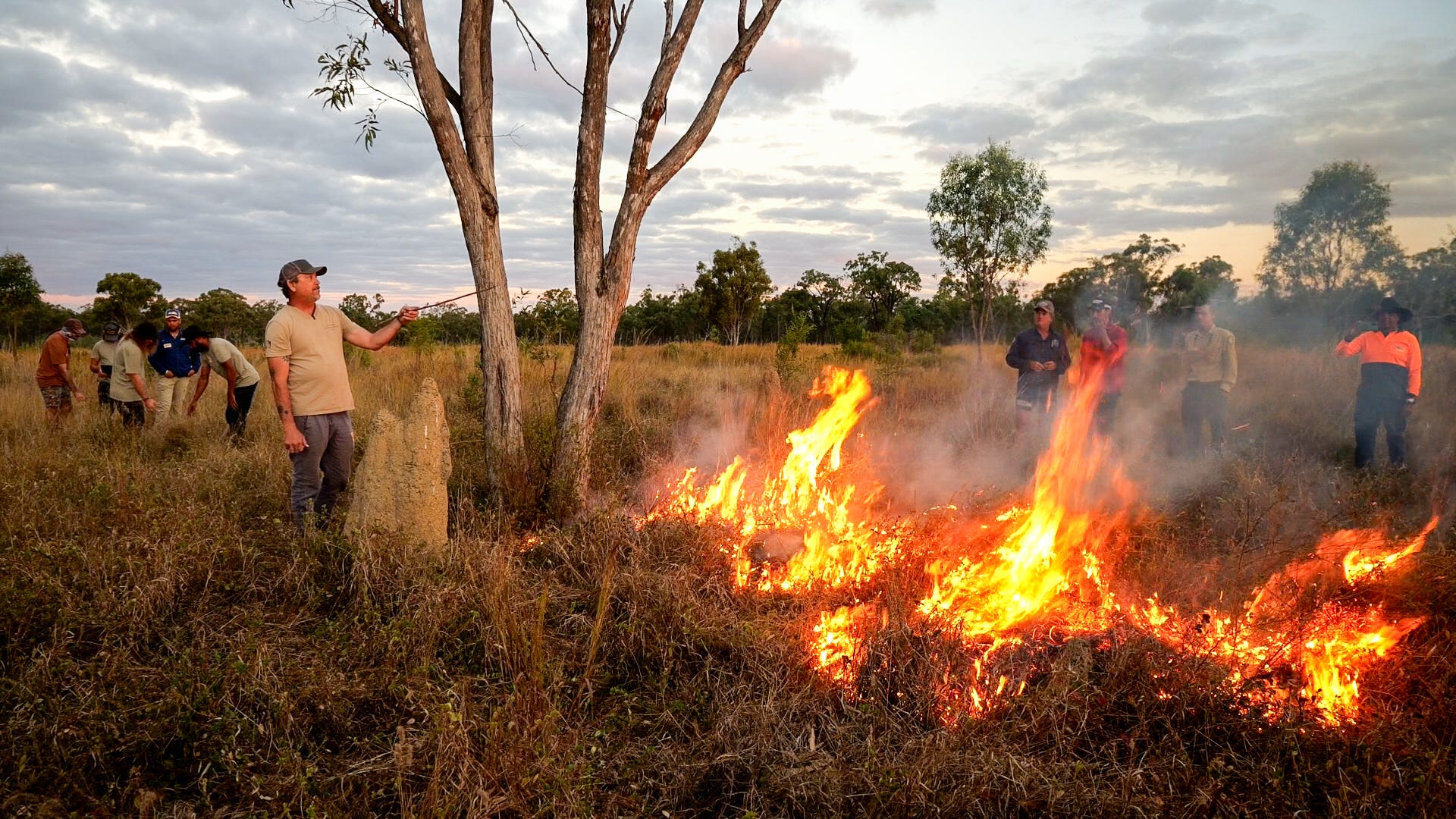
Hi everyone, Amy here. Last year, we put a callout in this newsletter: who should we talk to about Indigenous fire? We got 20 responses from around the world, and 18 of them came back with the same name: Victor Steffensen.
We weren’t surprised. Victor’s been near the top of our wishlist for podcast guests for a long time. A Tagalaka man, author, filmmaker, musician and co-founder of the Living Knowledge Network, he’s spent decades learning to read and care for Country. In recent years, his work has taken him around the world, exchanging practices with different communities. And now, in his new book The Knowledge, he’s asking an even bigger question: what if the knowledge we need most for the future is something we’ve been forced to forget?
In the latest episode of our podcast, we talked to Victor about why the climate crisis is also an identity crisis, about the relationship between Western science and Indigenous knowledge, and what he’s learned from working both in and outside Australia. This is knowledge, but not in the way you’ve heard it before: ancient and deeply local, and something Victor believes we all have access to.
How do you count 1.4 billion people? India has more than three million census-takers going door to door for its first count in 15 years. A second phase, starting in February 2027, will ask about caste for the first time since 1931. Sounds procedural, but it’s actually a huge lever for change: India’s affirmative-action quota system has been running on those colonial-era caste numbers for nearly a century. The count will also trigger a 2023 law reserving a third of lower-house seats for women, a rollout that's been on hold pending fresh census data.
The pancreatic cancer pill that got a standing ovation now has full FDA approval. In Edition 341 we told you about daraxonrasib, a pill that doubles median survival for deadly pancreatic cancer, with some patients living for years. Now the FDA has approved it, compressing a process that normally takes months into weeks because the benefit was so large, and the need so urgent. “We can now envisage a future with no chemotherapy needed.” NYT 🎁
Micronesia joins the Pacific’s internet cable revolution. Internet access in the Federated States of Micronesia’s 600 islands has exploded since 2014 (see Edition 347). Following the arrival of an undersea cable, the country is now rolling out fibre-optic cable for homes and businesses alongside a national digital ID and payments system — meaning Micronesians will be able to open bank accounts, receive government payments and file paperwork from any of the 600 islands, rather than travelling by boat to a state capital.
If you’re looking for an example of what internet access in the Pacific unlocks, look 4,800 km south to Tonga, whose cable arrived in 2013. At Vaiola Hospital in Nuku’alofa, the country’s sole radiologist Ana Akauola used to post x-rays and CT scans to Australia for a second opinion — a ten-day round trip during which, she said, some patients died. Turnaround has now dropped to hours. At the University of the South Pacific’s Tonga campus, administrative staff no longer need to come in before dawn to catch low-traffic satellite bandwidth. And Suliana Afu, a Nuku’alofa business owner, grew her office supplies company from one employee to 12 on the back of same-day email quotes to overseas suppliers. ADB / World Bank
Australia’s Northern Territory has legalised assisted dying, completing a nationwide rollout three decades in the making. The territory’s 1995 voluntary euthanasia law (back then, the world’s first) was overturned two years later by the federal parliament. The bill passed last week reinstates that right for Territorians, alongside strict rules including a 12-month prognosis limit and a ban on doctors raising the option unprompted. ABC News
London surgeons have removed a brain tumour with an AI system guiding them over their shoulder. Rhys Hibbert, 48, faced blindness from a tumour on his pituitary gland; the AI, trained on hundreds of past operations, colour-coded the nerves and blood vessels around it in real time so surgeons could avoid them by the millimetre. The patient walked unaided within a week. “It feels like I’ve got a 360-degree panoramic view of everything around me,” Hibbert says. UCL
Chinook salmon have recolonised 88% of their historic range on the Klamath River, with more than 13,000 fish passing the old Iron Gate Dam site in 2025, up from 7,700 the year before. Two years after the dams’ removal, it’s going better than anyone predicted. Scientific Reports / Inside Climate News
The biological response has been much faster than I, and most of us, expected. We expected salmon to eventually recolonize habitat above the former dams, but within two years we’ve seen thousands of Chinook salmon moving into the upper basin and spawning across an enormous portion of their historic range.Damon Goodman, Mount Shasta-Klamath regional director for Cal Trout
China's CO2 emissions fell 1% in the second quarter of 2026. Oil consumption fell by a whopping 9%, with transport emissions down 16%. The amount of oil displaced *exceeded the UK's total oil consumption *over the same period. The reason the overall drop in emissions wasn’t bigger was because the country’s grid is still struggling to absorb all its new wind and solar, leaving China's overall emissions marginally higher for the first half of the year despite the quarterly fall. Carbon Brief
Nearly two miles underground in South Africa, scientists have found oxygen that has never seen sunlight. In March 2026, researchers descended into the Moab Khotsong gold-and-uranium mine near Johannesburg, tapping brine that geochemical dating shows has been sealed off from the surface for at least 1.2 billion years. Their reading, 0.09 micromoles of oxygen per litre, echoes a 2023 find by the same team in ancient Alberta groundwater.
If radioactivity or biology can produce oxygen far from sunlight, then the deep biosphere, already estimated to hold as much as a third of Earth’s biomass, may sustain richer, more complex life than previously assumed. The implications reach beyond Earth: if oxygen can be produced without sunlight, then finding oxygen on another world may not necessarily mean that photosynthesis is happening, and similar chemistry could potentially sustain organisms underground elsewhere. New Yorker
Dark oxygen-breathing aliens yes please. Sci-fi writers, start your engines.
A foal born in Kazakhstan on 22 August is the first wild Przewalski’s horse born there in two centuries, two years after the species was reintroduced to the Altyn Dala steppe. Fauna & Flora
Mexico just took a big step closer towards ending bullfighting. Tijuana was one of the big draws of Mexican bullfighting from the 1960s to the 1990s, drawing tens of thousands of tourists from California. The Plaza Monumental at Playas de Tijuana, the “Bullring by the Sea”, opened in 1960 about 60 metres from the border, seated more than 21,000 people, and its fights were broadcast on US television in Spanish. You could walk across the border and watch a bullfight on a Sunday afternoon.
Today the bullring is a shadow of its former self. The Monumental hasn’t staged a bullfight since 2022 and now mostly runs on concerts and boxing. The action has moved to the Nuevo Toreo, a 7,000-seat ring in eastern Tijuana, and even that has been mostly dark: a federal court suspended fights in April 2023 after animal-rights groups argued they violated the constitutional right to a healthy environment. The ring’s owner managed to get the suspension lifted in April 2025 and was preparing to restart, but last month Tijuana’s city council unanimously repealed the 1991 regulation that let fights happen at all.
This is part of a national animal-rights campaign that has lasted decades. Mexico is one of the last countries where bullfighting is allowed, but six of its states have already banned the practice outright and Mexico City, home of the world’s largest bullring, voted in March 2025 to allow only fights with no blades or killing. Tijuana is the latest test case for whether bullfighting can be shut down without a politically challenging national ban. Legal appeals and a state-level loophole could still slow things down, but it’s a big step towards ending bullfighting in one of its most famous strongholds. Zeta
Gabon has committed to a decade of conservation, along with a financial incentive system to make sure it works. The new $200 million deal is Africa’s second Project Finance for Permanence (PFP): a single binding contract combining $94 million from donors, $86 million from the Gabonese government and a $27 million endowment.
The funds release only once the government hits milestones — expanded national parks, anti-poaching, community-based ecotourism — and the endowment then keeps funding the work in perpetuity. That’s the ‘for permanence’ bit; ordinary parks often have legal protection but no reliable operating budget, and can revert to paper parks when government budgets get cut.
Namibia signed Africa’s first PFP in May, backing a 30-year-old community-based model that has produced some of the world’s most striking wildlife recoveries: elephant numbers up from 7,000 in the early 1990s to about 26,000 in 2025, the world’s second-largest black-rhino population, desert lions up from fewer than 25 in the mid-1990s to over 150. Gabon is hoping to do something similar. Nature Conservancy
Fervo has agreed to sell Google nearly 400MW from its enhanced geothermal project in Utah. The company will spend over $2 billion on this facility, and now has 1,064MW contracted in total. At an 85% capacity factor, that would generate an estimated 8TWh a year, roughly half of all current US geothermal output. If completed on schedule, this project alone will add 20% of Utah’s entire power generation in five years. WSJ 🎁