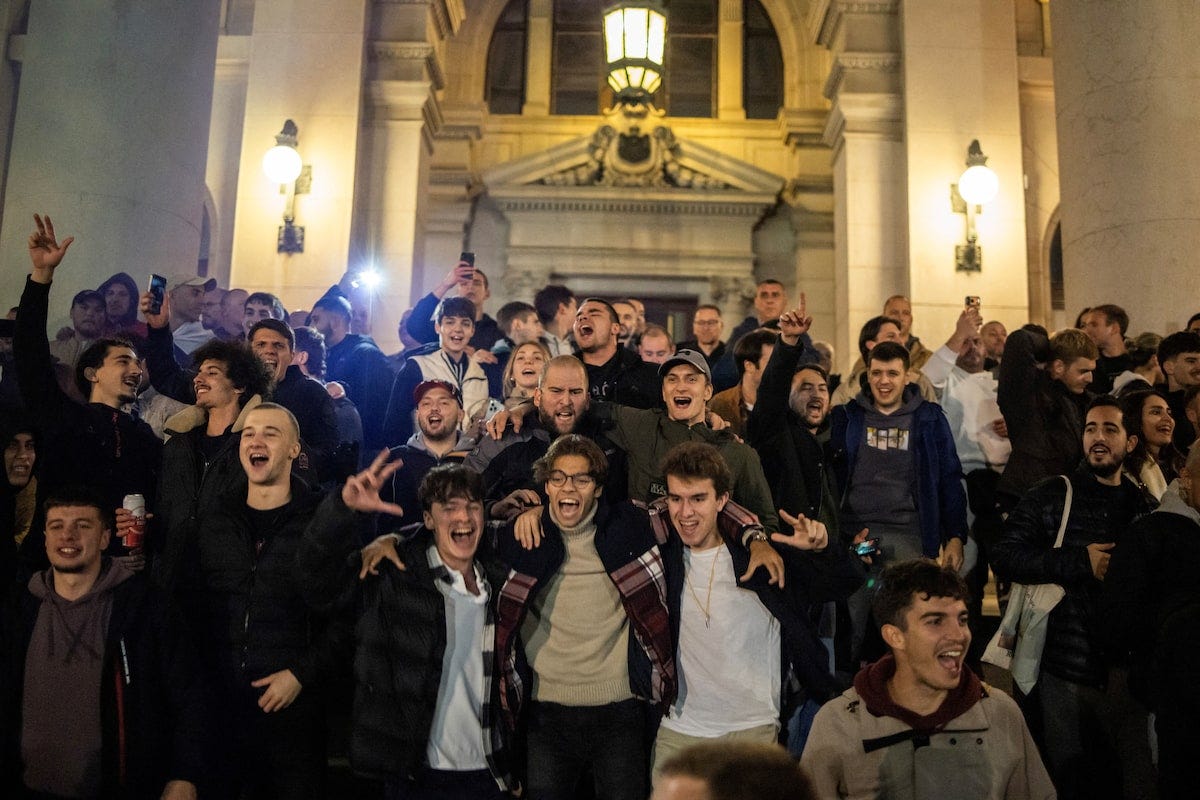
Until about 9.30pm on Sunday it looked like Serbia’s strongman Aleksandar Vučić wasn’t going to go quietly, with riot police massing beside the electoral commission in Belgrade and groups of men in black, many of them football hooligans, gathering in the streets around the city centre.
Then he walked out to the cameras and said, “It is clear that we have lost these elections.”
A new era in Serbia has dawned. The seemingly unbreakable control exercised by Vučić for the last 14 years has been overcome by a movement with no leader, no formal party structure, and with an approach to making decisions that by normal political standards simply shouldn’t have worked.
It started two years ago, when a renovated concrete canopy at the railway station in Novi Sad, Serbia’s second largest city, collapsed and killed 16 people. Furious, the country’s students took to the streets and never really left, which put them in good company – since the end of the pandemic we’ve seen a wave of Gen Z protests bring down governments from Sri Lanka and Bangladesh to Nepal, Madagascar and Bulgaria. These young people have been very good at knocking things over, but less adept at working out what comes next.
Serbia’s students were different. They occupied their faculties and ran everything through open assemblies where anyone could speak and decisions were made by direct vote after hours of debate. If you squint, you can see shades of everything in there from Occupy and the ideas of political theorist Hélène Landemore, to the Swiss Landsgemeinde and Ireland’s citizens’ assemblies on abortion and climate.
Nobody has ever used this kind of ‘assembly democracy’ to win a national election though. When they built their candidate list, the students disqualified themselves, and nobody from the ruling coalition or the top ranks of the old opposition was allowed to stand either. Every assembly could veto every other assembly’s picks, and they weren’t shy about it. The rector of the University of Belgrade, a supporter from day one, was the favourite to head the list, yet was voted off (imagine that happening in a Democratic primary).
What emerged was a list of 250 doctors, academics, lawyers, artists and athletes, 134 of them with PhDs. Because the students refused to stand themselves, their promises to clean up politics were believable to the electorate. Turnout jumped ten points to almost 70%, with roughly 600,000 more people voting than in the last election.
There’s a long way to go, of course, and plenty that can still go wrong. The assemblies have already dropped a planned limit on how long MPs are allowed to serve, those MPs can’t be recalled once elected, and the list stretches from conservative nationalists to pro-EU liberals. Not to mention, Vučić’s party still holds more than 100 seats. The next big test will be the presidential election, due before the end of the year.
But for anyone who’s spent the last decade assuming that the best we can do is defend the imperfect system we have, this should be a jolt. In 1989, Francis Fukuyama suggested that liberal democracy might be the end point of humanity’s ideological evolution. It turns out there are other places to go, but it’s taken a generation that never knew the Berlin Wall to show us the way.
This victory marks the end of institutional fear. For the first time in years, we can breathe freely.[Novak Simin], student
This isn’t just about Vučić. We’re protesting to build a new system that won’t allow this scale of corruption again. We’ve archived everything we’ve done – how we made decisions, organised logistics, built support – so others can replicate it. We want everyone, from communities to factory workers, to learn this model.[Nina Petrov], student
👇 Turn your sound up, and click here to watch the whole thing. Trust us. A Serbian victory hymn, for the ages.
Ukraine has brought in its biggest wheat crop since Russia invaded. Farmers finished the wheat harvest at 26.2 million tonnes. The US Department of Agriculture puts the national yield at a record 4.73 tonnes per hectare, up 11% on last year. Grain and pulses together stand at 41.7 million tonnes, and the figures leave out farmland under Russian occupation.
Five million Indian homes now have solar on the roof. A national subsidy pays up to $880 per household, and those homes now hold 14.9 GW, about half of India’s rooftop solar. Ember
In Nigeria, solar panels are the new wedding gift. Small-scale solar capacity now exceeds what Nigeria’s national grid delivers, and the country has already installed as much solar this year as in 2024 and 2025 combined. The end of the petrol subsidy in 2023, followed by the Iran war, has pushed generator running costs to about $200 a month; that means a $4,500 home solar system pays for itself in less than two years. Bloomberg
“Even tomato sellers have put signs up saying they collect solar batteries and all kinds of solar waste,” said Nnamdi Nkemka, the broad-shouldered owner of CNN Global Solar. When his shop opened in 2008, it was one of a handful of specialized dealers, tucked down an alley in the belly of the market. Now, it’s among well over 200 solar shops and sits right on the main street, with an adjoining warehouse to hold additional stock.
**Off-grid solar now reaches 149 million people around the world, up 26% in two years. **That’s according to the World Bank and the wonderfully named Global Off-Grid Solar Association, or GOGLA, who say solar is also now the cheapest way to bring power to at least 398 million people without any, and has saved its users $28 billion over 15 years.
Girls’ health has improved in 178 of 192 countries since 2000. The first World Girls Index, built by Plan International and Ruhr University Bochum, and based on data on roughly 971 million girls aged five to 19, finds that girls’ mortality has more than halved in this century, from about one in 800 in 2000 to one in 1,700 in 2023. Not quite the end times.
**South Africa’s HPV vaccine programme is working. **Before it kicked off in 2014, about one in five teenage girls carried the two HPV strains behind most cervical cancers. Among girls who are eligible for the vaccine, it is now three in 100. For girls living with HIV, who face the highest risk, infections fell from 29% to 4%. The drop in cancer cases, however, will take decades to show. Gavi
Denmark used to farm more mink for fur than any country on Earth. Now it’s quitting. The EU is banning mink farming from August 2027, and Denmark has decided not to ask for an exemption. Its last seven farms will close by 2029. The industry was gutted in 2020, when the government had 15 million mink killed over Covid, a cull it later admitted was illegal. BBC
Italy’s murder rate has fallen more than 80% since the early 1990s. In 1991, 1,916 people were killed, about a third of them by the mafia. The following year the mafia murdered two judges, Giovanni Falcone and Paolo Borsellino. In response, the state set up specialist anti-mafia police and prosecutors, protected witnesses who testified, and cut jailed bosses off from the outside world. Last year there were 327 homicides in Italy, one of the lowest rates in the EU. Eurispes
Colombia’s peace deal is ten years old, and seems to be holding. About 85% of former FARC fighters are still in the reintegration programme. The original peace deal planned for 25 cooperatives; ex-combatants have since founded more than 300 of them, spanning farming, brewing, sewing and tourism. La Silla Vacía
More than a million antiquities have been returned to their countries of origin since 1950. The Museum of Looted Antiquities has built the first database of these returns, worth at least $2 billion, and finds that repatriations have surged since 2020. Museums used to say “come and get it, and I’ll see you in court,” says director Jason Felch. “That has changed.” Financial Times
Australia’s Great Koala National Park is official. Ashley Love started campaigning more than a decade ago after locals on the New South Wales north coast told him they weren’t seeing koalas anymore. The new park covers 4,780 km², almost twice the size of Luxembourg, and ends logging in the state forests inside it. It’s patchy, with gaps between sections, “but it is a big step forward.” ABC
A Chilean president made a state visit to Bolivia for the first time in 71 years. In 1879, Bolivia and Chile went to war and Bolivia lost its only piece of coastline, officially becoming landlocked in 1904. In 1978, Bolivia tried to get a bit of coastline back, failed, and the two countries cut diplomatic ties. Since then, relations have been frosty, but now they are thawing.
On 16 October, Chile’s José Antonio Kast and Bolivia’s Rodrigo Paz agreed to a slew of trade and mining deals plus joint policing of their 861 km border; Chile also agreed to guarantee free transit for Bolivian goods that moved through Chile’s ports, while Bolivia agreed to be part of a fibre-optic corridor from the Pacific to the Atlantic. AP
Two-thirds of new cars sold in China in September had a plug. Electric and plug-in hybrid cars took a record 67% of sales, up from 63% in June. Petrol car sales fell 43% year on year as the Hormuz crisis pushed up fuel prices. Ember reckons China’s electric fleet has saved 143 million barrels of oil since the crisis began. Carbon Brief
“Four decades ago, we were in, excuse my English, deep, deep shit.” That’s Poland’s deputy foreign minister Marcin Bosacki, who spent his school afternoons in the 1980s queuing for butter. Today Poland is one of the world’s 20 biggest economies, and Polish incomes have gone from 40% of the EU average to 81%. The brain drain is reversing too. In 2024, for the first time on record, more Poles moved from Germany to Poland than the other way. The Guardian
A three-year-old boy’s liver cancer has been in complete remission for a year after an experimental CAR-T immunotherapy, following three lines of chemotherapy and surgery that failed to stop a chemo-resistant lung metastasis from recurring. Researchers at Baylor College of Medicine, Texas Children’s Hospital and Seattle Children’s engineered the boy’s own T cells to target a protein called glypican-3 on his hepatoblastoma cells, then gave him two infusions eight weeks apart, entirely as an outpatient. New England Journal of Medicine
How Montreal built a wildlife corridor for its foxes. Red foxes vanished from Mount Royal in 2010. Alexandre Beaudoin, a biodiversity adviser at the Université de Montréal, proposed a chain of small green “stepping stones” through the neighbourhood below. Since 2014, residents have turned alleys and verges into micro-meadows, rain gardens, food forests and giant planters, and near the far end of the corridor, a fox has since raised two cubs beside a community garden. Rewilding Magazine
A clarification on our Azerbaijan de-mining item from last week.
The return programme we described concerns Azerbaijanis displaced during earlier fighting. We should have attributed the figures to Azerbaijani authorities and included crucial context: following Azerbaijan’s 2023 offensive, more than 100,000 ethnic Armenians fled Nagorno-Karabakh, nearly its entire Armenian population. Reporting the return of one displaced population without acknowledging the displacement of another gave an incomplete and misleading impression.
Thanks to reader Marie S. for keeping us honest.