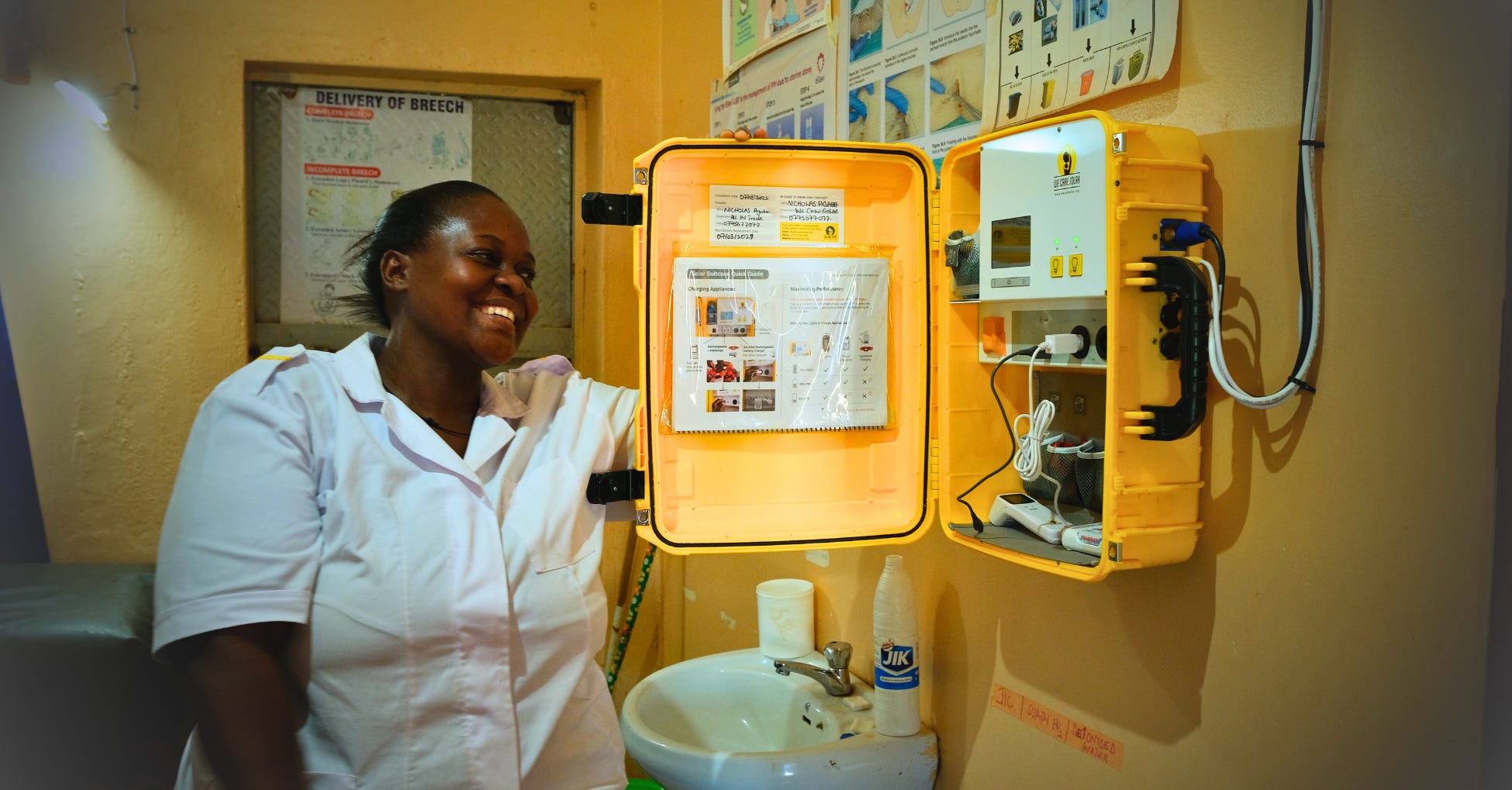
Humanity knows how to prevent most maternal deaths. We know what good maternal healthcare looks like. But in some parts of the world, the people delivering that care are working without something we take for granted: reliable electricity.
Nowhere is this a bigger problem than in Nigeria, where a woman giving birth faces a risk of death more than five times the global average. Women arrive at clinics carrying their own candles or lanterns. Midwives use the torches on their mobile phones to deliver babies. And when complications arise in the middle of the night, healthcare workers find themselves trying to save lives in the dark.
But there’s a solution. An organisation called We Care Solar has developed something called a Solar Suitcase: a compact, solar-powered system that gives maternity clinics reliable light and essential equipment, even when the grid fails or doesn’t exist.
For US$4,500, one clinic can be equipped with a system that provides power for more than a decade, including installation and battery replacement.
We supported We Care Solar’s work in Sierra Leone a few years ago. Now we’re hoping to bring their reliable power to four more healthcare centres in Nigeria.
Our goal is to raise US$18,000, and we’d love your help.
In the lead-up to Giving Tuesday on the 1st of December 2026, we’re inviting Fix The News readers (and friends!) to come together to help Turn On The Lights. We’ve set up two ways to contribute:
🇦🇺 In Australia? Donate via Myriad Australia. It’s 100% tax-deductible for all Australian residents.
🇺🇸 In the United States or anywhere else? Donate via Every.org. It’s 100% tax-deductible if you’re based in the US.
We’ll be running this campaign here in the newsletter for the next few weeks. Every donation helps bring light to places that bring life, and every cent goes directly to purchasing and sending the suitcases to these clinics.
**Lenacapavir, the twice-yearly HIV-prevention injection, is moving closer to cheaper access in low-income countries. **Indian generic manufacturers Hetero and Dr Reddy’s have committed to making it for $40 per person per year in 120 countries covered by Gilead’s licensing agreements, compared with the US annual list price of $28,218. Chemists in Virginia have also developed a simpler synthesis route that reduces raw-material costs by roughly 30%. Dr Reddy’s version received FDA tentative approval this week, with first supplies expected before the end of the year and broader availability in 2027. But this extraordinary medicine will still need funding if it is to reach the estimated 20 million people worldwide who need it.
Barbados has eliminated mother-to-child transmission of HIV. No baby born there between 2022 and 2024 caught the virus from their mother. Of pregnant women, 98% now get antenatal care, 98% are tested, and 98% of those with HIV are treated. PAHO
**Reality keeps beating the IEA’s predictions on solar. **Energy researcher Auke Hoekstra has plotted every International Energy Agency outlook since 2002 against how many solar panels the world actually ended up making. It’s one of the most famous graphs in clean energy research: the forecasts keep levelling off, while production keeps climbing. Needless to say, the IEA’s 2025 outlook is going to be wrong too. RenewEconomy
Vaccinating mothers for RSV is keeping babies out of hospital. Pooled data from the US, UK, Argentina and France show babies whose mothers got the jab in pregnancy are 74% less likely to be hospitalised with related lower respiratory tract infections. The mother’s antibodies cross the placenta, so the baby is protected from birth. England saw 63% fewer bronchiolitis admissions in babies under three months than expected (and that’s with only 55% of mothers vaccinated). Gavi
Don’t say we don’t bring you the important news! A multi-country citizen-science study on what makes coffee enjoyable (yes, really)** **found that people say coffee tastes best black, during spring, in the morning, on Wednesdays, and when drunk from ceramic cups. You’re welcome. Nature
All five of life’s genetic letters have turned up on a second asteroid. Japanese scientists analysing dust that the Hayabusa2 probe brought back from asteroid Ryugu have found adenine, guanine, cytosine, thymine and uracil, the five bases that spell out DNA and RNA, in roughly similar amounts. In 2023 the same team had found only uracil. NASA’s samples from Bennu, a different asteroid, held all five too (we wrote about that in Edition 349). That means the ingredients are probably common in space; how often they turn into life is still anyone’s guess. Nature Astronomy / ScienceDaily
Ecosystems covering 2.5 million km², about the size of Alaska and Texas combined, are now under restoration. A report launched at COP17 counts projects in 149 countries, with more than a million jobs created from the 35 World Restoration Flagships, big government-backed projects the United Nations holds up as showcases. “Restoration” covers a lot of ground, from replanting native forest to simply stopping whatever was wrecking a place and letting it heal, and about half the global total is in China.
In Brazil, Paraguay and Argentina, more than 300 organisations are stitching the shattered Atlantic Forest back together into corridors for jaguars and golden-headed lion tamarins. In South Africa, the World Bank has launched a $120 million bond to pay for restoring spekboom thicket, a scrubby succulent landscape that feeds elephants and black rhinos. And in Canada, Indigenous communities and Parks Canada have begun restoring hundreds of kilometres of salmon streams; salmon numbers are up at six of the seven sites. UN News
The most eye-popping of these World Restoration Flagships is in the middle of a war zone. Ethiopia is restoring the Desa’a forest, one of the country’s oldest remaining dry Afromontane forests, which straddles the northern regions of Tigray and Afar about 45 km from Mekelle, Tigray’s capital. From 2020 to 2022, Tigray was the centre of a civil war between Ethiopia’s federal government and Tigrayan forces: the restoration work carried on through it, with small groups, constantly changing location, getting around by bicycle and donkey when the fuel ran out. “We were asking communities to plant trees and carry out activities, but at the same time, we were afraid to do so because of airstrikes or drone attacks,” says Aklilu Negussie Mekuria, WeForest’s country director for Ethiopia. A peace deal was signed in November 2022, but fighting broke out again this September.
So far the project has brought more than 230 km² of degraded land under restoration, holding an estimated 500,000 tonnes of soil in place and capturing 1.9 million cubic metres of rainwater a year (about 760 Olympic swimming pools). It has created nearly 16,000 jobs, around 60% for women, and backs local livelihoods like beekeeping (Tigray honey, project manager Yemane Gebru notes, is very expensive). Endangered Nubian dragon trees are being revived, leopards are returning, and the area shelters ‘church forests’ and some of the oldest Christian sites in the world. Mongabay / WeForest
**Brazil has published the first global roadmap for moving off fossil fuels. **Its COP30 presidency wrote it after oil producers blocked the idea at last year’s Belém talks. It asks for national transition plans by 2028, renewables investment under way by 2030, and a 2031–33 push to speed up the switch. “We don’t need more negotiations,” said André Corrêa do Lago, the COP30 president. Nobody is bound by it, but with the Iran war keeping oil north of $100 a barrel and solar panels costing a fraction of what they did a decade ago, the plan looks a lot more viable than it would have a few years ago.
- A separate group is going further:* at Santa Marta, Colombia, in April, nearly 60 countries formed a “coalition of the willing” to write their own
Fossil gas is losing its grip on six of the world’s biggest markets. Fossil gas’s share of power fell this year in China, Japan, the United Kingdom, the Netherlands, South Korea and Turkey. In the Netherlands it was just under 32%, down from nearly 60% in 2020. Reuters
Also… no energy transition huh? Someone might want to tell the coal, oil and gas companies in Colorado.
Bangladesh has wired electricity to 99% of the country, and is now going after the last remaining hills. A $175 million Asian Development Bank loan approved in September will pay for at least 88,000 new household connections in the Chattogram Hill Tracts, aiming to lift access there to 68% by 2032.
Google’s AI just beat the physics on a hurricane. In early October, conventional models predicted that Hurricane Isaias would head west towards Louisiana. Google DeepMind’s model correctly put it on the western Florida Panhandle, where it came ashore near Destin as a Category 2. “By far and away, the best performing computer model that we’ve ever seen,” says meteorologist Michael Lowry. NPR
Visits to China’s archaeological parks have risen nearly fivefold in four years. The country’s 65 national archaeological site parks, from 7,000-year-old Neolithic villages to imperial tombs, drew 97.74 million visits in 2025, up from 20.97 million in 2021. Some of that is just a rebound: 2021 was a pandemic year, and between 2016 and 2020 the parks averaged about 40 million visits a year, back when there were only 36 of them. But interest really has grown. In 2021, state broadcaster CCTV livestreamed the excavation of the sacrificial pits at Sanxingdui, and the site’s very strange bronzes went viral (one standing figure looks remarkably like the Japanese superhero Ultraman, which the internet did not fail to notice). Splashy new site museums followed, at Sanxingdui in 2023 and at the Yin Ruins, the last capital of the Shang dynasty, in 2024. Xinhua