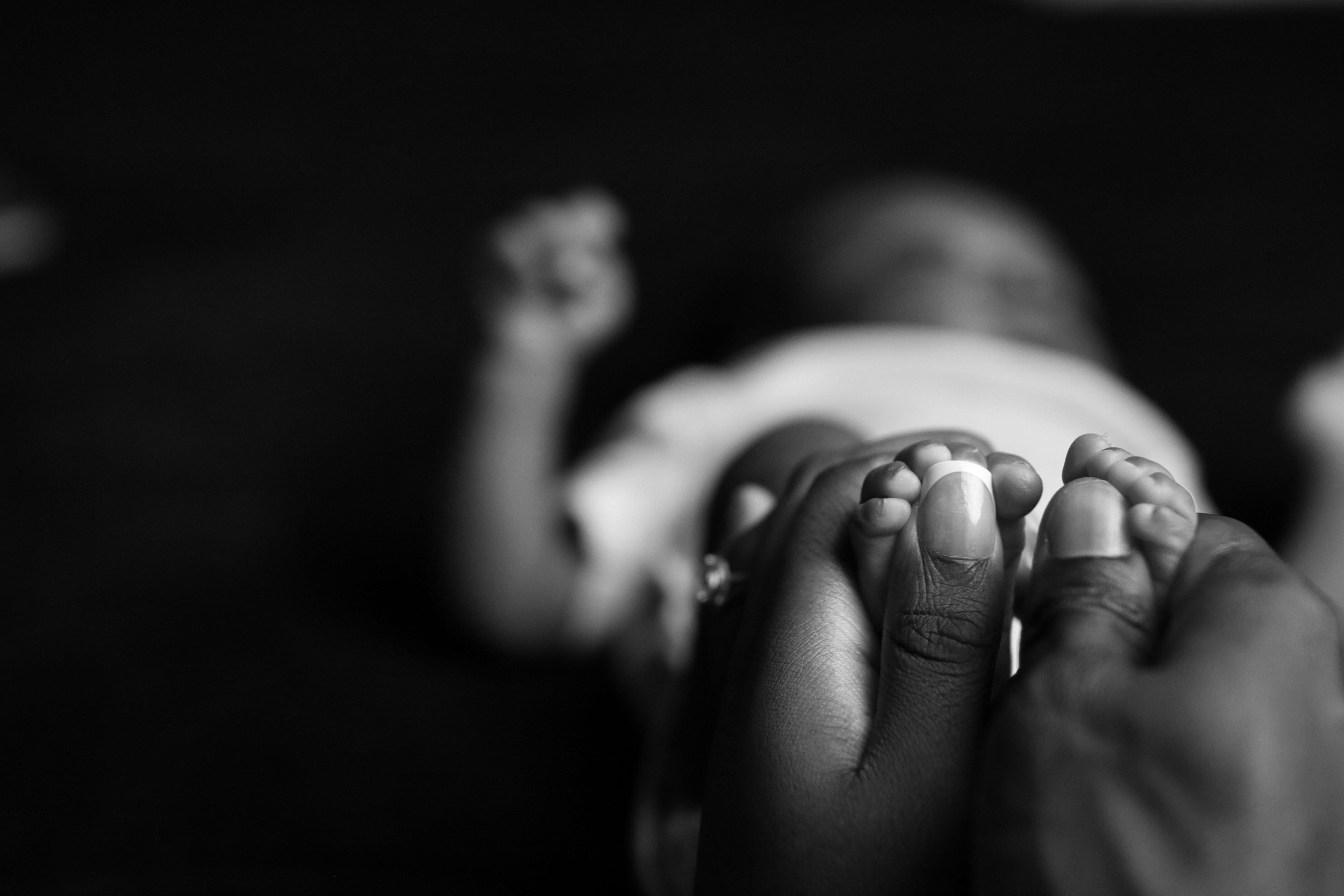
Last week we launched our crowdfunding campaign to bring light to maternity clinics in Nigeria, and we’re thrilled to report we’ve already crossed the halfway mark. A massive thank you to everyone who has already contributed.
Every cent goes directly to purchasing and setting up a solar suitcase a clinic, and it’s tax deductible if you’re in the United States or Australia. If you’re somewhere else in the world you can donate too, our fundraising portal accepts all cards.
Ok, so a bit of backstory. The inspiration to run this campaign came from a conversation we had with Dr Julie Yemi-Jonathan from We Care Solar. She told us about healthcare workers in Nigeria using torches on their phones to deliver babies, and lifesaving procedures having to wait until sunrise because there was no light, and when we heard that, we decided we had to do something.
You can listen to Julie in the latest episode of our podcast, along with two other remarkable people finding ways to make childbirth safer around the world. Lisha McCormick from Last Mile Health, who are training community health workers to deliver lifesaving care in remote villages, and Paulina Ospina from Direct Relief, an organisation getting midwives the medical supplies they need in war and disaster zones.
Why are we doing this? Because these solar suitcases are a proven solution to a huge problem. Around 260,000 women around the world die from complications in pregnancy or childbirth every year, and Nigeria carries more than a quarter of that global burden. Bringing reliable electricity and essential medical equipment to these clinics means more babies delivered safely, day or night.
Help us help them?
Listen to the episode | Support the campaign
Continuing on our theme, Mongolia, where the nearest surgeon can be 400 km away, has cut maternal deaths by more than 80% since 1990. It pulled it off by planning around that distance: more than 300 free maternity waiting homes near hospitals, telemedicine for remote clinics, and every high-risk pregnancy sent to a provincial hospital. Telegraph
“Sometimes it is hard,” added Dr Tsogbadrakh, who’s been Renchinlkhumbe clinic’s obstetrician for eight years. “But the thing I love about my work is that moment when you safely deliver the baby, and you get to see the mother and the baby meet for the first time. It’s the beginning of a new human life.”
👆 Gus here. I consume a lot of solutions journalism, and often (our own stuff included) it can feel a bit like eating your vegetables. Once in a blue moon though, you get a piece like this.
It opens in a 4x4 on a rocky Mongolian road, with a reindeer herder in early labour racing south, while the doctors race north to meet her. As the story unfolds, we get the inside scoop on Mongolia’s incredible progress on solving one of humanity’s oldest and most heartbreaking problems, snapshots of a fascinating, unfamiliar culture, extraordinary photographs, and the story of a nation told through a obstetrician, a midwife and a handful of families.
A hook! Narrative! Show don’t tell! It’s like water in the desert.
They say a good solutions story should have a response to a problem, evidence, insight and limitations. This piece ticks all four boxes, but it never feels like you’re walking through a checklist. It’s what you get when a serious newsroom like The Telegraph reports on genuine progress, a glimpse of what the news media could be like if more editors believed in this form of journalism. Hats off to everyone involved. One of the best stories of the year.
China’s emissions fell 3.1% in the third quarter of 2026, the biggest quarterly drop since the 2022 lockdowns. Coal use fell 3% and oil 4%, as solar, wind and nuclear generated more than twice the growth in electricity demand. Electric vehicles reached 67% of car sales and half of heavy-truck sales in September. Emissions have now been flat or falling in China since March 2024. Carbon Brief / BBC
Sex between men is no longer a crime in Trinidad and Tobago. The country’s final court of appeal, the Privy Council in London, has struck down the colonial-era law criminalising sex between men as unconstitutional. Jason Jones, a gay man born in Trinidad, won his case at home in 2018, saw that win overturned, and took it to London. “Laws which seek to criminalise such activities cannot be justified,” said Judge Philip Sales. Some Caribbean nations still have similar laws. Reuters
Raja Ampat is one of the few places on Earth where manta rays are increasing, to the point where it now has to deal with its own success. In 2004 marine scientist Mark Erdmann persuaded Indonesian officials to drop planned logging and mining in favour of a patchwork of protected areas that now cover about 20,000 km² (we covered the archipelago’s walking sharks in Edition 345). His pitch was that a dead manta fetches around $500, while a live one earns more than a million dollars from tourists over its lifetime. It worked; mantas now number more than 3,000, but tourists have gone from about a thousand a year to more than 33,000, and their boats’ anchors and sewage are now damaging the reefs, so Erdmann is back, lobbying to cap dive boats at 60. National Geographic
Oh, and Indonesia just protected another 8,467 km² of ocean (about one and a half times the size of Bali), and an annual gathering of sharks that scientists can’t explain. Every October and November since 2015, between 10 and more than 200 critically endangered scalloped hammerheads have turned up at the same four pinnacles in the southern Banda Sea. This new 6,838 km² Maluku reserve protects them, and a second, 1,629 km² area off Papua’s Bird’s Head Peninsula, covers reefs and seagrass used by dugongs and sea turtles. Kompas
**American teenagers’ mental health is improving, overturning the assumption that it’s been in freefall for years. **Emergency-room visits for suspected suicide attempts among teens fell more than 20% between 2021 and 2025, the CDC reports. The suicide rate for 15 to 19-year-olds has been falling since 2018, though it remains higher than in the early 2000s. NYT
America’s most ambitious geothermal plant is now sending power to the grid. We covered Google signing up for nearly 400 MW from Fervo’s Cape Station in Edition 352. Last month the first electricity left the site, outside Milford, a Utah town of 1,600 that has lost its mines, its railroad and its hog farms. Fervo uses fracking techniques to pump water through hot granite more than 3 km down, and reckons the site could eventually reach 8 GW, easily enough to supply the entire state around the clock.
Britain has landed the biggest offshore wind investment in its history. Two utilities are putting £12 billion into two wind farms off Norfolk, Vanguard East and West, with another £1 billion from the state-owned National Wealth Fund. Together they will generate 2.8 GW, enough for three million homes, from 2030. Not all good news, unfortunately, because in the same week, British ministers approved the Jackdaw gasfield and rejected what would have been Britain’s biggest solar farm. Guardian
Indonesia and Mexico have each cut ozone-destroying chemicals by more than 70%. Indonesia has reduced its use of HCFCs, the refrigerant gases that replaced CFCs, by 72.66% against a 67.5% target. Mexico is down 88% and aims for zero by 2030. Both reported at this month’s Montreal Protocol meeting in Kigali. RRI / Mexico Solidarity
There are nearly ten times as many Antarctic blue whales today as when the hunting stopped. A new estimate puts the population at 4,018, up from 418 after the last reported catch in 1973, and growing 4.5% a year. Still only 1.9% of what the Southern Ocean once held. Phys.org
**The World Health Organisation just dropped a 290-page report on neglected tropical diseases and you won’t hear about it anywhere else, but we got your back. **In 2024, 1.41 billion people still needed treatment for diseases like river blindness, elephantiasis, trachoma and intestinal worms. That’s 36% fewer people than in 2010. By June this year, 63 countries had eliminated at least one of these diseases, up from 42 at the end of 2020. A few highlights:
Guinea worm, a metre-long parasite that burns its way out through your skin, infected about 3.5 million people a year in the mid-1980s. Last year there were 10 human cases worldwide, putting it within touching distance of becoming only the second human disease ever to be eradicated, after smallpox.Sleeping sickness, a parasite carried by tsetse flies that gets into the brain and causes confusion, seizures, wrecks your sleep cycle, and eventually kills you. Only 430 cases in 2025, down 98% since 1999.Elephantiasis, caused by mosquito-borne parasites that block the lymphatic system and swell your legs, arms and genitals to several times their normal size. 502 million fewer people require preventative treatment since 2020.Trachoma, a bacterial eye infection that comes back again and again until your eyelid scars, the lashes turn inward and scrape the eyeball until you go blind: 92 million people lived in at-risk districts in 2026, down from 325 million in 2011. That’s a 72% fall.
This is one of the biggest public health efforts in history. Between 2019 and 2025, drug companies donated more than 21 billion tablets and vials, and health workers carried those medicines into thousands of villages all over the world that don’t appear on any maps. We are talking here about one of the great miracles of our time and it’ll get about a millionth the amount of airtime as the midterms.
Who us, political? Never :) But we do read the news, and since the 5th November 2024 we’ve been collecting headlines.
Turnout for last week’s US midterms was the
second-highestfor a midterm since 1914, behind only 2018.
An estimated
27%of 18 to 29-year-olds voted, the second-highest youth turnout for a midterm in 30 years.At least
159 womenwill serve in the next Congress, a record, up from 152. That’s about 30% of members.New Mexico elected
Deb Haaland, the first Native American woman ever to govern a US state.Minnesota elected
Peggy Flanagan, the first Native American woman in the US Senate.Georgia elected
Keisha Lance Bottoms, the first Black woman ever elected governor of a US state.Minnesota, Ohio and Tennessee elected their
first female governors.Michigan elected
Abdul El-Sayed, the first Muslim in the US Senate.New Hampshire elected
Chris Pappas, the first openly gay man in the US Senate.Iowa elected
Josh Turek, the first US senator with a permanent disability.Texas elected
Gina Hinojosa, its first Hispanic governor.California elected
Xavier Becerra, the first Latino to win governorship at the ballot box.Wisconsin, Nevada and Florida each elected their
first Black governor: David Crowley, Aaron Ford and Byron Donalds.South Carolina elected
Annie Andrews, the first woman it has ever voted into the US Senate.Alabama, Georgia, Michigan, Washington and Wisconsin each elected their first
transgender state lawmaker.Virginia wrote
reproductive freedominto its constitution.Virginia replaced its 2006 ban on same-sex marriage with constitutional protection for
marriage equality.People in Virginia who have served a felony sentence will now get their
voting rightsback automatically.Nevada voted for a second time to put the
right to abortionin its constitution, the final step required.Missouri voters
refused to repealthe abortion rights they approved in 2024.Montana wrote citizens’ right to propose their own
ballot measuresinto its constitution.Utah voters rejected a plan to make it harder to pass citizen-led
tax measures.Missouri voted to stop politicians
overturning lawsthat citizens pass at the ballot box.Montana voted to ban political donations from
corporations.Arizona voters rejected wider restrictions on
diversity programmes.Massachusetts will let people
register to voteon election day, from 2028.Massachusetts opened the records of its governor’s office and legislature to
public scrutiny.Massachusetts gave its public defenders the right to
form a union.Vermont wrote the right to
join a unionand bargain collectively into its constitution.Vermont added
equal protectionto its constitution, covering race, sex, religion, sexual orientation and gender identity.Massachusetts voted to keep the tighter
gun lawsit passed in 2024.Michigan voted to ba…