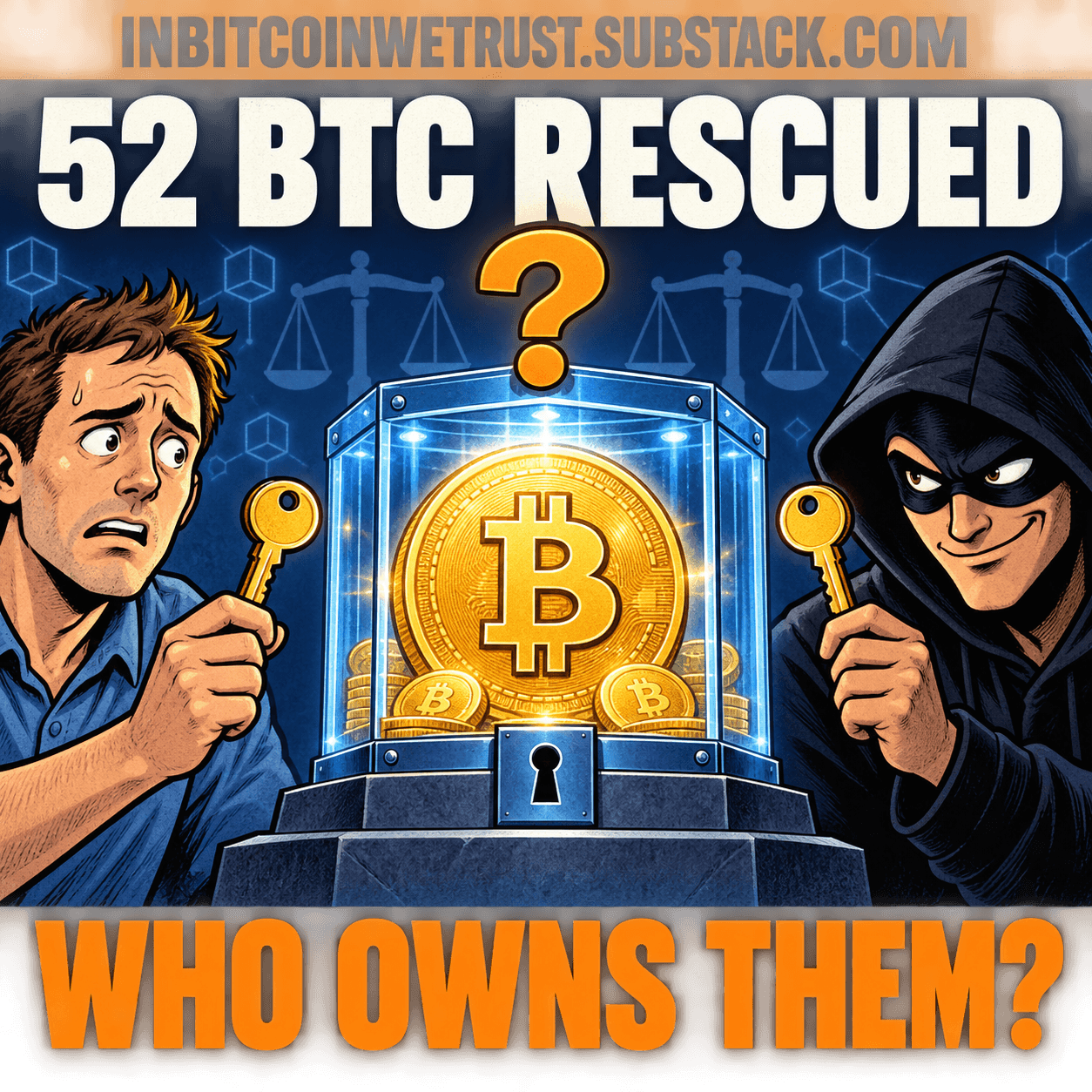
Imagine discovering that someone has saved your Bitcoin.
The savings you thought might be gone are still there. Someone reached the vulnerable wallet before a thief did. The coins have been moved to safety, and there is a process for claiming them.
Then comes the question you never expected to struggle with:
Can you prove they were yours?
You still have your seed. You can produce a valid signature. You can demonstrate that you know the secret that controlled the money.
Unfortunately, so can someone else.
That is the problem behind one of the most consequential Bitcoin recovery stories of the year. According to Galaxy’s Alex Thorn, as ** reported by CoinDesk on September 22**, white-hat operators consolidated
For affected savers, that represents a chance to recover something far more personal than a number on a block explorer. It might be a house deposit, years of disciplined saving, or money intended for their children.
But securing the coins and returning them are separate achievements. A recovery address establishes where the Bitcoin is now. It does not, by itself, establish who should receive it next.
The hardest part of this story begins precisely where the successful transaction ends.
To understand why, we need to be careful about what was rescued.
The phrase “stolen Bitcoin recovered” suggests that thieves took the money and researchers subsequently wrestled it back. That is not an accurate description of every coin involved here.
In ** its August 17 account**, Digital Asset Recovery Technologies, or DART, said that it and independent researchers had secured just over 50 BTC from exposed addresses. The operation aimed to reach vulnerable funds before malicious actors took them. DART said the assets were placed with Crypto Recovery Trust rather than retained in researchers’ personal wallets.
This distinction changes the entire meaning of the rescue. Nobody rolled back Bitcoin. Nobody instructed miners to undo a theft. Researchers used a weakness that could also be exploited by attackers, then moved exposed money into a recovery arrangement.
Consider a building where someone has discovered how to reproduce the apartment keys. A burglar can use a copy to enter. So can someone trying to remove valuables before the burglar arrives. The lock works in both cases. It has no way to evaluate either person’s intentions.
Something similar happened at the level of Bitcoin authorization.
Coinkite’s ** technical account** says a build and linking error caused affected firmware to use MicroPython’s Yasmarang software pseudorandom generator where the intended hardware randomness should have been used. The company traces the integration problem to the March 2021 libNgU migration. Its explanation is explicit: the devices were not remotely taken over. Attackers exploited weakened seed generation by reconstructing keys offline.
This was a failure beneath the protective features users could see. A device could remain disconnected from the internet. Its owner could guard the backup carefully. Transactions could display correctly. Yet the secret at the foundation of the wallet could be more predictable than the owner understood.
Once another person can reconstruct that secret, protecting your original copy is no longer enough.
The consequences also outlive the software bug. Coinkite’s ** current security guidance** says that corrected firmware fixes future seed generation but does not repair an existing affected seed.
The practical point is easy to miss during a crisis: changing the software and changing the compromised secret are different operations. Restoring the same vulnerable seed on another device carries the original problem with it.
For anyone who followed the usual advice about self-custody, this is an especially painful kind of failure. The person may have done everything they understood they were supposed to do. The defect was in an assumption their entire setup depended on.
And when that assumption failed, the ownership problem followed.