BOROUGHBRIDGE, ENGLAND—I went to the English countryside struggling. I had four years of war behind me—reporting daily from Ukraine—with more to come, and I had just completed weeks of intense meetings encountering a great deal of Western naivety and stupidity about Russia’s war and Ukraine’s resistance.
We publish this newsletter every day at 9:05am NYC time / 4:05pm Kyiv.Your subscription fuels our work.
I needed to get out of London, much as I love the city. I could handle the noise of Kyiv but I could not take the noise of a city not knowingly at war. I also had a nasty encounter with pro-Russian millionaires from Florida. Enough.
So I went up to Yorkshire, figuring the quiet countryside would offer the conditions I needed to restore my strength and sharpen my clarity.
I stayed above a pub in a Yorkshire village two or so hours north of London by train. I was missing the Ukrainian trains—the food, the camaraderie of a nation resisting together, the comfort. But stepping off the train at Thirsk, feeling the fresh air, witnessing the old ways carry on with people coming and going from the Thirsk Races and families gathering in pub gardens, I began to feel all right: There is hope yet for the West, all is not lost, etc.
Members of the ** Catholic Military Association **of His Majesty’s Armed Forces, who follow our UFN work and have become friends in the war, hosted me and made introductions throughout my UK travels. One of them, a British veteran of America’s wars in the Middle East, collected me at Thirsk and brought me to my destination, the
Well, I had a week in the country, so I read it. It caught much of what I was carrying, and what so many I know carry, amid the current resistance to Russia’s war machine. But it fell short in ways that I don’t want those emerging from this war, when it ends in victory for free people, to fall short.
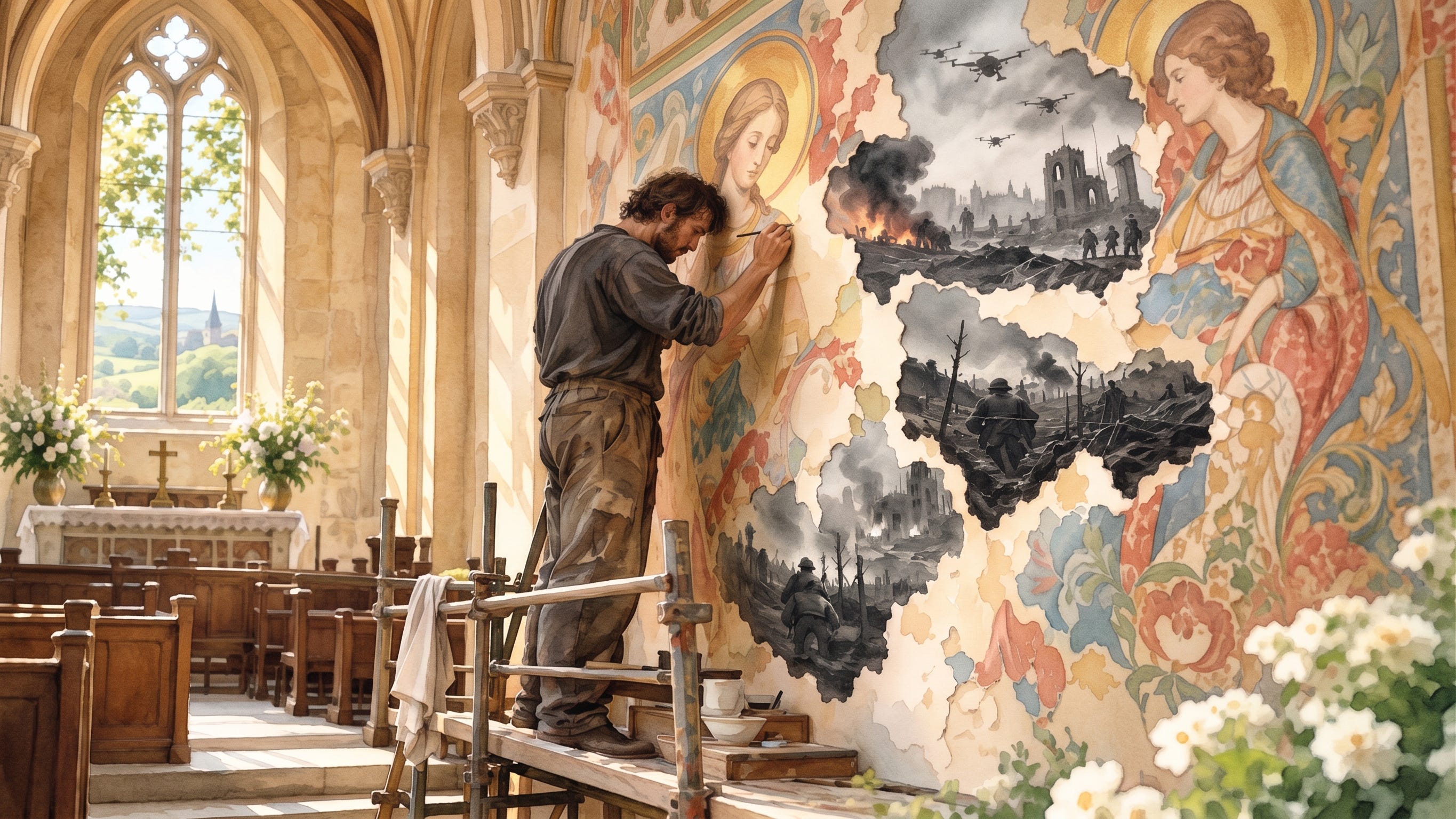
For all of its graceful writing, the story falls short in that Birkin never seems to reckon with what he experienced. He paints over it, like Henry VIII’s officers painted over the same Last Judgment mural Birkin was restoring.
Each morning, listening to English composer Edward Elgar and the music of the English folk rocker Johnny Flynn—which warrants another story, how each song felt relevant—
In our world, it’s hard to get away from war.
Those same fields saw bloodshed 700 years ago:** In 1322, the Battle of Boroughbridge** showed what English soldiers fighting on foot, with archers, could do against mounted knights at a river crossing, a forerunner of the tactics that won at Crécy (1346) and Agincourt (1415). It ended in a mess: The rebel Earl of Lancaster was captured and beheaded six days later outside his own castle at Pontefract, and the victor was executed a year after that. In our world, it’s hard to get away from war.
Still, these Yorkshire fields are serene today, and I was starting to feel better than all right in the countryside not far from the places where *James Herriot’s *** All Creatures Great and Small unfolded. Each mid-morning, over post-run bacon sandwiches or pork pies and coffee in the town centre, I read
In the book, Tom Birkin emerges from the horrific trenches at Passchendaele in Belgium with a facial tic and a stammer, and a wife who has left him. He takes a job in the summer of 1920 uncovering a medieval wall painting in a church in a Yorkshire village, paid for by an aristocrat’s legacy that the vicar resents.
Birkin sleeps in the belfry. He works slowly, at height, on a “Doom”—a Last Judgment mural—that has been under whitewash for four hundred years, since the reformation or revolution of Henry VIII and Elizabeth I covered it up. In the next field, another veteran, Moon, is digging for a lost grave and living in a tent.
The weather is good all summer. The village feeds Birkin. He falls in love with the flirtatious and beautiful vicar’s wife and, for the best, does nothing about it. He talks with Moon about the war, just a little. Then the work is finished, and he leaves.
He knew at the time that it was a good interlude in a wild world. He did not know that, for him, such a time of peace, even happiness, might not return.
I see this book not as a guide or a diagnosis, but as a starting point and maybe a warning. The descriptions of idyllic Yorkshire, which was surrounding me, are spot on. The prose is noble, transporting us to a luminous summer. But unless you know where you’re going next, it will leave you empty. It is a temporary, maybe necessary, comfort—* yes, others have been through this*—and it is a reminder to those of us who have not been literally firing back at the enemy that there are things we cannot understand.
I’m grateful I read this book during my mid-war sojourn. Carr’s novel showed me how I did not want to use my “month in the country”: I wanted to recall what I had witnessed and felt, what others have told me, to face the fears and trauma, and to begin to make sense of things, not to keep them quiet and covered up.
Somewhere in Yorkshire, people in a pub asked me to tell them one lesson I learned in the war. It is always one lesson they want, and quickly. They don’t have or want to make time for more than that. They don’t want to know too much of the war that has not yet directly come to them, and maybe, maybe, that’s fine, and you’ll see why it’s maybe fine in how I answered them:
Hold on to the happy moments as they arrive, instead of dreaming of future ones. You have no idea if moments so good will return. Cherish them. Live in them. Recall them. While goodness still surely lies ahead, those truly happy times might not.
Those people in the pub gathered around me—whom I can’t see in my mind’s eye, so maybe it was a dream but I’m sure it wasn’t—nodded with solemnity.
“That sounds like a real lesson from the war,” said one.
*JP Lindsley, an American journalist based in Ukraine, is co-founder and editor-in-chief of UnderFire.News. *
Help us keep Under Fire News independent and daily.If you’d like to support our work with a one-time contribution, you can do so here:
underfire.news | PayPal | X | Instagram | LinkedIn | Youtube | Facebook