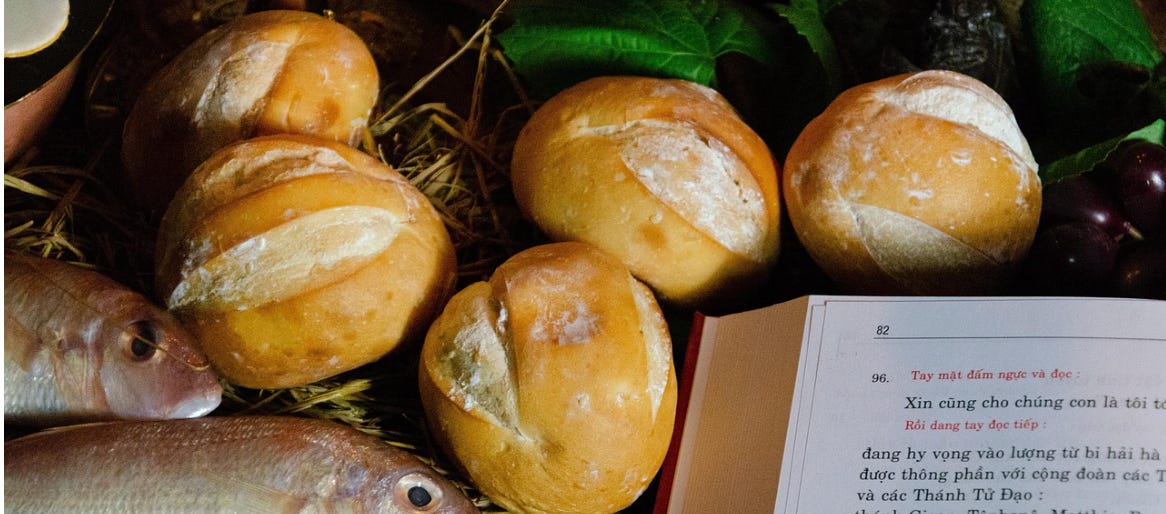
A Boy's Lunch
” — John 6:9 Notice who Andrew brings to Jesus. Not a wealthy donor. Not a religious leader with influence or a synagogue behind him. Not someone whose name anyone in the crowd would recognize. A boy. With a packed lunch.
Per-article narration is paused while we focus on the 9 daily compilation episodes. Listen to today's Science daily brief — the story below is covered there alongside the rest of the day's reads. The full article text is below — read along while we ramp narration back up.
“There is a boy here who has five barley loaves and two fish — but what are they for so many?”— John 6:9
Notice who Andrew brings to Jesus.
Not a wealthy donor. Not a religious leader with influence or a synagogue behind him. Not someone whose name anyone in the crowd would recognize.
A boy. With a packed lunch.
And Andrew seems embarrassed by the offering before it’s even made. He introduces the child and immediately undercuts him in the same breath: “But what are they for so many?” It’s the kind of sentence we say when we’ve already done the math — when the numbers don’t add up and we’ve decided, before asking, that the answer is no.
We do this all the time. We size up what we have. We size up what’s needed. We subtract. And then we sit down
Five thousand people followed Jesus to a remote hillside. John says they came because of the signs he performed on the sick. But Amos had described exactly this kind of crowd, seven centuries before:
"Behold, the days are coming," declares the Lord, "when I will send a famine on the land — not a famine of bread, nor a thirst for water, but of hearing the words of the Lord." Amos 8:11
A famine of hearing. These people weren’t just hungry in their stomachs. They were starving somewhere deeper — in a place no bread or political savior could reach. That’s why, when Jesus fed them, they immediately tried to crown him king by force. They had experienced something extraordinary, but they completely misread what it meant. They wanted the miracle without the Bread of Life. They wanted the sign without the one the sign was pointing to.
Philip made the same mistake from a different angle. Two hundred denarii — not enough. His math was accurate. But he was solving the wrong equation.
Here’s what the text doesn’t tell us: how the boy felt.
We don’t know if he hesitated. We don’t know if he understood the scale of what was happening around him. We don’t know his name, his age, where he came from, or whether he ever realized what his lunch became.
What we know is that he gave what he had.
Barley bread — the food of the poor, the grain people ate when they couldn’t afford wheat. Two small fish. A meal designed for one person. In the ancient world, barley was what you ate when you had no other options. This wasn’t a grand gesture from someone with surplus. This was someone with almost nothing, giving it anyway.
Jesus took it. He didn’t wait for a more impressive offering. He didn’t ask Philip to go raise funds. He looked at what was in that boy’s hands — laughably insufficient, entirely ordinary — and gave thanks. Blessed it. Broke it open.
The miracle of feeding of the five thousand begins not with abundance, but with surrender.
When the crowd had eaten as much as they wanted, twelve baskets of fragments were collected — one for each disciple. The ones who had calculated why it couldn’t work walked away carrying more than they’d started with. The miracle didn’t bypass the small offering. It required it.
What is in our hands right now — that we’ve already decided is too small to matter?
It might be a conversation we’ve delayed because we don’t have the right words. A skill that doesn’t feel spiritual enough. Time, money, attention — not offered dramatically, but quietly placed in front of the person who's hungry right now.
We tell ourselves we’re waiting until we have more. More confidence, more resources, more clarity, more of whatever we think the situation requires.
But the boy didn’t wait.
He didn’t understand how it would work. He just handed it over.
We spend so much energy measuring the gap between what’s needed and what we can offer, and letting that gap become our reason to stay still.
But the gap was never ours to close. That’s the part that belongs to Jesus.
Our part is the lunch. Too small, too ordinary, not nearly enough. Quietly placed in his hands.
The miracle was already in motion the moment the boy let go.