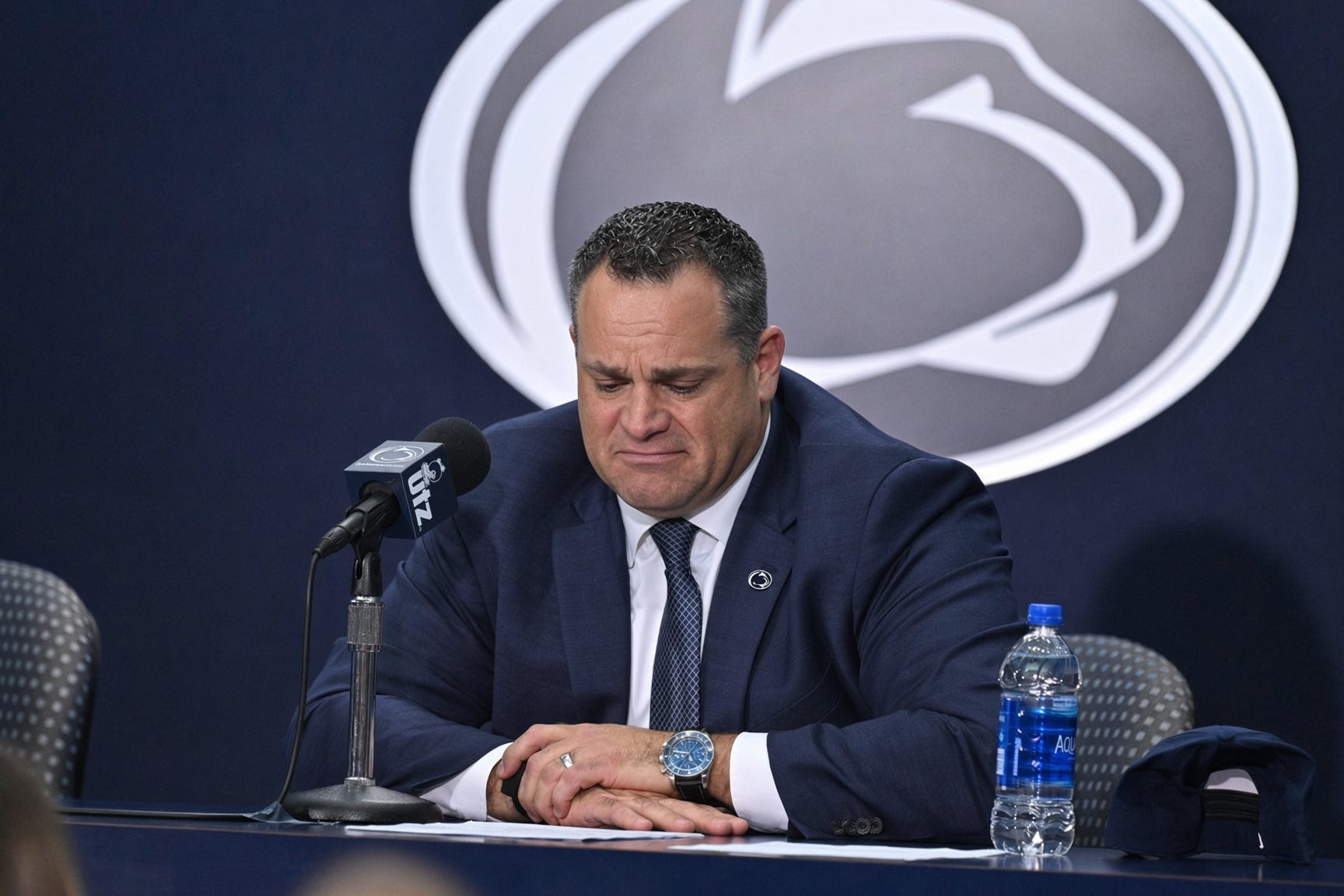
LUTHMANN NOTE: I’m with Greg: Kraft wrote the standard, and he can damn well answer to it. Firing Franklin meant accepting responsibility for the next hire and the machinery needed to make that transition work. Fans were promised a higher ceiling. They have every right to question the man who made that promise while watching Chesney win at UCLA. Campbell deserves a fair opportunity to coach his team. Kraft has already had his opportunity to run the department. If demanding excellence justified firing a coach, demanding competent leadership justifies replacing an athletic director. Penn State’s trustees should stop treating accountability as something that ends at the locker-room door. This piece is “A Crafted Fumble in Happy Valley,” also available on NY News Press.
When James Franklin was dismissed last October as head football coach at Penn State, Athletic Director Pat Kraft vowed the university would pursue a higher standard of football excellence.
One year later, that promise echoes like a personal foul Kraft threw on Nittany Nation.
The firing was a muddled, poorly communicated mess that created confusion among players, recruits, alumni, donors, and the media. It was obvious Kraft had no established game plan before axing Franklin, which raised plenty of questions about his strategy and his ability to close a deal.
Kraft took a program that had reached the College Football Playoff semifinals the previous season and plunged it into a protracted search littered with more frustration than hope.
After 11-plus seasons, Franklin compiled a 104–45 record, won one Big Ten championship, and came within one win of reaching the national championship game. Franklin’s tenure was a tug-of-war between lofty expectations and inconsistent results, as he came up short in his share of big games. Then came those fateful three consecutive defeats last October that were Franklin’s swan song.
Moving on, Penn State needed clarity, professionalism, and a plan. Instead, Kraft delivered a circus. Firing Franklin was a gamble. Kraft’s responsibility was to make sure it was justified. For 54 days, the hiring saga played out like a fourth-and-long with the punter still anchored at the popular Fullington Bus tailgate.
The coaching search should have been Kraft’s opportunity to reaffirm the program as a national power. Instead, Kraft turned it into a scavenger hunt minus the map. Names were floated and withdrawn, and sports agents used Penn State for leverage.
Bob Chesney, a Central Pennsylvania native son, should have been the obvious choice, but instead Kraft let him walk. He landed at UCLA, currently the only undefeated team in the Big Ten.
Given Penn State’s history, resources, and expectations, that is no administrative fumble but a failure of leadership. Penn State’s athletic tradition is too important to its far-reaching alumni and fans to treat this as business as usual.
As Kraft pursued candidates while enduring setbacks, the process became an embarrassment. Kraft finally settled on Matt Campbell, who was a success at Iowa State.
As the search dragged on, a recruiting quagmire was emerging. Penn State’s 2026 recruiting class ranked 41st nationally on national signing day, with 11 former commitments following Franklin to Virginia Tech.
Moreover, The Sporting News had this season’s schedule as the easiest in the Big Ten, as Penn State quickly morphed into Iowa State East.
Four consecutive Big Ten losses ended Campbell’s honeymoon as the bandwagon turned into a pumpkin shortly after his team was manhandled by Northwestern.
Any new coaching transition inevitably takes time, and Campbell deserves the opportunity. Kraft cannot escape responsibility for the circumstances in which Campbell arrived or the expectations he fostered.
Kraft demanded a higher standard when he fired Franklin. That standard must apply to the athletic director, too. An athletic director’s job is to control the narrative, not get run over by it.
Accountability must begin at the top.
Kraft has become the face of Penn State’s current dysfunction, and the case for his firing grows stronger with every Saturday that ends in disappointment.
Culturally, financially, and historically, Penn State athletics is too important to be led by someone who is not up to the job. The department needs a leader who can execute a plan, not improvise one. Someone who can restore confidence, not erode it.
Penn State can’t afford another year of leadership purgatory.