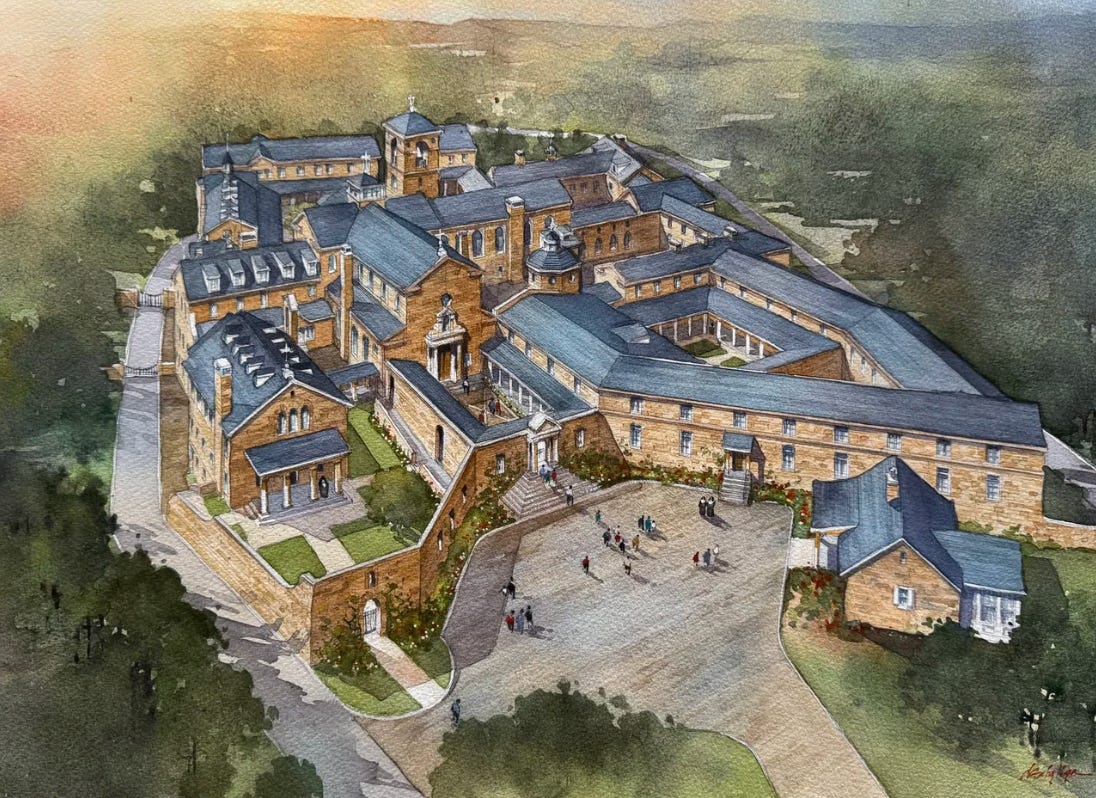
This is not the most interesting or superficially significant item today, but it’s one that gives me hope, which we all need: a group of Carmelite nuns in Pennsylvania is building a stone monastery meant to last a millennium. From the NYPost:
A group of cloistered nuns in
[rural Pennsylvania]who trace their history back to 16th-century Spain are building a sprawling monastery meant to last 1,000 years — and they’re doing it almost entirely by hand.Expected to be completed in 2041 at a cost of $100 million, the 48-acre Carmel of Jesus, Mary and Joseph monastery in Fairfield, Pa., is entirely the vision of one woman — Mother Thérèse of Merciful Love, the 41-year-old daughter of a firefighter from Cape Cod, Mass.
“We had a vision, a dream, an interior kind of intuition that there was something that we needed to do different,” Mother, as she’s known around the compound, told The Post in an exclusive interview from behind an iron screen
[inside the monastery’s]guest house. “We are building an authentic building.”The nuns are laying the foundation brick-by-brick themselves, in between their daily
[spiritual duties]and tending to the livestock and garden. For the heavier lifting, they’ve brought in outside help — renowned New York architect Riccardo Vicenzino and local contractor Joe Bonifate, who is also in charge of fundraising.
I knew Ricky Vicenzino back when I lived in New York! Super-devout Catholic family, great people. The Vicenzino brothers are Catholic traditionalists, so this makes sense. I’m so cheered by this! If Mother Therese is 41 years old, and Ricky Vicenzino is helping them build, you know she ain’t no Sister Stretchpants. In fact, the nuns of this monastery are traditionalist who use the Latin mass, and are completely in communion with Rome (see here). They depend entirely on donations and almsgiving — if you are Catholic, or sympathetic with their project, please consider giving!
Here’s the website of the Fairfield Carmelites. Whatever else you do today, set aside nine minutes to watch the video about them and their monastery. They say in a world filled with noise, they are establishing a stronghold of prayer, peace, silence, and stability. And the foundress is a Millennial! The Carmelites are not Benedictines, but this monastery is a literal manifestation of what I call the Benedict Option. May God bless their project, and cause it to flourish. So much hope!
I need to figure out how to get up to the Russian Orthodox monastery in West Virginia, which I hear is growing. I met a Protestant this past summer who had been there, and who had been shaken deeply (in a good way!) by what he experienced there.
After the western Roman Empire fell, so many young men and women went into monastic life. Don’t be surprised if we see the same thing happening in our time and place. Let us lay Christians who believe in the goodness of monasticism be willing to support them with our prayers and tithes!
Andrew Snyder is a Christian scholar who spends a lot of time thinking and writing about Tolkien, Lewis, and the Inklings. He came up with a short quiz in which you answer a few questions, and find out which “sphere” of the planets you would land in. As he writes, “The medieval poets did not believe that the heavens fatalistically determined our future, but they did believe they each had a character that influenced the spiritual climate.” This is not astrology or anything like that, but a way to see how Dante and other medievalists would have classified your personality.
I took it, and this is what it said about me. I was startled by how accurate it was!
Yep, yep, yep. Snyder goes on:
Saturn is the farthest and slowest of the planets, and his influence was the hardest one to receive well. On Earth he shows up as sickness and old age, as things wearing down, as melancholy and death. Father Time wears his face. The medievals did not pretend otherwise, but they also said that, received rightly, Saturn gives godly sorrow, penitence, and the kind of insight that only comes from long contemplation. This sphere holds the sad stories, the long defeat, and the last battle, and asks what hope looks like when it is tested hardest. Stay a while to mourn, and to discover the Light and High Beauty that can only be found in the darkest of places.
It also said that my “second sphere” (not everybody has them) is Venus:
You also have a soft spot for beauty, and I suspect a garden, a song, or a face has changed your mind about something more than once.
Oh, that is so very, very true too! I was texting this morning with a friend who took the quiz, and said her results are accurate too. Knowing her as I do, I’d say so. I was telling her that I feel caught by a melancholic tide that is pulling me away from shore, out to solitude, and that I am wrestling inside over whether or not to resist it. I don’t want to live in solitude for the rest of my life, but it seems that I have suffered so many heavy defeats over the past 15 years that solitude seems inevitable. I wish I had more wherewithal internally to resist, and try to make my way back to shore, but so far, I haven’t found the resources for that. Can’t decide if this is God’s will for the rest of my life, or if I’m giving up too soon. To put it another way, am I despairing and calling it realism? Or am I living with a realistic assessment of my prospects as I prepare for the last quarter of my journey on this earth, and calmly accepting limits.
In any case, the “second sphere” really does modulate my natural melancholy. One of the reasons I get up in the morning is knowing that on this day and every day, I might be surprised by beauty, in a life-changing way. The greatest example for me is how being struck hard at 17 by the beauty of Chartres set me on a new path in life, towards ancient Christianity. The second-greatest example is how the wisdom radiating from the beauty of Dante’s poetry saved me from my own dark wood. What might I see today? Who might I meet? What might I read? These surprises have happened so often in my life that I can never fully surrender to what seems like fate.
There is a reason why my favorite scene in all of cinema is the encounter between Andrei Rublev and the shade of his mentor Theophanes in the ruins of the sacked cathedral, in Tarkovsky’s “Andrei Rublev". In it, Theophanes tells the shattered Andrei not to despair over the evil of men, which will always be with us, but to accept that his vocation as an iconographer is to create beauty to give others hope, by reminding them that this world of pain and defeat is not all there is. I’ve cued this to that scene (reminder: all of Tarkovsky’s Russian-made films are available for free on the Mosfilm YouTube account):
Take the quiz and let us know in the comments which sphere is yours. I’m exploring Snyder’s website today — it’s really interesting. If you’re a Jonathan Pageau fan, you’ll love it.
Today’s newsletter continues below for subscribers. Why not become one?