The Weekly | Issue No 243 | November 20, 2026
Thanksgiving is next week, which means Americans are about to spend a small fortune on groceries, booze, and feeding relatives who will probably complain about something anyway.
So, here’s something to be thankful for. Free money. Well, almost.
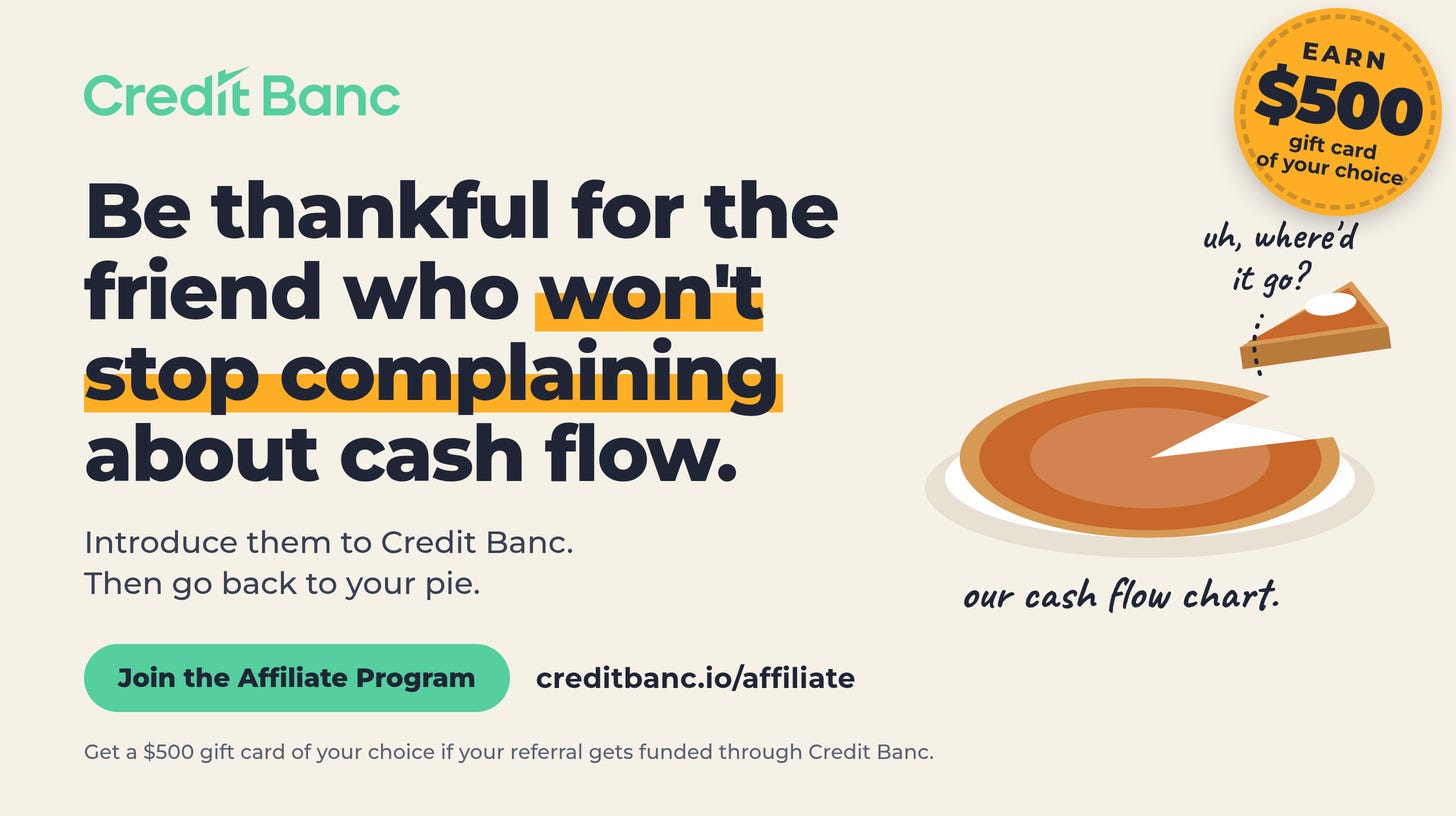
Credit Banc is handing out $500 gift cards for every business referral that gets funded. No limits. Just introduce a business owner who needs financing, and if the deal closes, you get $500. That’s a lot of turkey. Or bourbon. We won’t judge.
Join the Credit Banc Affiliate Program
Now, let’s get into this week’s headlines before someone starts an argument at the dinner table.
Fifth Avenue is Back.
**And So Are the Ridiculous Rents.**Car Dealers Have a Customer Service Problem. AI Smells Money.Bookstores Are Booming.
Apparently, Nobody Told the Internet.****Who Needs International Students?(American Universities, That’s Who.)College Just Got Shorter.
**The Tuition Bill Got the Memo.**Wait…Aren’t We Supposed to
**Hate Cash Advances?****And from Around the Web:**Corporate Gaming, Cosmic Ghosting, and Questionable Hippo Dining
Want to get in front of business owners who actually read their emails? Sponsor The Weekly, collaborate on The Liquid Lunch Project, or explore other ways to work with us. Learn More Here
The news shaping business, finance, and technology, for better or considerably worse.
Apparently, the world’s most expensive shopping street is back in business. Manhattan’s Fifth Avenue has reclaimed the top spot for retail rents, beating London’s New Bond Street and Milan’s Via Montenapoleone. Rents jumped 35% in the past year, while retail rents worldwide rose just 3%.
On upper Fifth Avenue, stores now pay about $2,700 per square foot per year. Anything larger than 371 square feet, roughly a two-car garage, costs more than $1 million a year in rent. That’s before you’ve sold a single handbag.
It’s not just the stores. Manhattan’s high-end office asking rents hit a record $87 per square foot in the third quarter as vacancies fell. City hotel rates are up 7% this year to an average of $328 a night, outpacing the rest of the country. Quite the turnaround for a street where rents fell to $1,500 per square foot in 2019, thanks to store closures, steep costs and online shopping.
Meta just signed a 10-year lease for its Meta Lab flagship next to Harry Winston. Shoppers can test AI glasses and VR headsets, listen to Sunday DJs and sip free coffee while their glasses are customized. Apparently, selling things now requires throwing a small party.
Come December, daily foot traffic can hit 1.5 million as holiday displays go up. Just don’t expect many sale signs.
Luxury retailers are betting big on physical stores, where the shopping experience matters almost as much as what’s being sold.
🔗 Take a closer look at Fifth Avenue’s comeback. Window shopping is still free.
Numa just raised $45 million to expand its AI customer-service system, already used at more than 1,500 car dealerships across the U.S. and Canada.
Its digital agents answer calls, book appointments, update drivers on repairs, and handle warranty paperwork. Basically, all the things that tend to get lost between “We’ll call you back” and never hearing from the dealership again.
Dealerships aren’t always losing sales because people stopped buying cars. They’re losing customers because nobody picks up the phone, messages pile up, and buyers walk away before anyone notices. Great salespeople aren’t automatically great at follow-ups, and many dealers still run on old systems. Numa sees an opening in a fragmented industry that badly needs better customer service.
The robots may not know much about engines, but at least they’ll return your call.
Businesses spend a fortune finding customers, only to lose them over unanswered calls and poor follow-up. AI might finally help close that gap.
🔗** **Meet the AI that might actually return your dealership’s phone calls.
Turns out e-books didn’t kill print. They just gave bookstores something to be smug about.
Print made up three-quarters of book sales in 2025. The U.S. added 422 indie bookstores last year, **31% **more than the year before, including shops devoted to romance, horror and other niches.
Even Barnes & Noble, which spent years getting punched around by Amazon, is opening stores again. After a 2019 private-equity buyout, new CEO James Daunt gave individual stores more say in what they stock and redesigned locations. The chain planned 60 new stores in 2026 after opening dozens in 2025.
U.S. print sales in 2025 were up **10% **from 2019, though still below their 2021 pandemic peak. Steamy romance helped, and demand for Japanese manga jumped **40%. **Apparently, dragons and questionable love interests have better staying power than another app.
There is a catch. The share of Americans who read for pleasure on a given day fell from 28% in 2004 to 16% in 2023. The share reading novels or short stories dropped from 45.2% in 2012 to 37.6% in 2022. Still, 75% of Americans had opened at least one book, a figure largely unchanged since 2013, and more than a third of adults read over five books last year.
The bigger worry is kids. Pleasure reading among 9- and 13-year-olds is dropping fast. The stores are back. Now somebody needs to convince the next generation to open a book that doesn’t have a screen.
Independent bookstores are proving there’s still money in print, especially in niche markets, even as fewer Americans make time to read.
🔗 The comeback has a few more chapters. Here’s what’s selling, who’s reading, and why bookstores aren’t dead yet.
U.S. colleges have a new enrollment problem, and it comes with a very large bill. New international student enrollment fell 15% this fall compared with fall 2025, according to a survey of more than 800 colleges. Graduate programs took the biggest hit.
At schools seeing declines, 88% cited visa applications, 70% cited travel restrictions, and 45% cited degree costs. Some officials argue fewer foreign students means more room for Americans. College leaders see it differently: International students often pay full tuition, helping cover financial aid and other costs for U.S. students.
Penn State, facing lower international enrollment and broader student declines, projects a $124 million budget gap next fiscal year. Illinois Institute of Technology plans to borrow **$200 million from its endowment. **And because 57% of international students study STEM, engineering and computer science-heavy schools could feel the pinch especially hard.
International students brought nearly $40 billion into the U.S. economy last school year. This fall’s drop is expected to cost $2.4 billion.
Turns out, making it harder to get into the country can also make it harder for universities to balance their books.
Fewer international students mean less tuition revenue for universities and potentially higher costs for American students, with a multibillion-dollar hit to the broader economy.
🔗 Fewer students, bigger budget holes. See how the numbers are adding up for U.S. colleges.
College is expensive. Some universities have discovered a radical solution: make it shorter.
A growing number of schools, including NYU, the University of Oklahoma and Suffolk University, are proposing or launching three-year bachelor’s degrees as families question the price of a traditional four-year education.
This isn’t about cramming 120 credits into fewer semesters. Many programs are redesigned around roughly 90 credits. Students pay about the same each year, but only for three years instead of four. One less year of tuition and, ideally, one less year of debt.
**The degree may arrive sooner. **Whether your local store clerk can make change for a twenty is still another matter.
Cutting a full year from college could help families save on tuition and get graduates into the workforce sooner.
🔗 Four years of tuition or three? See how universities are rewriting the math.
One minute of money talk. Several expensive mistakes avoided.
with Matthew R. Meehan
A few weeks ago, I told you merchant cash advances can be the cure that costs more than the problem. So why are we partnering with a cash advance company?
Fair question. Here’s my answer.
Every week we talk to business owners the banks won’t touch. Credit’s been beat up. They’ve only been at it a few months. Or they need $2,000, and no traditional lender is going to waste paperwork on two grand.
Those people still have a van that needs tires and inventory that needs buying. And “come back when your credit is better” doesn’t pay for either one.
So we teamed up with Cashera to give our readers an option built for exactly that situation:
➡️ $500 to $5,000, sized to your cash flow, not your credit score
➡️ Quick application. Approved applicants can be funded in as little as 20 minutes
➡️ Weekly payments, not daily withdrawals
➡️ Built for gig workers and 1099 earners too. Driving for Uber, delivering for DoorDash, selling on Etsy? You need about 80 days of bank activity, not years in business
The problem with an advance usually isn’t the advance. It’s the owner who takes one to fix a problem it can’t fix, then takes another one to pay off the first.
Use this for a short-term need you can clearly pay back. A repair. An inventory order you’ve already got buyers for. A slow week between paydays. Not to plug a hole in a business that’s losing money every month.
⚠️ And if you already have advances stacked up, don’t add another one. My team at Credit Banc may be able to help. ( Learn more here.)
Bottom line: Bad credit isn’t a dead end. But know exactly how you’re paying the money back before you take it.
The internet’s least supervised corner. Useful? Debatable. Entertaining? Always.
**Paid to Play. Literally:**Logitech, citing research that 81% of gamers believe gaming improves confidence and work performance.gave employees a paid day off Thursday to play video games*We conducted our own study and found a 100% increase in grown men yelling at screens in their parents’ basements.***Houston, We’ve Been Left on Read:**After nearly 50 years traveling at 38,000 mph,meaning messages take a full 24 hours to arrive. It’s also carrying a Golden Record introducing humanity to potential aliens, who, if they’re smart, will probably leave us on read.NASA’s Voyager 1 is now one light-day from Earth,**Hippo Takes Hat Trick Literally:**At the Cincinnati Zoo, a visitor tossed a knit hat into the air, a ceiling fan launched it into Fiona the hippo’s enclosure,Vets are monitoring her, while the visitor has presumably retired from hat tricks.and Fiona promptly swallowed it.
Thanks for spending part of your Friday with us. If you know someone who’d appreciate this kind of nonsense, send them our way. Refer a friend, earn some rewards, and give them something better to read than another email from their bank.
Cheers,
Stay connected with ** Credit Banc**, proud sponsor of