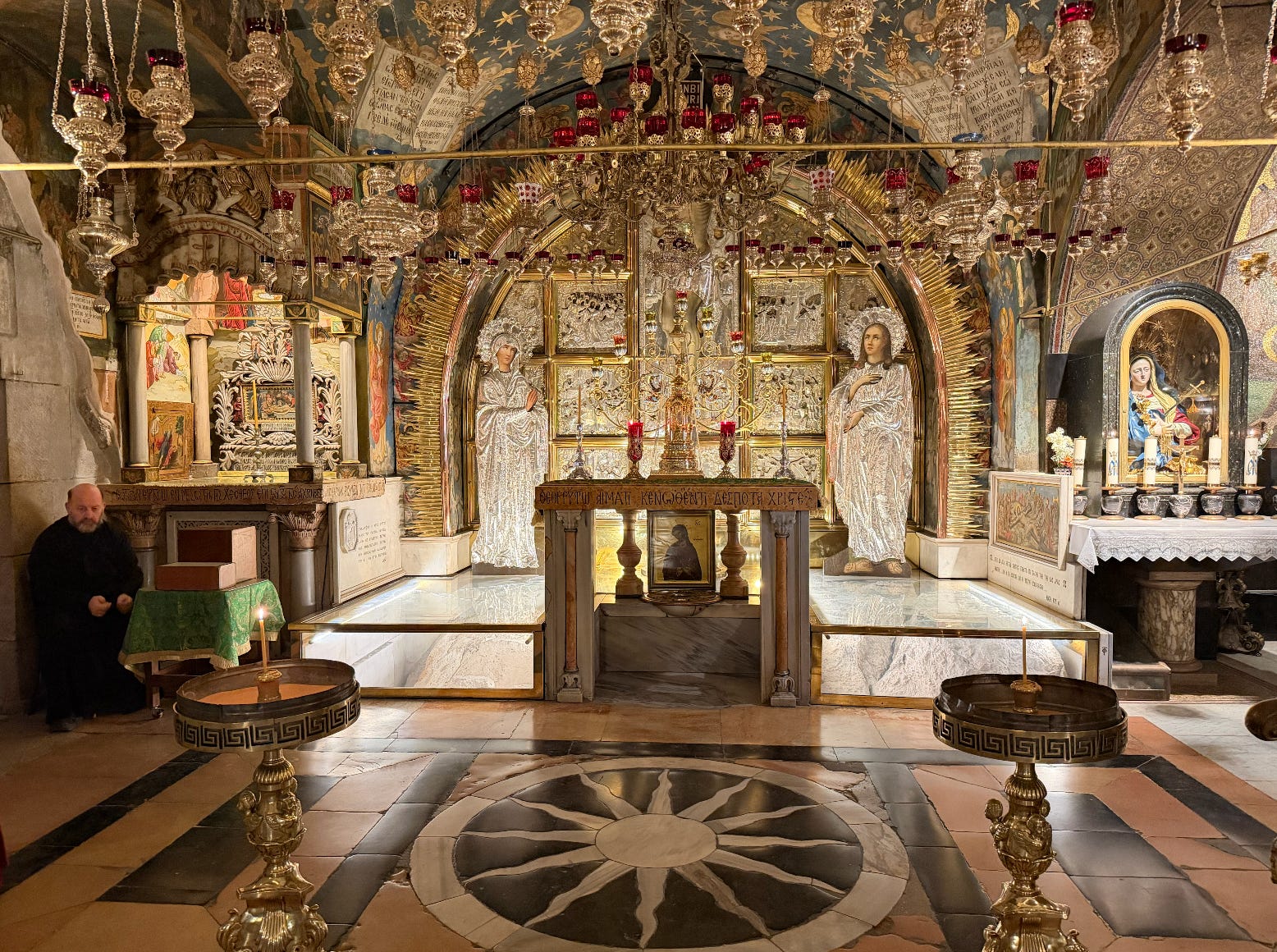
That is the altar built over the top of the hill of Golgotha, where Jesus of Nazareth was crucified, and died. It’s inside the Church of the Holy Sepulcher, in the Old City of Jerusalem. I went there early this morning to pray. The church was largely empty, and calm. I could smell the sweet incense from the church perfuming the narrow alleys of the Old City even before I arrived. The aroma of incense and the smell of za’atar — that’s Jerusalem’s Old City.
I prayed for you all there at the altar. I really did! Whatever the intentions of your heart, I offered them to the Lord. It felt good. There is nowhere like Jerusalem on earth — a banal thing to say, but if you are a Jewish or Christian believer, this is the most important city on earth. I tell you, there is nothing like seeing and touching the places where Jesus of Nazareth, and other men and women of the Bible, lived and breathed and walked (and, in the case of Jesus, died and returned to life).
I also prayed for everybody inside the “edicule,” the large stone box build over the Tomb of Christ. Here it is from the outside:
I took this photo after I finished praying outside, for you all.
After, I stopped by Zack’s Jerusalem Gifts, a little antiquities shop in the Old City, not far from the Church, to visit my friend Ian Norton. You’ll remember him from *Living In Wonder. *He’s the London junkie who came to Israel around 30 years ago, looking for drugs. Eventually he was desperate to kick the habit, because he knew he would die otherwise. He made his way to the banks of the River Jordan. He had no faith, and no knowledge of the Christian faith. He experienced an extraordinary miracle there (I give the details in the book), made his way back to Jerusalem, and begged for food. A pastor found him, invited him to the mission. Eventually Ian was baptized, and started his new life. He never left Jerusalem.
He’s doing very well! We talked for a bit about a conversation I had last night at the conference with some English friends, all of whom were very downcast about the future of their country. Ian said this is actually a blessing, because, in his view, his people need to suffer to be brought to their knees, and return to God. Nothing else will do it. After I left the Old City, I ran into one of my English friends back at the conference hotel, a devout Christian. I told him about the conversation with Ian. He agreed, but said the signs of religious revival in Britain are so weak. He said that the need for church leadership is desperate, but the institutions are feeble. Yet he is fighting the good fight. What else is there?
Before I went back to the conference, I stopped by Razzouk, the centuries-old tattoo shop run by a Coptic Christian family. I went with a Catholic priest friend, who is also a past customer of the shop. I got a Byzantine cross tattoo there in 2022, during Holy Week. I never thought I would ever get a tattoo, but being in the Holy City during Holy Week, and getting used to the new reality I was living in (my wife annoucing to me by email that we were divorcing), I decided to get a cross tattooed on my arm, with the letters IC XC NI KA — meaning, “Jesus Christ Conquers”. I wanted to mark in my flesh my conviction that even though I was at the lowest part of my life, through Christ, I would come through it.
Would I get another tattoo now that I was back in town? Reader, I did. This is an unusual one: it’s part of the Trisagion Prayer, in Aramaic, the language spoken by Jesus. It’s written in Syriac script. The words are: “Holy God, Holy Mighty, Holy Immortal.” In transliterated Aramaic, it sounds like: “Qadeeshat Aloho, Qadeeshat Hyeltono, Qadeeshat Lomoyouto.” I know this because when I lived in Brooklyn from 1999 till 2003, my family and I worshiped at the Maronite cathedral. Maronites are Lebanese Catholics; we were Catholics in those days, and started attending mass at the Maronite cathedral because we were longing for a more reverent mass. They welcomed us. The Maronite liturgy uses Aramaic in parts — including the great and ancient prayer of the Christian East, the Trisagion.
In my memory, one of the most precious sounds is hearing that dear old Monsignor Ignace Sadek, our pastor, chanting this prayer at the altar in the language of Our Lord. I have continued to pray it, in Aramaic, over the years, chanting according to the melody Monsignor (and all Maronites) use. We Orthodox also use the Trisagion prayer, but I first heard it an Aramaic, in the voice of that holy old priest who is almost certainly now a saint (though he may never be canonized). So, I know have the Trisagion inscribed into my arm, in Aramaic (Syriac):
I’ll show it to you up close in a few days, when the redness goes away. The Trisagion is one of my favorite prayers, and the Aramaic version is very close to my heart, because Monsignor Sadek taught it to me, in the happiest time of my life.
And that’s how I spent my morning.
Today is the anniversary of the 2023 mass terror attack by Hamas on Israeli settlements. This morning, a 58-year-old Israeli cab driver, Gadi, drove me to the Old City. He told me that he doesn’t understand why we in the West don’t understand that the same thing that happened to his country on this date three years ago will happen to Europe too, as soon as the Islamic mobs get the chance. “They hate you Christians almost as much as they hate us,” he said.
I told him I didn’t understand it either.
He went on to say that life in Israel is expensive. “I thought at my age, I wouldn’t have to work so much, but instead, I drive from eight in the morning until eight at night. Money seems to run through my hands. But I love this country. It is my home. I fought for it, and I would die for it.”
This is one thing I see over and over here in Israel: a deep and natural commitment to the nation. In various conversations I have had here this week, this comes out over and over. As one Israeli woman said to me today, “This is our home. We have nowhere else to go.” Her husband added that everybody in this country came here as a refugee or is descended from refugees. They learned from their dreadful history that there is no safe place for Jews outside of the Jewish state. This morning, watching Israeli families walk through the Old City, men wearing yarmulkes, obviously Jewish, I thought about how if they tried that in any western European capital, they could be risking their lives. Just by taking a stroll.
I watched them and thought: this is why there has to be a Jewish state — so these families can live openly as Jews without having to fear violence and murder. There are few places in the world where they can do this, and those places are shrinking. Israel itself is not entirely safe, as the events of this awful date showed. But it’s the best the Jewish people can do. Their state deserves our support.
Today I read this essay by Danny Burmawi, a Muslim who converted to Christianity, and why October 7 radicalized him in support for Israel. He writes:
Golda Meir once said that if the Arabs put down their weapons, there would be peace, and if the Jews put down their weapons, there would be no Israel. As an Arab and a former Muslim, I testify to the truth in that statement. Yes, we were raised to hate Jews, to hate any non-Muslims, but Jews in particular; to wait for the day when trees and rocks would call us Muslims to go find the Jew hiding behind them and kill him. We grew up chanting “Khaybar, Khaybar,” a reference to the massacres Muhammad committed against peaceful Jews who rejected his false prophethood.
After leaving Islam, I realized that Bibi Netanyahu was right to reject what Yitzhak Rabin and his naive school were seeking: fragile peace with people who are determined to end the Jews, not because of what Jews do, but because of who they are.
He says that after October 7, he was sitting on a park bench in the US speaking on the phone in Arabic, when a Jewish woman, hearing his language, hurried away:
I realized that the monster I fled from in the Middle East had made its way to America ahead of me. A Jewish woman, in the heartland of America, was afraid of the same Islam that massacred her people 14 centuries ago and that has been attacking her people for the past 80 years for no reason except religious hatred.
That is when I realized that Islamic jihad had been fully rebranded in America. Jihad, the war that was declared on the entire world by Muhammad and his Allah, had now become, in America, “resistance to occupation” and a “response to imperialism.” That is when I made a decision that educating the American people about the truth of Islam, the Middle East, and this unholy alliance between Islam and the Left was my mission.
The de-converted Muslim Hussein Aboubakr Mansour has a more complicated reflection on the meaning of this day. He surveys the wars throughout the region, and makes clear that things are an impossible mess. It’s well worth reading, because it shows how tangled and unsolvable things are here. He concludes:
In one of his books, Oscar Wilde gives one of his characters the line: “In this world there are only two tragedies. One is not getting what one wants, and the other is getting it. The last is much the worst.” Three years after October 7, every power in the Middle East, and the United States as well, faces one or both of those tragedies. Sinwar wanted a war on all fronts and got one — and died in it. Israel wanted to break the axis that surrounded it, and succeeded, but now finds its army held among the peoples of Gaza, Lebanon, and Syria, who accept none of the new lines. The Gulf states wanted to be left alone to grow rich and have not been. The United States has wanted for fifteen years to leave the region and has not been able to; now it has got what American hawks sought for a generation — a war with Iran. Some of them have got what they wanted, and some have not. Wilde’s character was sure that getting what one wants is the worse tragedy; the governments of the Middle East, and the government in Washington, will find out for themselves whether he was right.
One more thing: I simply cannot understand how people outside of Israel can see what Hamas did on that day, and fault Israel for its response — especially given that Hamas deliberately embedded its military installations among Gaza civilians. Mansour points out that Yahya Sinwar, the mastermind of Hamas’s attack, understood that Israel would go to war, and it would have to destroy much of Gaza to prevail — and that this destruction would cause the world to turn on Israel. He was prepared to sacrifice tens of thousands of Gazan lives to fulfill this goal — and it worked.
It seems to have done something that even Sinwar couldn’t have imagined: opened the West to Islamism. I would have thought October 7 would wake the West up to what Islam in power among us means. It did not. Gadi the cab driver said, “Who is killing people with terrorism? Is it the Christians? Is it Jews? Is it Hindus? No, it’s always Muslims. Don’t people see that?!”
I had no answer for him.
Last word, from Ahmed Fouad Alkhatib, who calls out his own side. He says since October 7, he’s seen many Zionists criticize Israel’s response. But so far, nothing from the Palestinians or their supporters about Hamas. Excerpt:
Three years after October 7, the Palestinian people face their greatest crisis of the modern era.
I begin on the ground, in Gaza itself. The majority of Gaza’s buildings are partially or fully destroyed. Tens of thousands have lost their lives, including entire families wiped out by ferocious Israeli bombardment. People will argue to the moon and back about who was ultimately responsible for the level of devastation in Gaza. I personally believe Israel killed far too many civilians, including dozens of my own family members. Israeli air strikes destroyed both of my childhood homes. I will never not be angry or upset about this.
But I will also forever be furious at the fact that Gaza would still be standing had Hamas simply kept its terrorists at home on October 7. I will forever be rageful at the fact that Hamas not only weaponized every aspect of Gaza’s infrastructure but also held Israeli hostages in a manner that was inevitably going to invite more devastation and suffering for Palestinian civilians. I will forever be resentful of the useful idiots who ignored Hamas’s sadistic tactics, hiding behind vacuous appeals to “international law” despite there being no legal framework to justify a terrorist group entrenching itself in medical facilities, educational spaces, markets, and areas meant to shelter the displaced.
Now there’s a Nine Books list. Here’s mine:
These aren’t the “best” books I’ve ever read. “Anna Karenina” and “Kristen Lavransdottir” would be on that list, for example. But these are nine books that really landed hard with me when I read them, and shaped my life in real ways.
Let me give you short reasons why I chose these:
“Laurus”: a magical-realist evocation of the Russian Middle Ages, and the spirit of Russian Orthodoxy. An Evangelical Christian reviewer said he didn’t see Jesus anywhere in this novel. Really? To Orthodox eyes, Jesus is everywhere.
“The Seven Storey Mountain”: I read this book when I was 18, and it opened up the world of Catholicism to me, which I had only glimpsed the year before at Chartres. Thomas Merton, in college, was a lot like me: literary and louche. But he found his way to Catholicism, and then to the monastery. Traveling the road with him opened up new paths for me at a critical period of my life.
“A Confederacy Of Dunces”: What more can I say about this comic masterpiece? Let’s just say that it crystallized in me awareness of the basic comic absurdity of life, and of human nature.
“The Matter With Things”: Iain McGilchrist’s brilliant magnum opus about the brain and reality shook me to the core. I’ll be re-reading it for the rest of my life.
“Secondhand Time”: This long oral history of the former Soviet Union in the 1990s is unforgettable. It tells the story of the fall of a great and terrible empire through the eyes of ordinary people. It taught me how quickly things can fall apart, in ways that can’t be predicted — and how even a good thing (the fall of the Evil Empire) can have terrible consequences for ordinary people, who can lose all sense of order and stability. You want to know where Putin came from? Read this book. You want to know why American radicals of Left and Right who talk about wanting to overthrow our system are dangerous fools? Read this book.
“The Deptford Trilogy”: The Canadian novelist Robertson Davies is a forgotten, or at least under-appreciated, wonder. This trilogy begins the with effects of a carelessly thrown rock, and how they ripple through the lives of many people. It’s tremendously entertaining, and his use of Jungian psychology is fascinating while not being oppressive.
“Flannery O’Connor: The Complete Stories”: Aside from being terrific stories, O’Connor’s work was the first time I encountered true literature made from the lives of people I recognized, people like those I grew up among in the rural Deep South.
“The Mountain of Silence”: Kyriacos Markides wrote a book that’s basically an extended interview with an Athonite monk about Orthodox spirituality. I read it when I was exploring Orthodoxy, and it made me realize that Orthodox Christianity was what I had been searching for since the day I walked through the door of Chartres. I re-read it n…