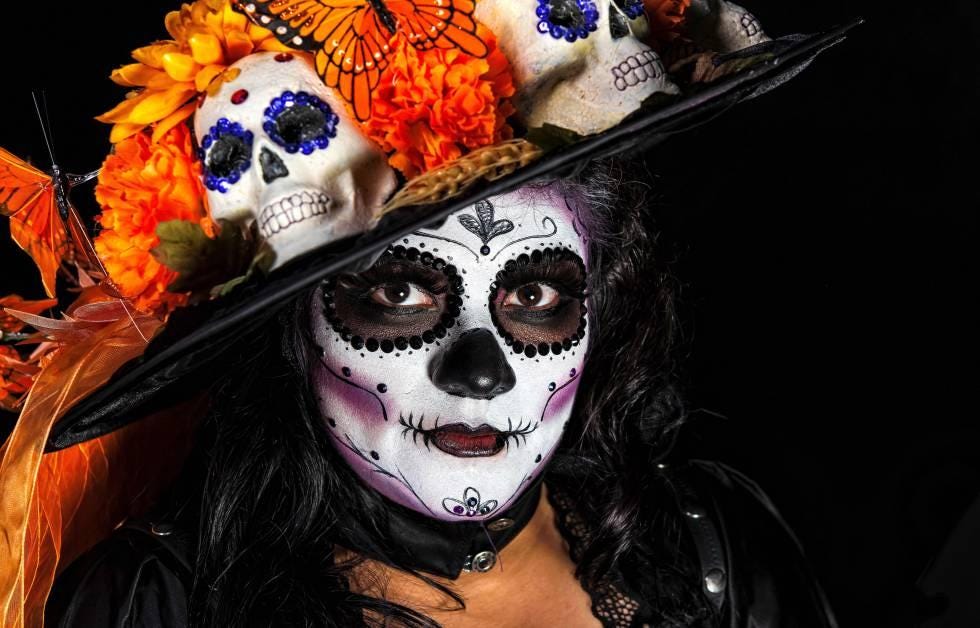
Tomorrow is Halloween, and in some Mexican communities, observances welcoming the dead are also beginning. Día de Muertos extends across several days, with dates and practices that vary by place and tradition. Their proximity on the calendar invites confusion, but it also opens a question worth carrying into this weekend: what place do the dead have in the lives we are still living?
Someone remembers how they liked their coffee. A photograph is brought out, a favorite dish prepared, and a place made for a person who will not walk through the door in the ordinary way again. Death has ended their ability to arrive, but the household is still arranging itself around their existence.
Across many Mexican communities, preparations for Día de Muertos give such acts a place in the calendar. Flowers, candles, food, photographs, and visits to graves become part of welcoming and remembering particular dead people. The offerings attend to their tastes, their identities, and the relationships through which they remain known.
What arrests my attention is the specificity. Death readily becomes an abstraction in the hands of people who explain it for a living. Here is someone’s preferred meal, insisting that the person being remembered had an appetite.
My former religion supplied an account of where the dead had gone. Leaving it exposed a question that the account had often answered before I understood what I was asking: what do we do with our love when the person is no longer available to receive it?
A skull does not tell you what a community is doing with death. Its meaning depends on whose hands made it, where it is placed, and what people gather around it to do.
The proximity of Halloween and Día de Muertos on the calendar makes their imagery easy to combine, especially in a marketplace that sells cultural differences from the same seasonal aisle. Understanding them requires looking beyond the decorations.
Halloween’s history includes Celtic seasonal traditions associated with Samhain, Christian observances surrounding All Saints, and centuries of changing customs. Its name comes from All Hallows’ Eve, the evening before All Saints’ Day.
Costumes, visiting households, mischief, and encounters with the supernatural developed through that complicated history, eventually taking forms familiar in contemporary celebrations. Reducing Halloween to a commercial fascination with horror obscures its own relationship with the dead.
Día de Muertos developed in Mexico through Indigenous practices concerning the dead and Catholic observances introduced under Spanish colonial rule. All Saints’ Day and All Souls’ Day supplied the November calendar, while communities sustained and transformed their ways of receiving, remembering, and honoring deceased relatives.
Its history includes the enforcement of Catholicism under colonial rule, alongside Indigenous efforts to preserve and adapt their traditions. Regional differences remain substantial, resisting any claim that every Mexican family observes the same tradition or understands death identically.
The contrast becomes clearest in the attention given to particular people. Much contemporary Halloween imagery presents an anonymous dead: a skeleton, a ghost, a body rising from a grave.
An ofrenda - an offering arranged to honor and welcome deceased loved ones - often includes photographs, candles, flowers, and foods the person enjoyed. These offerings gather around someone remembered by name. For many participants, these preparations welcome returning souls; their religious meaning deserves to be taken seriously, even by those who do not share the belief. Calling this Mexican Halloween misses the relationship being enacted.
It would be equally careless to conclude that one tradition fears death while the other has overcome it. A candlelit grave does not establish that the person tending it is unafraid, and celebration does not make a loss painless.
What draws my attention is the work of making room: death has occurred, yet a name is spoken, food is prepared, and the relationship receives another occasion for expression. That leaves me asking what forms of remembrance remain available when certainty about the dead has disappeared.
For someone leaving Christianity, a death sometimes becomes newly painful years after the funeral. The person has already been lost, but now the promised reunion becomes uncertain, too. A consolation that once helped hold the loss has ceased to be believable.
This deserves more care than either side of the religious argument routinely gives it. Telling someone that their loved one is certainly in heaven asks them to accept a claim they no longer trust. Announcing that death is final and they should accept reality treats a philosophical conclusion as though it settles how a person is to live with grief.
What is lost is more than an explanation of death. There was going to be another conversation, another embrace, an opportunity to know one another beyond the damage or incompleteness of this life. Someone who loses that expectation loses an imagined future with a person already gone.
I know the religious vocabulary that enters such moments. Years in ministry made me familiar with the explanations, the reassurances, and the impulse to place a loss inside a story large enough to contain it. I have become more cautious about what an explanation is entitled to do at the bedside or the grave.
An honest admission of uncertainty leaves the relationship requiring attention. You still love the person, still find yourself turning toward them, and still encounter situations that their presence would have changed. Whatever your position on an afterlife, these are facts of the life you are living now.
A person should not have to manufacture conviction to give that experience expression. Speaking a name, preparing a meal, or keeping an object is not inherently a declaration about the structure of the universe. Such acts also express what someone’s existence has meant within yours.
There is something philosophically disruptive about remembering a dead person through their favorite food. It interrupts our tendency to turn them into a lesson. Before they became an example of courage, a guardian angel, or a reminder to cherish life, they were someone who preferred one thing on their plate to another.
Mexico’s ** National Institute of Indigenous Peoples **describes
My reflection begins there, without claiming that this exhausts the meaning of the offering. Love contains knowledge of details that a general tribute cannot supply. You knew how someone took their coffee, which story would make them laugh, and what they would move to the edge of the plate.
Those details resist the polished person who sometimes emerges after death. An obituary compresses a complicated life into acceptable virtues. A family establishes which stories are suitable for repetition, and the person gradually becomes easier to praise and harder to recognize.
The small particularities restore some resistance. They return us to someone who had a temperament, occupied space, and occasionally made dinner difficult. Remembering them honestly protects the relationship from becoming a monument that no longer resembles its subject.
This also raises an uncomfortable question about the living. How much do we actually know about the people we claim to love, beyond the roles they perform in our lives? Their future photograph should not become the occasion on which we finally grow curious about them.
Remembrance has its own forms of dishonesty. A person dies, and the family is suddenly expected to agree that they were kind. The people who experienced something else discover that accuracy is now considered an injury to the deceased.
Death does not revise conduct. Someone who was generous to neighbors might have been cruel at home. A parent’s sacrifices might coexist with injuries their child is still learning to name. Grief often contains incompatible feelings because the relationship itself contained incompatible experiences.
Making a place for the dead therefore requires judgment about what sort of place is appropriate. Some people deserve tender remembrance without reverence. Others are remembered through boundaries the living finally have the freedom to maintain.
No one owes a deceased person an altar, an affectionate story, or a declaration of forgiveness. A practice of remembrance becomes another instrument of control if it requires the injured to surrender their account of what happened. The dead are beyond correction; the living still bear the consequences.
Honest remembrance also refuses the opposite simplification, in which a person becomes nothing but the worst thing they did. Where complexity is bearable, it deserves room. Where closeness remains destructive, distance deserves respect.
The aim is a relationship with the past that permits reality to enter. Sometimes that means recovering gratitude from beneath anger. Elsewhere it means allowing anger to disturb a gratitude that was demanded too soon.
A funeral gives a death an appointed time and place. Afterward, daily life often requires the bereaved to carry what follows through settings that have no language for it. The work meeting begins, groceries need buying, and the person whose absence has rearranged everything becomes someone no one mentions.
Others are frequently trying to be considerate. They fear bringing up the name will cause pain, without realizing that the person remembering has already encountered that pain repeatedly before breakfast. Silence protects the conversation from discomfort while leaving the bereaved alone with the work of remembrance.
A recurring observance makes a different social arrangement imaginable. The calendar acknowledges that the relationship will require attention again. People do not have to invent an excuse for remembering someone whose death is no longer recent.
Día de Muertos carries religious and communal meanings that exceed this observation. Still, its visible preparations draw my attention to a public question: what structures help a community remain in relationship with its losses? A private capacity to endure grief is a poor substitute for places where grief is permitted to be shared.
This belongs within my work in existential health. Our relationship with mortality develops partly through the responses available around us. Someone whose loss is acknowledged inhabits different conditions from someone expected to demonstrate recovery by becoming silent.
A community reveals its understanding of human life through what it makes room for after the funeral. If the dead become unmentionable, the living learn to conceal part of the relationship that formed them.
There is a danger in saying that people live on through memory. Intended as consolation, the phrase sometimes assigns survivors an impossible responsibility. A person fears that forgetting a voice, missing an anniversary, or laughing through an afternoon amounts to allowing the dead to disappear again.
Memory is vulnerable. Photographs are lost, stories change, and the last person who knew a particular gesture eventually dies. No individual memory is adequate to preserve the whole of another person, and grief should not be made into a failed conservation project.
An existence does not become worthless because its traces grow faint. Most human lives will never receive a durable public record. The care someone gave still entered another life; a kindness altered an afternoon; a child was fed. Those events took place without requiring an everlasting witness.
Public remembrance poses a different question because institutions choose where attention goes. Some deaths receive ceremonies, official language, and names engraved in stone. Others arrive as a number, or become difficult to discuss because doing so would require questions about responsibility.
Dying is shared by everyone, but exposure to preventable death is not evenly distributed. Neither is the power to have a death publicly acknowledged. An honest encounter with mortality has to leave room for the difference between accepting that humans die and accepting the conditions under which particular people were allowed to die.
Remembrance then becomes more demanding than sentiment. To restore a name is sometimes to reopen a question that others would prefer to regard as settled. Grief enters public life carrying a claim about whose existence deserved attention in the first place.
It is possible to acknowledge that everyone dies while living as though your own death remains negotiable. Mortality receives intellectual agreement without being allowed much influence over how you understand yourself. You know the fact, yet continue imagining the future as a resource that will replenish itself.
The deaths of others sometimes interrupt that arrangement. Someone your age dies, a diagnosis enters the family, or a familiar voice becomes a recording you will never hear supplemented by another sentence. For a moment, death loses its distance. What happened to them belongs among the possibilities of your own life.
Mortality is one of the givens of the human condition that my work in existential health asks us to encounter directly. Our lives have limits that no degree of goodness, vigilance, knowledge, or accomplishment removes. We exercise considerable influence over how we live without acquiring final authority over how long we remain.
Accepting that condition requires more than repeating that death is natural. Many natural things frighten us, and understanding the biology does little to settle the thought of leaving someone we love. Fear deserves a place in an honest relationship with mortality, alongside grief for experiences we will miss and concern about what dying will involve.
Death acceptance does not require welcoming death or becoming emotionally undisturbed by it. It involves allowing the reality of our finitude into decisions and conversations we would otherwise organize around its exclusion. We remain invested in living while relinquishing the demand that life guarantee our continued presence.
Religious certainty sometimes helps people face this limit, and sometimes places it beyond examination. The promise of another life offers reassurance, but it also risks making this life seem like a preliminary arrangement whose unfinished business will eventually be resolved elsewhere. Leaving that promise behind brings us into contact with the possibility that some conversations will remain incomplete.
Secular lives have their own evasions. A person pursues perfect health as though sufficient discipline will establish immunity, or seeks a legacy substantial enough to compensate for disappearance. Worthwhile commitments become burdened with an impossible task when we ask them to secure us against being mortal.
A healthier relationship with death permits practical care without the fantasy of exemption. We discuss our wishes, attend to responsibilities others would inherit, and make room for conversations whose difficulty has kept them postponed. Such acts acknowledge that our absence would have consequences for people whose lives will continue.
Something changes when death is admitted into the life we are living. The future remains worth preparing for, but it no longer serves as the place where we deposit everything that makes the present bearable. We begin taking seriously the person whose company is available now, the commitment awaiting our participation, and the life that will remain finite however carefully we live it.
Death is regularly recruited into the business of self-improvement. Remember that your time is limited, we are told, and you will finally prioritize correctly. Mortality becomes an executive consultant with a skull on the business card.
For someone already exhausted by the demand to justify their existence, this advice adds another supervi…