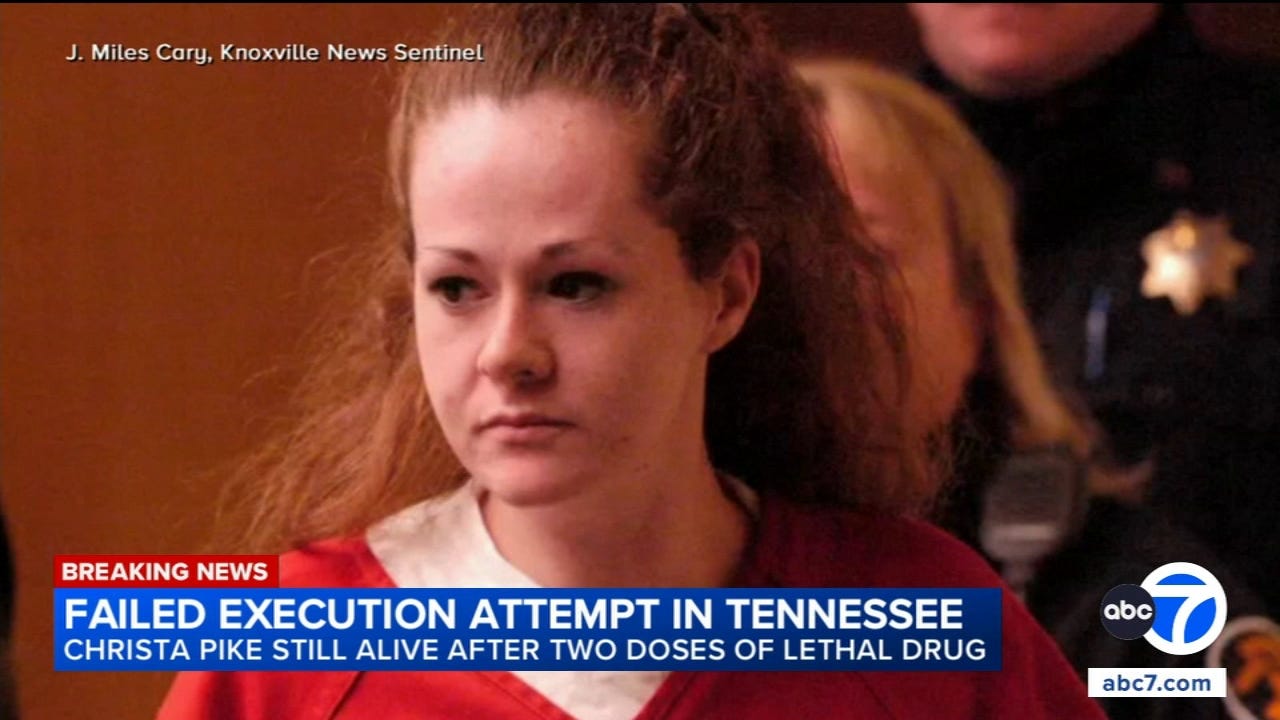
Let me start with Colleen Slemmer.
She was 19 years old when Christa Pike and her boyfriend killed her. Colleen should have had decades of life ahead of her. Her mother has had to live with that loss for more than thirty years, and she supported Pike’s execution. I’m not going to tell that woman what she should feel about the person who killed her daughter. apnews.com
I also can’t look at what Tennessee did Wednesday night and call it justice.
Pike was strapped to a gurney and asked for her last words. She said she would leave the world as she believed she had spent much of her life: “in love.” The state gave her a lethal drug. She remained alive. It gave her a second dose. She was still breathing and was taken to a hospital. Governor Bill Lee has halted Tennessee’s remaining execution this year and ordered a review. apnews.com
Think about that for a second. The state told a woman it was time to die, began killing her, couldn’t finish the job, and then had to get her medical care.
And Colleen’s family, who had already endured the murder and decades of appeals, was left to witness this mess. They deserved better, too.
Don’t get me wrong. I worked in law enforcement. I know people are capable of horrific violence. There are people whose crimes make me think, Yeah, I understand why someone would want them dead. If you murdered my family member, I can’t promise I’d feel any differently.
But that feeling is exactly why we have to ask what powers we give the state.
I don’t have to feel sympathy for every convicted murderer to oppose executions. I have to decide whether I trust our justice system to get every critical decision right—from the investigation, to the conviction, to the sentence, to the moment somebody puts a needle in a person’s arm.
I don’t. I’ve seen enough of the system to know better.
Tennessee’s Department of Correction says it followed its approved execution protocol. Well, that makes me feel worse. If they followed the fucking protocol and Pike was still alive after two doses, then what protection did that protocol provide? Officials have not yet explained why the procedure failed. This was also Tennessee’s second execution attempt this year that it could not complete. apnews.com
People like the phrase lethal injection because it sounds clean. Medical. Controlled. Wednesday night was a reminder that giving an execution the appearance of a medical procedure doesn’t make it merciful.
I would rather have a thousand people convicted of murder spend the rest of their lives behind bars than put one person through a botched execution like that.
Pike has acknowledged killing Colleen. I’m not suggesting she’s innocent. But her failed execution forces a larger question: Why do we keep giving an imperfect system a punishment it can never take back?
The Death Penalty Information Center counts 203 people exonerated after being sentenced to death since 1973. That’s 203 people who might have died for crimes they did not commit had their errors not been uncovered in time. deathpenaltyinfo.org
As a former cop, that number gets to me. An investigation can go wrong. A witness can be mistaken. Evidence can be mishandled. A prosecutor can decide a theory is right and stop looking hard enough at anything that contradicts it. And yes, sometimes people in positions of authority lie.
A prison sentence cannot give back the years taken from an innocent person. But while that person is alive, there is at least a chance to find the mistake and let them out. Once the state executes them, that chance is gone.
So here’s where I stand: I’d rather see a thousand guilty murderers serve life than have the government execute one innocent person. I can live with the first outcome. I could never defend the second.
Pike was 18 when she killed Colleen. Her lawyers have pointed to her age, mental illness, and history of abuse in asking that her death sentence be commuted to life in prison. Those facts don’t excuse what she did. Colleen was only 19, and she never got a chance to become the person she would have been at 50. apnews.com
But a mitigating circumstance isn’t a get-out-of-jail-free card. It’s part of deciding which punishment is just.
I think about how many people enter the incarceration pipeline after growing up surrounded by poverty, violence, neglect, and schools that gave up on them. How many were never given a believable path to a safe life and honest work? We don’t get to ignore all of that until somebody commits a terrible crime and then act as though the only question worth asking is how severely we can punish them.
Pike is responsible for killing Colleen. Full stop. We can hold her responsible for the rest of her life and still ask whether the failures that shaped her life mattered when the state decided to end it.
Pike said she was leaving this world with love. I can hear somebody responding, “Bullshit.” I get it. Her words cannot undo Colleen’s murder. They cannot require Colleen’s mother to forgive her. Pike has said she regrets what she did and is no longer the person she was at 18; whether her family finds that meaningful is up to them. dpw.lawschool.cornell.edu
What her words did was remind me that this was a human being on that gurney. She believed she was about to die. Then the state put her through a prolonged execution attempt and she lived through it.
We can keep Pike confined for life. She can be held accountable every day she remains there. Where possible, she can work and be of service to other people without anyone pretending that makes up for the life she took. Colleen will never get those years back, whatever punishment the state chooses.
I understand why her loved ones wanted the sentence carried out. I won’t pretend a life sentence will necessarily bring them peace, either. But after watching Tennessee fail to kill Pike and then call for a review of what went wrong, I’m left with this question: What would another killing give Colleen’s family that a lifetime of accountability cannot?
The state has shown us how badly it can get even the final procedure wrong. The rest of our justice system has shown us that it sometimes gets guilt wrong, too. That’s enough for me. I don’t want the government exercising a power whose mistakes no one can repair.