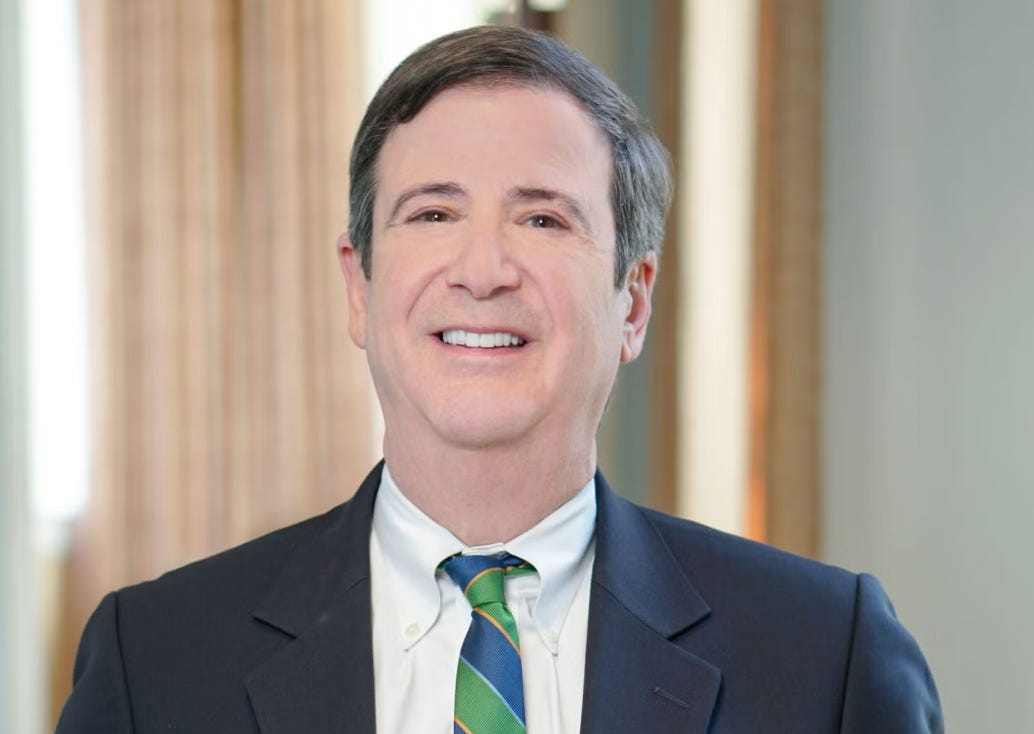
Friends, sharing today a recording from the live discussion we held a few days ago with my old friend, Dr. Rob Shapiro. This is a long and comprehensive discussion about the economy, where it is headed, and how Democrats should be approaching it when we return to power next year. Rob and I also spend time talking about how a Democratic Congress should be thinking about dealing with a wounded, rejected, lame duck in the White House.
In that regard I view this conversation as a companion to my discussion with Rep. Adam Smith, the Ranking Member of the House Armed Services Committee. In that conversation we talk about how Democrats should be thinking about our national security policy next year, the wars, and also about how to approach dealing with Trump:
Here are some highlights from my conversation with Rob:
You know, Richard Nixon, one of the things he said was that it didn't matter so much what you did with the economy because the economy is so big, so strong, so solid. And that's generally true, so long as the policies aren't stupid. You can damage an economy with a series uninformed and stupid decisions. And that describes the economic policy of this administration.
We had substantial deficits. And the first thing [Trump] did was essentially ensure that we would have much bigger deficits for the next decade. Deficits equal to 6% of GDP. In the midst of an expansion, you know, not at the depths of a recession. Well, does that matter? Well, the reason it matters is because the entire economy lives on credit. Every individual lives on credit. We live on credit cards. We live on mortgages. Businesses live on credit for investment and the government lives on credit. But when the government is claiming 6% of GDP for its deficit, that means there is not only less for everybody else, but what is there costs more. Because there's less of it. It's supply and demand. And once you get into a syndrome where interest rates are tending up, the economy slows.
More from Rob:
It’s a series of totally uninformed decisions that come from his gut and his obligations to cut taxes for the wealthiest people in the country and his predilection for doing so. And, you know, the unspoken message from all of these policies, and certainly from the result, is he doesn’t care about Americans. He doesn’t care about the daily life of Americans. And no hint of course correction, which is another sign of a failed presidency. A president incapable of change, of modifying course, in the face of results which didn’t come in as the president expected? I have never seen a presidency so failed so quickly.
He's a sociopathic narcissist. And narcissists are incapable of admitting they're wrong. Because if they do, it threatens their sense of themselves that they have to be always right. And so I think part of this is his psychopathology.
Look, his mental capacity is deteriorating. His emotional coherence is deteriorating. And that makes him, on the one hand, more volatile and unpredictable, and on the other hand, perhaps easier to manage. The Democrats, we take both houses of Congress and we have divided government. We do not have unified government. We have to deal with him. And our charge is to do as much as we can for the American people. Even if Donald Trump gets to share in part, you know, gets to share in the benefits, the political benefits of that. The country knows who he is. The country knows what the Republican Party has become. And the country will know that Democrats were driving this. But, you know, a lot of politicians see politics as war. He's someone who has seen governing as war. We cannot fall into that and do the same.
Friends, enjoy these two conversations with important thought leaders not about the 2026 election but what comes next, share them with others, offer your thoughts below, and keep working hard all. For we have a country to save, and elections to win all across the country this November, together! - Simon
Robert J. Shapiro, a Washington Monthly contributing writer and a Senior Fellow at the McDonough School of Business at Georgetown University, is chairman of Sonecon, LLC, a private firm that advises U.S. and foreign businesses, governments and nonprofit organizations. Shapiro has advised, among others, Presidents Bill Clinton and Barack Obama, U.K. Prime Minister Tony Blair, and numerous members of the U.S. and U.K. cabinets and U.S. Congress; private firms including AT&T, Exxon Mobil, Google, Gilead Sciences, Nasdaq, Nordstjernan of Sweden, and Fujitsu of Japan; and nonprofit organizations including the International Monetary Fund , the U.S. Chamber of Commerce, and PhRMA. He also is a director of Overstock.com and an advisory board member of Civil Rights Defenders, Cote Capital, and the Pricing Carbon Initiative.
From 1997 to 2001, Shapiro was U.S. Under-Secretary of Commerce for Economic Affairs. In that position, he directed economic policy for the Commerce Department and oversaw the nation’s major statistical agencies, including the Census Bureau while it planned and carried out the 2000 decennial census. Prior to that appointment, he was co-founder and vice president of the Progressive Policy Institute and legislative director for Senator Daniel Patrick Moynihan. He was the principal economic advisor to Governor Bill Clinton in his 1991-1992 presidential campaign and a senior economic advisor to Albert Gore, Jr., John Kerry, Barack Obama, Hillary Clinton and Joseph Biden in their presidential campaigns. Shapiro also has been a fellow of Harvard University, the Brookings Institution, the National Bureau of Economic Research, and the Fujitsu Institute. He holds a Ph.D. and M.A. from Harvard University, a M.Sc. from the London School of Economics and Political Science, and an A.B. from the University of Chicago.