Good morning and welcome to Vittles! In today’s essay, Juliet Jacques attempts to escape the tyranny of planning and making meals by eating meal replacements for a week – and has some surprising realisations.
Our third print issue, ** The Influencers** contains a discussion between
There are 3 days left to complete our reader survey if you have five minutes to spare (free subscribers should complete this survey, while paid subs should complete this one). The survey will remain open until 15 October.
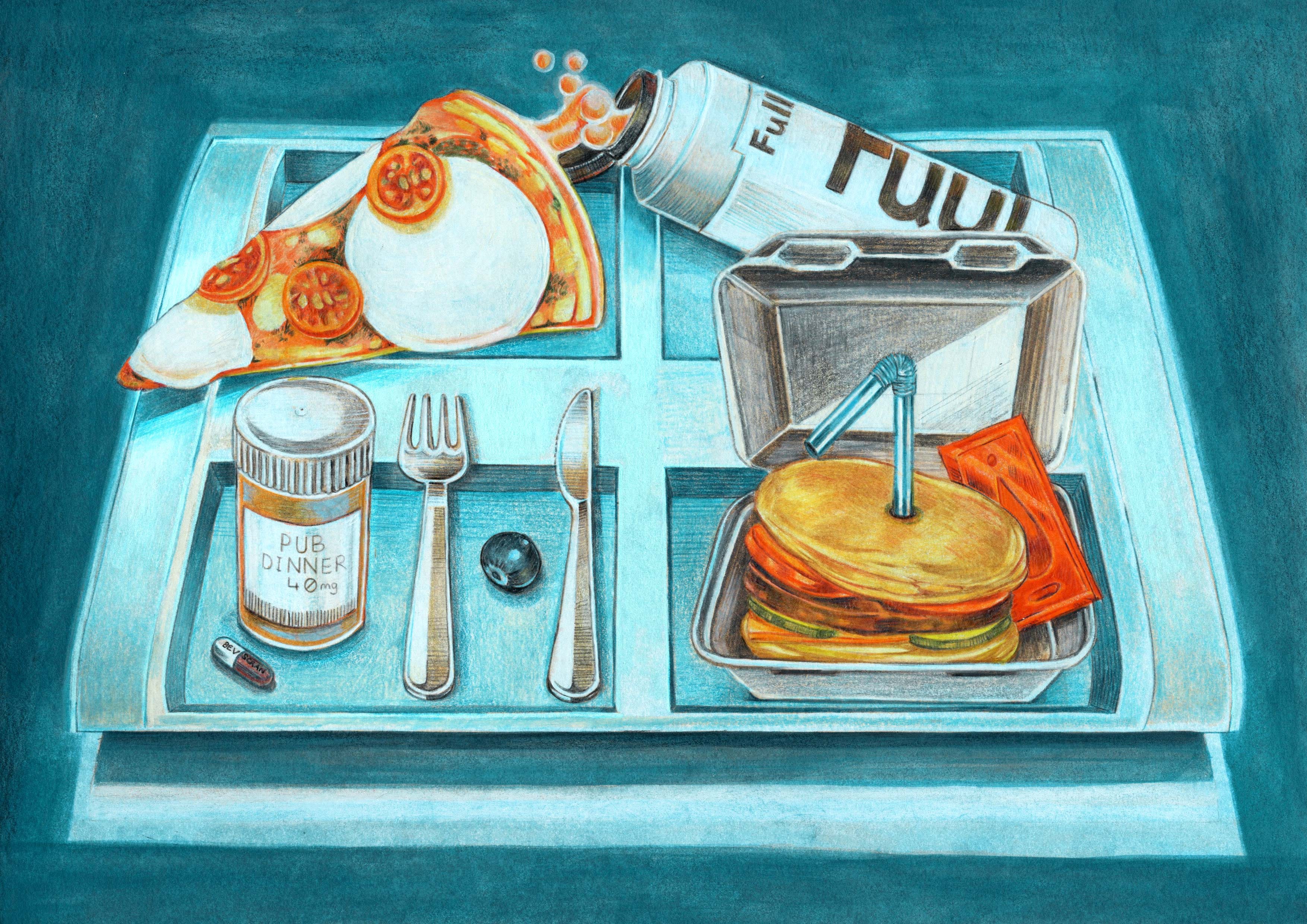
Juliet Jacques attempts to liberate herself from thinking about what to eat. Illustration by Sing Yun Lee.
It’s not that I don’t like food. It’s that I resent having to decide what to eat three times a day, and that I absolutely *hate *cooking. This means I often eat things that are boring at best and spend an absurd amount of money to eat very badly. I live on a diet of supermarket sandwiches, takeaways that I pretend are healthier than they actually are, junk food in pubs and ever more expensive dinners in restaurants across London. I am so averse to food preparation that I never even take a sandwich to work.
This surprises people, as I treat most things, especially my cultural interests – literature, film and music – as high art. My disdain for mass entertainment (Hollywood, contemporary pop) drives friends to distraction, but it contrasts starkly with my tendency to live off ready-made pizza or things from a van outside a football ground. I find myself unable to take even a basic interest in nutrition, and I’ve often thought it would be great if we could escape the need to think about meals entirely. What might we do with the time, money and energy this would free up?
I’ve often thought it would be great if we could escape the need to think about meals entirely. What might we do with the time, money and energy this would free up?
Food substitutes in the Western world are nothing new. In a series of articles published in the run-up to the 1893 World’s Fair in Chicago, the American suffragette Mary Elizabeth Lease suggested that synthetic food would liberate women from the obligation to feed their families and ‘furnish men with substance for days’. In the end, meal replacements were designed to help women conform to established beauty standards rather than to escape housework, with weight-loss products such as Mead Johnson’s ‘Metrecal’ – a powder containing ‘the essential nutrients of protein, carbohydrate, fat, vitamins and minerals’ – launched in the US in September 1959. However, in recent years, meal replacements have been recalibrated as something to help everyone, especially busy men, deal with an ever more demanding work life.
I’ve long wondered if replacements such as Huel might help with my reluctance to put effort into making meals, and if they might even improve my atrocious diet. Would they be more appealing than putting time into cooking or money into restaurants? I resolved to eat meal replacements for a week, putting aside their histories and politics, in an attempt to find out.
I resolved to eat meal replacements for a week, putting aside their histories and politics, in an attempt to find out.
My first reference point for food substitutes was Richard Fleischer’s film *Soylent Green *(1973), which is set in a dystopian 2020s, when global warming and pollution have left a population in squalor and subsisting off processed food wafers made by the Soylent Corporation. *Soylent Green *isn’t widely watched now, and its plot twist is less famous than the one in Planet of the Apes (which also starred Charlton Heston), but it was well known enough at the time that it discredit the concept of food substitutes for a generation. My second reference point has been the American tech bros who have helped to make the 2020s so dystopian, with their insistence on rushing or automating the pleasurable things in life – from watching films at 2x speed (hilarious to me, as a Béla Tarr fan) to using AI to make art so they can devote the time ‘saved’ to ‘productivity’. Huel has become an avatar of that mindset, and the last thing my friends would imagine me consuming. So, of course, that was the first one I tried.
I’d never noticed the range of time-saving bars, powders and drinks in the supermarket before, and had to work out which were meal replacements and which were supplements. I spent £3.95 on Huel’s blueberry-flavoured Black Edition, which promised a ‘Complete Meal’ containing 26 vitamins and minerals, 35g of protein and 6g of fibre: healthier and cheaper than the sandwich, crisps, chocolate bar and fruit juice I’d usually buy for lunch. I drank it slowly, and it tasted as I expected – like a smoothie that was letting you know it was Good for You – but with less aftertaste than anticipated. It was less depressing than I imagined, too – a palatable substitute for a solo lunch. All afternoon, I wanted to eat but wasn’t hungry. I recalled an old friend who was a frustrating dining partner as he would find something to disqualify almost any choice of restaurant: ‘If there was a pill I could take that would give me nutrition and fill me up, I’d probably do that.’ Huel wasn’t quite like the tablets that George consumes in *The Jetsons *(1962), but in it I’d found something close to what my friend and I wanted. The food substitute had seemed to ‘work’ … but hours later I was in Sainsbury’s, buying the biggest pizza I could find.
The food substitute had seemed to ‘work’ … but hours later I was in Sainsbury’s, buying the biggest pizza I could find.
The next day – less than twenty-four hours into my task – I found myself resenting my commitment to a Super Size Me-style week of monotonous replacement lunches. I was grateful that the plant-based drinks helped me cut down on meat – several attempts to go vegetarian have foundered on my dislike of vegetables, which appals my overseas friends even when I remind them how badly vegetables are often cooked here in Britain. I chose a chocolate pistachio shake by Müller, a brand without Huel’s workaholic associations. I was reminded of when Müller sponsored the English football club Aston Villa in the 1990s, getting the squad to pose while eating yoghurts (most of them looked like they were having a great time). It also promised 26 vitamins and minerals, the same ones as on the Huel bottle, and a ‘source of fibre’ with ‘no added sugar’.
The pistachio shake was far sweeter than the Huel – perhaps unsurprisingly, given Müller’s reputation as a yoghurt dessert company. I found it easier to imagine the shake replacing my lunches from the Co-op, the Bento takeaway or the delicious but exorbitantly priced deli for at least some days a week, when I was teaching. As with Huel, I found afterwards that I didn’t want to snack on bread or even fruit, but in contrast, I also felt fine about not feeling hungry. I didn’t mind not eating again until the evening … when I found myself wolfing down a decidedly unhealthy pub meal.
By the third day I was having a bigger breakfast than usual, packing in extra toast in preparation.
By the third day I was having a bigger breakfast than usual, packing in extra toast in preparation, hours before my BOL chocolate power shake, with 9g of high fibre and 26g of high protein in addition to 26 vitamins and minerals, like the other two. Selling itself as more natural than the ultra-processed Müller shakes, with no dairy, gluten or added sugar, the BOL shake claimed to help maintain muscle mass, with the assurance that it had been tested for banned substances (my football career is long over, so no worries). Like Müller, the sweet taste made it feel less spartan than Huel: I drank it quickly, then realised I’d consumed 300 calories in under five minutes, rushing as I had to meet a friend and didn’t want her to see me living off these drinks. This sudden self-consciousness felt strange, given the crap I’ve eaten in front of people, but it made me realise that even I have standards – and, moreover, how politically right-coded the concept of these meal replacements felt (even more so than McDonalds in the 1990s, when anti-corporation activism was at its height).
On my final day of meal replacements, Soylent loomed. I’d been surprised to learn Huel was invented in Aylesbury: I’d assumed it was from Silicon Valley, but the Americans brought a darkly comic and typically nerdish cultural reference to their version. Designed for ‘busy professionals’, Soylent is hard to find in the UK – it’s not sold as a powder here, just as a shake, and I couldn’t find it in shops. It is sold mostly in bulk through the Soylent website. It seems like Soylent has lost the battle for the British masculinist market – already smaller than in the US – to Huel. Buying a large quantity of it online felt like a step too far, so I didn’t. Soylent, like the pastes in Terry Gilliam’s satire of technocratic capitalism, *Brazil *(1985), or the various instant substances in Matt Groening’s TV series Futurama, is best kept within the realm of the imagination, and I can’t say I was disappointed with this result.
Soylent…is best kept within the realm of the imagination,
and I can’t say I was disappointed with this result.
Certainly, trying meal replacement shakes hasn’t drastically changed my attitude to them, partly because I don’t dislike eating. It’s more that I wish I didn’t have to decide on a meal three times a day. But while drinking the shakes didn’t feel as dystopian or as depressing as I’d expected, swapping out just one meal a day proved deeply unsatisfying – particularly with the UK’s most famous substitute. Free of the manosphere connotations of Huel and nicer to taste, but not so sweet that it feels like a dessert, the Müller is the only one I’d return to – if I’m really in a hurry – which, as a freelance writer, is seldom the case – or feeling exceptionally lazy. Really, making a sandwich isn’t that much harder.
This experience has reminded me of the need for variety in all aspects of life, of how joyless the concept of trying to replace physical sensations is once you actually act upon it, and the delight in different tastes even when I know what I’m consuming is terrible, aesthetically and nutritionally. Really, I didn’t get a fraction of the pleasure from these shakes as I do the burger and chips from the food hatch at Carshalton Athletic.
Juliet Jacques(b. 1981) is a writer and filmmaker based in London. She has published seven books, includingTrans: A Memoir(2015),Variations(2021) andThe Woman in the Portrait(2024). Her fiction, and journalism has appeared in numerous publications, and her short films have screened across the world. She teaches at the Royal College of Art and hosts the arts podcast Suite (212).
Sing Yun Leeis an illustrator and graphic designer based in Essex. You can find more of her work[here].The full
Vittlesmasthead can be found[here].