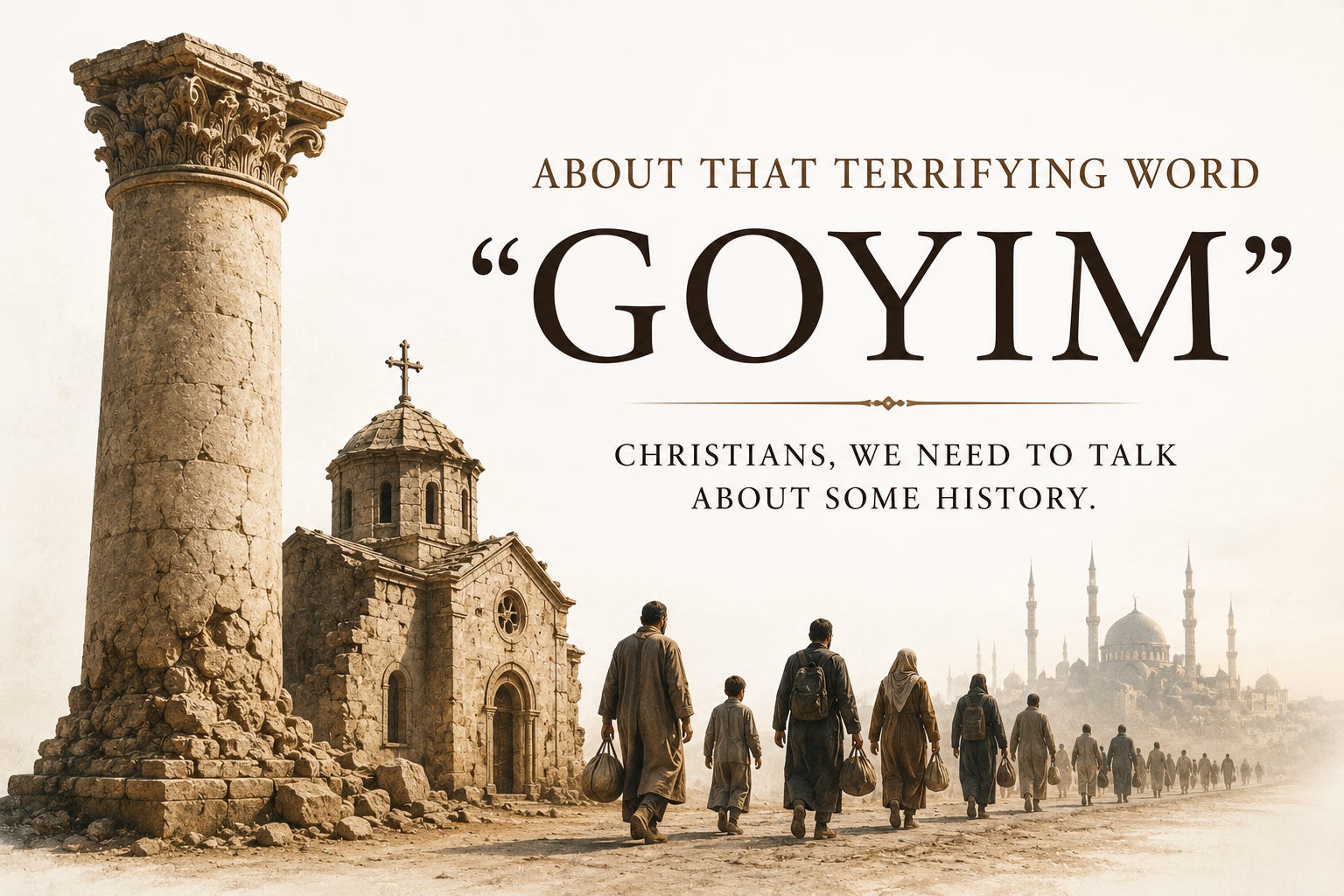
Every single time I write about the word *"goyim," *the same people show up on cue in the comment section. I explain that goy means “nation,” goyim means “nations,” and that the Hebrew Bible calls Israel a goy kadosh, a holy nation. In later Jewish usage, goy also became an ordinary word for someone who isn’t Jewish. Like almost any word describing a group of people, it can be said with contempt. That doesn’t turn it into this top secret Jewish slur the internet has decided it is.
Then, inevitably come the conspiracies about how Jews supposedly hate Christians. Jews think Christians are animals. Jews consider everyone else subhuman. Somebody has a screenshot, somebody saw a video, somebody heard a rabbi (most likely AI) say something. An awful lot of people suddenly concerned about protecting Christians from Jews seem remarkably uninterested in what actually happened to Christians across the Middle East.
That story begins in a Middle East that was very, very Christian.
By the time Islam emerged in the seventh century, Christianity had been rooted across the Middle East for hundreds of years. Egypt was overwhelmingly Christian. Ancient Christian communities stretched across Syria, Palestine and Mesopotamia. Armenia had adopted Christianity as a state religion centuries earlier. Christians worshipped in Jerusalem, Alexandria, Antioch, Edessa and communities scattered across the region.
Then Arab Muslim armies swept out of Arabia. Damascus fell in 635, Jerusalem surrendered in 638, Egypt was conquered in the 640s, and Muslim armies took Mesopotamia and continued across North Africa.
The people living in those places didn’t suddenly become Muslim because the government changed. Christians remained the majority in many Muslim-ruled territories for centuries. Cambridge’s History of Christianity places Christian majorities in parts of the conquered Middle East well into the 11th century.
The Christians weren’t late arrivals to a Muslim Middle East. They were already there when Muslim rule arrived.
Christians and Jews occupied a category under Islamic rule. As People of the Book, they could generally retain their religions under the dhimma. In return, they accepted Muslim political supremacy and paid the jizya.
The jizya comes directly from Qur’an 9:29, which instructs Muslims to fight those among the People of the Book who don’t follow the religion of truth until they pay it. English translations render the final Arabic phrase differently. Arthur Arberry translates it as paying tribute “and have been humbled.” Yusuf Ali gives “with willing submission, and feel themselves subdued.”
This is why “protection” needs quotation marks. Christians and Jews were “protected” communities because they were permitted to remain Christian and Jewish under Muslim government. They weren’t equal citizens of a religiously neutral state. Not even a little.
Over time, that inequality was expressed through laws governing taxation, houses of worship, public religious displays, clothing, weapons, government positions, and the authority non-Muslims could exercise over Muslims.
One of the best-known collections of these restrictions became known as the Pact of Umar. The surviving text was compiled after the lifetime of the caliph Umar to whom it was traditionally attributed, but its provisions became influential in Islamic jurisprudence.
Christians agreed not to build new churches or monasteries, publicly display crosses or religious books, ring church bells loudly or hold conspicuous religious processions. They agreed not to carry weapons, to distinguish themselves by their clothing and not to prevent relatives who wanted to convert to Islam. Related legal traditions imposed many of the same disabilities on Jews.
That gives a rather fuller picture of what dhimmi “protection” meant. Christians and Jews could keep their religions, but the law made clear which religion occupied the superior position.
In 850, Abbasid caliph al-Mutawakkil made that hierarchy impossible to miss. Christians and other dhimmis were ordered to wear distinctive honey-colored clothing and belts, and their riding equipment had to identify them as non-Muslims. Newly constructed churches were to be destroyed. Some Christian property could be converted into mosques or cleared completely. Dhimmis were removed from government positions in which they exercised authority over Muslims, and their children were restricted from Muslim schools.
Jews lived under the same basic classification. Centuries before European governments forced Jews to identify themselves through distinctive clothing and badges, religious minorities under Muslim rule could also be visibly marked. Those minorities included Christians.
Christian tradition places the crucifixion, burial and resurrection of Jesus at the Church of the Holy Sepulchre, making it one of Christianity’s holiest places. In 1009, Fatimid caliph al-Hakim ordered it destroyed. The church was razed, and other Christian institutions were targeted during his anti-Christian policies.
This happened almost ninety years before the First Crusade reached Jerusalem. The Christians worshipping there weren’t European Crusaders. They were Middle Eastern Christians whose communities had existed there for centuries.
That chronology tends to disappear from the simplified version of history in which Christian-Muslim conflict in Jerusalem begins when Europeans arrive in 1099.
If Egypt was overwhelmingly Christian when Muslim armies arrived, and Christians remained majorities across parts of the conquered Middle East for centuries, how did those populations eventually become minorities?
It happened over generations. Conversion removed the jizya. Muslims occupied the dominant political and legal position. Arabic increasingly became the language of government, commerce, and advancement. Islamic family law favored the transmission of Muslim identity across generations. Christians periodically faced restrictions on churches, worship and government employment. In other periods, Christians became wealthy, influential physicians, merchants, translators and officials.
The cumulative effect changed the region. Families converted, communities shrank, others emigrated, and periods of persecution accelerated the process. The Christian majority in Egypt eventually became a minority, and similar demographic transformations occurred elsewhere across the Middle East.
The military conquest happened relatively quickly. Islamization and Arabization took centuries.
The Copts are descendants of that ancient Christian Egypt. Their ancestors didn’t immigrate into a Muslim country. Muslim rule came to a country in which their Christian community had already existed for centuries.
They survived conquest, taxation, periodic persecution, Arabization and more than a millennium of political change while maintaining one of Christianity’s oldest traditions. They’re still there today, a minority in a country where Christians once constituted the overwhelming majority.
By the 19th century, the Ottoman Empire had begun dismantling parts of the old religious hierarchy and formally promising greater equality to non-Muslim subjects. Then, in July 1860, the Christian quarter of Damascus erupted in violence.
For eight days, Christians were murdered while churches, homes and businesses were looted and burned. Roughly 6,000 people were killed. One of the great heroes of the massacre was Abd al-Qadir al-Jaza’iri, the Muslim Algerian resistance leader then living in Damascus, who sheltered Christians and sent his men into the streets to rescue others.
Thousands survived because Muslims protected them during the massacre. Thousands needed rescuing because Christians were being slaughtered in the streets. Both belong in the history.
World War I brought catastrophe to ancient Christian populations across the Ottoman Empire. Beginning in 1915, Ottoman authorities launched mass deportations and killings of Armenians. The U.S. Holocaust Memorial Museum estimates that between 664,000 and 1.2 million Armenian men, women and children died through massacres, deportations, starvation, dehydration, exposure and systematic mistreatment. Tens of thousands of Armenian children were removed from their families and forcibly converted to Islam.
Assyrian Christians were devastated during the same period in what Assyrians remember as the Sayfo, the Year of the Sword. Ancient Syriac-speaking communities across southeastern Anatolia and neighboring regions were massacred and displaced.
These weren’t European Christian settlements. They were some of Christianity’s oldest communities. Raphael Lemkin later looked to the destruction of the Armenians while developing the concept for which he created a new word: genocide.
The Assyrian story continued after World War I. In August 1933, Iraqi troops and irregular forces massacred Assyrian Christians around Simele in northern Iraq. Villages were attacked and civilians killed in one of the young Iraqi state’s earliest episodes of mass violence against a minority.
Simele also attracted Raphael Lemkin’s attention. Once again, the victims weren’t foreigners arriving in the Middle East. They belonged to Christian communities that had survived there for centuries.
Eighty years later, ISIS swept across Iraq and Syria. Christians fled Mosul. Churches and monasteries were destroyed and desecrated. Christian homes were marked. Yazidis were massacred, kidnapped and enslaved, and women and girls were sold into sexual slavery.
ISIS eventually lost its territorial caliphate, but the communities it shattered didn’t simply return. Iraq had an estimated Christian population of roughly 1.5 million before the upheavals beginning in 2003. Only a fraction remain. USCIRF continues to document displacement, insecurity, militia harassment, political marginalization and property appropriation affecting Iraqi Christians and Yazidis.
Some of the oldest Christian communities on Earth have been reduced to remnants within a generation.
The Copts survived, but full equality still hasn’t arrived. Egyptian Christians continue to face discrimination, sectarian violence and problems surrounding church construction and recognition. Laws governing blasphemy and religious expression have also been used against Christians and other religious minorities.
The timeline stretches almost fourteen centuries. Christian Egypt existed long before Islam. Muslim armies conquered it in the seventh century. Christians gradually became a minority, and their descendants are still dealing with religious discrimination in their ancestral country.
Iran’s Islamic Republic targets religious minorities including Baha’is, Christians, Jews, Sunnis and others. Christian converts from Islam face particular danger. House churches have been raided, Christians arrested and religious activity prosecuted as a security offense.
Baha’is face arrests, property seizures and restrictions on education and employment. Iran also retains ancient recognized Christian and Jewish communities living under an explicitly Islamic state that regulates their religious and political lives.
Saudi Arabia is one of the starkest examples left in the region. The government still prohibits the public practice of every religion other than Islam and forbids non-Muslim houses of worship. Christians can worship privately in limited circumstances, but there are no public churches, and public displays of Christianity are prohibited.
Saudi law also criminalizes conversion from Islam, non-Muslim proselytizing and public religious expression that challenges the state’s interpretation of Islam. Shi’a Muslims face discrimination as well, and USCIRF reported in 2026 that Saudi Arabia continues to impose severe restrictions rooted in a state-sanctioned interpretation of Sunni Islam. It recommended that the country remain designated a Country of Particular Concern for systematic and ongoing violations of religious freedom.
Think about what that means in 2026. Millions of Christians live and work in Saudi Arabia, many of them migrant workers from the Philippines, India and elsewhere. They can live there, work there and contribute to the country, but they still cannot build a public church and worship openly in it.
Fourteen centuries after the first Muslim conquests, public Christian worship remains illegal in the land containing Islam’s two holiest cities.
Qatar presents a different version of the same religious hierarchy.
The country allows eight recognized Christian denominations to worship publicly, but their churches are concentrated inside the government-approved Mesaymeer Religious Complex in Doha under state supervision. Christians cannot simply build churches wherever communities need them, and proselytizing for any religion other than Islam is prohibited.
Other religious minorities have even fewer rights. USCIRF’s 2026 report says unregistered religious groups, including Baha’is, Hindus and Buddhists, cannot legally worship in private spaces, import religious texts, publish religious material, hire staff or operate as recognized religious organizations. Qatar also maintains laws carrying prison sentences for religious offenses, while members of some minority Muslim communities have faced detention and surveillance.
USCIRF recommended in 2026 that Qatar be placed on the U.S. government’s Special Watch List for religious-freedom violations.
So even in enormously wealthy Qatar, where luxury hotels, universities, international corporations and World Cup stadiums announce a thoroughly global country, religious equality remains sharply bounded. Certain Christian communities may worship, but where and how they do it remains subject to government permission.
Yemen once had an ancient Jewish community whose history stretched back more than two thousand years. Almost all of it is gone.
Under Houthi rule, Christians, Baha’is, Jews and nonreligious Yemenis have faced detention, intimidation and persecution. Members of minority religions have hidden their identities and practiced privately. Another Middle Eastern society that once contained multiple ancient religious communities has been almost completely emptied of them.
Syria’s Christians had already been devastated by more than a decade of civil war when Bashar al-Assad’s government collapsed in December 2024. The following year brought another wave of sectarian bloodshed.
In March 2025, massacres swept through Alawite communities along Syria’s Mediterranean coast. A Reuters investigation documented 1,479 Alawites killed at 40 locations over three days, including women, children and entire families. Months later, horrific violence engulfed Druze communities in Suwayda.
On June 22, 2025, Christians gathered for Sunday liturgy at the Greek Orthodox Mar Elias Church in Damascus. A suicide attacker entered the church, opened fire and detonated an explosive vest, killing twenty-five people and wounding more than sixty.
They weren’t medieval dhimmis or Crusaders. They were Christians who went to church on a Sunday in 2025 and were murdered while worshipping.
The violence against Christians didn’t remain confined to the Middle East.
On July 26, 2016, two ISIS-linked terrorists entered a Catholic church in Saint-Étienne-du-Rouvray, France, during morning Mass. They took the congregation hostage and murdered 85-year-old Father Jacques Hamel at the altar. Another parishioner was seriously wounded.
Four years later, on October 29, 2020, an Islamist terrorist entered the Basilica of Notre-Dame de l’Assomption in Nice and murdered three peop…