I am Daniel Böttger1. In 2023, my review of On The Marble Cliffs took second in the ACX book review contest, and Scott offered me the right to pitch him more essays. I have worked as a neuroscientist, so in 2024 I pitched a post with my theory of consciousness. Later that year, my connection to neuroscience took an unexpected turn, and I wrote about my experience getting diagnosed with brain cancer. This post is an update on how I’m doing.
I’m doing well. Very well, in fact. Suspiciously well. So well that the only other person I’ve ever heard of doing as well as I am was Jo Cameron, who was profiled on ACX for her rare genetic mutation that makes her incapable of negative emotion. My case can’t be a mutation, so it must be related to my brain cancer and subsequent surgery. I write about it here in the hopes of making a novel contribution to the study of low-suffering phenotypes.
Content warning: the first part of this review contains medical details that some people might find gruesome; I am bad at judging these things since I can no longer feel disgust or fear myself, and have tried to err on the side of completeness.
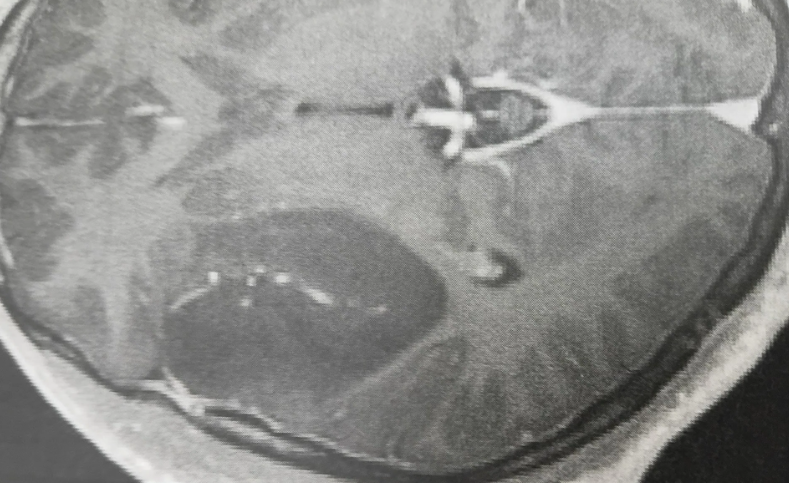
In summer 2024, I had an open craniotomy. Doctors cut open my skull and took out the part of my brain with the cancer - an astrocytoma2 about the size of my fist. Collateral damage included my right-side amygdala, the rightmost edge of my hippocampus, and a big chunk of my temporal cortex, including my right-side primary auditory cortex. Now there was only cerebrospinal fluid (CSF3) flowing between the remains of my tumor and those of my brain. It’s the dark 🫀shape in the middle of this MRI segment:
The remains of the tumor were then blasted with radiotherapy: high-powered photons at X-ray wavelength. Minor collateral damage to the remains of my brain was unavoidable. The doctors were so worried that they made my health insurance pay for taxi rides to return home after the near-daily radiation treatments for weeks, even though it was only a ten minute walk.
I got what passes for good news. The oncology center where I was in treatment offered to make me the only experimental subject in a case study to see, for the first time anywhere on the planet, what happens to my kind of brain cancer when attacked simultaneously with both of the most powerful chemotherapy drugs that can cross the blood-brain barrier. This combination had previously been tried only on 72 patients with glioblastomas, a type of brain cancer far more dangerous than mine, and had extended patient survival times by about a quarter on average, meaning several months. I immediately accepted the offer, delighted to receive this unique opportunity. I guessed I could reasonably expect my own life expectancy to grow by about a quarter compared to standard care as well, which for my comparatively less aggressive cancer could mean a year or more!
That was the plan. But chemo and major surgery don’t mix, and I ended up needing a long string of follow-up neurosurgeries, each necessary to repair a shortcoming of the previous one. A triangular piece of my skull, which in the craniotomy had been sawed off and screwed back on with three little titanium screws, was found to have a population of bacteria happily growing on the inside; an abscess inside the brain cavity equals an immediate medical emergency. This necessitated the removal of that bone triangle and its replacement with a customized 3d printed piece of polymethylmethacrylate bone cement, an exciting new implant technology expected to be much better than the old standard-issue titanium implants.
Shortly after I had gotten it implanted, I developed a big swelling on my right forehead below the wound that grew enough to squeeze my right eye shut, prompting neurosurgery number three. A few weeks after that neurosurgery, while briefly released from stationary care, I developed signs of brain overpressure - from too much CSF, which can cause strokes and death - so I went back for number four.
A particularly low point came in January 2025, when the swelling on my forehead came back; the neurosurgeons told me it was CSF leaking from the cranial cavity, indicating a common post-neurosurgery complication called “postoperative hydrocephalus.” I needed a fifth neurosurgery to receive a shunt, a valve and pipe system that would drain the excess CSF to my gut. At least, that was the unanimous opinion of the expert team of neurosurgeons at the big research university. I didn’t know physiology, but I did know hydraulics, and the swelling wasn’t growing, which clearly falsified their increasingly exasperated explanations. I had read the many pages of fine print they pressure you to sign before each surgery and become a minor expert in German medical law, so I knew I didn’t need their permission to refuse the surgery and they needed mine to perform it. I said no. On the morning of February 8, 2025, I awoke while a large fountain of body fluids was erupting from my scalp. The swelling had opened and was spraying most surfaces4 of the double bedroom with what was obviously too red to be CSF. The large rescue team that came running to answer my roommate’s panicked emergency call was finally quiet about their shunt, I smugly noted. The swelling had instead been an unusually large seroma filled with serosanguineous exudate, and I got to leave, promptly proceed to the chemotherapy experiment5 and skip neurosurgery number five.
…for three months. In the spring, a scab fell off the hole in my skull, revealing that the flesh had failed to close over it. I could see the 3D-printed bone cement in the mirror (it was bright green) it was exposed to the open air. Open air contains microbes that could colonize it and give me meningitis, which could kill me rather more suddenly than cancer. I asked if the doctors could just sew the hole together, and they explained why that wouldn’t work. I was going to need another major neurosurgery to replace the newfangled implant with a good old titanium mesh. And in order to get my head properly and permanently closed to microbes again, I was going to need a flap, a handful of my flesh transplanted to the side of my head from someplace else6 with all blood vessels connected exactly right, and the new hole they’d carve to fill the old one would get patched with a skin graft. These are just routine surgeries, but as additions to the implant replacement they would turn this fifth neurosurgery into a six-surgeons-for-six-hours operation, and the first of my surgeries to necessitate blood infusions.
But should they do it at all? I was in chemotherapy, which could potentially slow wound healing. My wonderful chief oncologist had co-authored the only study of this chemo, so I asked him to review the old confidential files he had clearance for, while I studied surgery survival statistics in order to calculate the overall risk profile of this big omnibus operation. I wasn’t medically educated enough to have known what a seroma is until a few weeks earlier, but multiplying risk probabilities was just math that I do for a living, so by the time I learned that the old study files did not indicate particular difficulties in wound healing, I had confidently calculated a 94% likelihood I would survive the big surgery. A proper nerd would have also calculated the chance I could dodge meningitis for another six months with a gaping hole in my head7. I just guessed, from how each and every doctor or nurse squirmed and sounded sad that I would even ask, that there was no way I could get the probability of that cause of death confidently lower than 6%. So we went ahead and scheduled the surgery for May 19 2025.
I mention all of these difficulties because you might expect that, at some point during this process, I would be unhappy or afraid. I do not recall feeling this way. Between surgeries I had a lot of hospital bed time; the many neurosurgery station bedrooms, where I spent roughly a week each, blend together in my memory. I busied and entertained myself on Twitter, and translated the Seven Secular Sermons into German. I meditated and introspected a lot, figuring that I needed to rebuild my mind since it was now running on a very different brain. I noticed my intuitive sense of time was broken8 and built myself a harness of routines, alarms and timers to compensate. Then I moved on through my whole collection of thought habits, relishing the opportunity to reconsider and reconstruct them all. Eventually I noticed how many of my many doctors and nurses kept saying that I was in an incongruously good mood, considering my condition.
It wasn’t just that I was less depressed than expected under the circumstances. I was actually feeling glorious. I had been diagnosed with major depressive disorder several years earlier, and since then been continually on the maximum dose of the antidepressant mirtazapine. Now I no longer felt like it was necessary. In consultation with my doctors, I stopped, and felt fine without it. When a nurse accidentally restarted it, I stopped again, this time “cold turkey” without a taper, although every psychiatrist knows this is a terrible idea. I felt the unusual certainty that my particular case of depression had been caused by, and ended with, the tumor firing seizures into my amygdala meant the usual rule would not apply. I felt fine.
I meditated deep into myself, and despite my best efforts could not find anymore the old abyss of depression! And I could not find any traces of fright, terror or panic either! I felt much better than just “not depressed”. I have never been a particularly jumpy or skittish person, but over these many months in the hospital, constantly surrounded by death, woeful patients and endurance-focused doctors, my unflappable light-heartedness stood out strangely9. I had been too zoomed in on the many minute mental movements I was rebuilding to appreciate how the overall picture had turned out absurdly audacious.
My doctors were concerned about my inappropriate emotions, and diagnosed me with F06.3, “organic affective disorder”. But I didn’t feel “disordered”. I continually contradicted the many nurses and counselors who said or implied every day that surely I was having a terrible time, like anyone would on a postoperative stay in the neurosurgery ward. I felt great, I told them, and cheerfully refused almost all the painkillers they kept offering because they only slowed down my thorough examination and refactoring (autology) of this curiously cheerful cortex.
During my fifth neurosurgery, I decided to put my sunny disposition to the test. Before each of the previous surgeries, my doctors had given me the sedative midazolam. This wasn’t the anaesthetic per se; it was a sort of pre-anesthetic, given outside the operating theater to help patients enter that dreaded room, which some would not leave alive. I hadn’t felt fear in months, and I wanted to know if a surgery with a 6% chance of death would do the trick. I decided to refuse the midazolam and see what happened. I expected my doctors to protest, but medical regulations said they had to defer to my wishes if I could prove “capacity” - that I was still rational and intelligent enough to make my own decisions. To remove any shadow of a doubt, I prepared a poem to recite to the anesthesiologist when the time came:
“Ich brauche kein Midazolam.
Hab keine Angst, seit die
Amygdala abhanden kam
durch Kraniotomie.
Wie ist mein Bispektralindex?
Ich nehme hundert an.
Ich brauch noch Propofol gesetzt
und das Sevofluran.”[10]
Any and all anxiety apparently absent, an attentive and able anesthetist allowed abnormal admission absent anxiolytic amnesiac: an active, authoritative acknowledgement that nobody who experiences fear normally could pull that off!
I finished surgery number five, completed the experimental chemotherapy11, and, in another absurd accident, autonomously apprehended 𝕏a cheap easy safe way to eliminate many chemotherapy side-effects for myself and hopefully many fellow patients12. Surgery number six wasn’t even a real neurosurgery, just a maxillofacial wound revision that didn’t touch the brain. I have been cancer-free since late 2025, when I victoriously returned to full-time employment.
The only time I have felt any fear in the past two years was one brief moment, when I was practicing walking the streets of Leipzig with newly purchased 40 inch stilts strapped to my shins13. I lost my balance, started to fall towards the stone pavement, and felt an instant of aversion. Then I crashed onto the stone pavement and bruised my butt. That hurt, but I didn’t mind. I was busy laughing and cheering on my poor brain for having finally, with a lot of help from my stupid decision to stiltwalk, managed to scrape together my first and only spike of visceral fear in nearly two years. Afterwards, I discovered its reverberation as a distinct disinclination to try stiltwalking again immediately, a delightfully unfamiliar sensation that I enjoyed examining until I went back up on stilts a few days later14.
Readers with neuroscience backgrounds have probably already put two and two together: my good mood started after surgeons removed my amygdala, a brain structure which plays a key role in fear and other negative emotions.
Specifically, I lost my right amygdala. I still have the left, but it doesn’t seem to be able to do a very good job on its own. I’ll go into my experience in more detail, then talk about its relevance to mental health more generally.
The main purpose of the amygdala is to trigger acute stress, also known as the fight-or-flight response. This does not cover everything that we mean when we say “fear”, only the powerfully visceral “gut drop” or “adrenaline rush” from psychological stress, which shuts down neocortical deliberation in favor of immediate defensive action. I don’t have that part of fear like most healthy people do. A sudden angry shout at me from a stranger a few steps behind me on the street will still get a minute semblance of a startle response, but in my repeated experience, each random crazyman, rage addict or methhead who accosts me so will then hilariously fail to intimidate me; they’re always too stupid to stop trying after an hour or two.
I do still appreciate and mitigate risks, and I still abstractly regret risks I can’t avoid, which don’t need the visceral amygdala activation boost to seem worth attention (that’s neocortex, not amygdala work). I used to experience fearful rumination and fractally expanding fear-of-fear-itself, I have found old written notes about that. But I can’t remember or imagine what that used to feel like, because those fearful loops needed amygdala boosts to keep looping. This absence of visceral fear frees up a lot of attentional resources and affords me the freedom to act in ways like I described in the first part.
I’m finding this fearlessness an amazing advantage on balance, but it’s not an unalloyed good. Many times since the operation, I have inadvertently scared, angered or o…