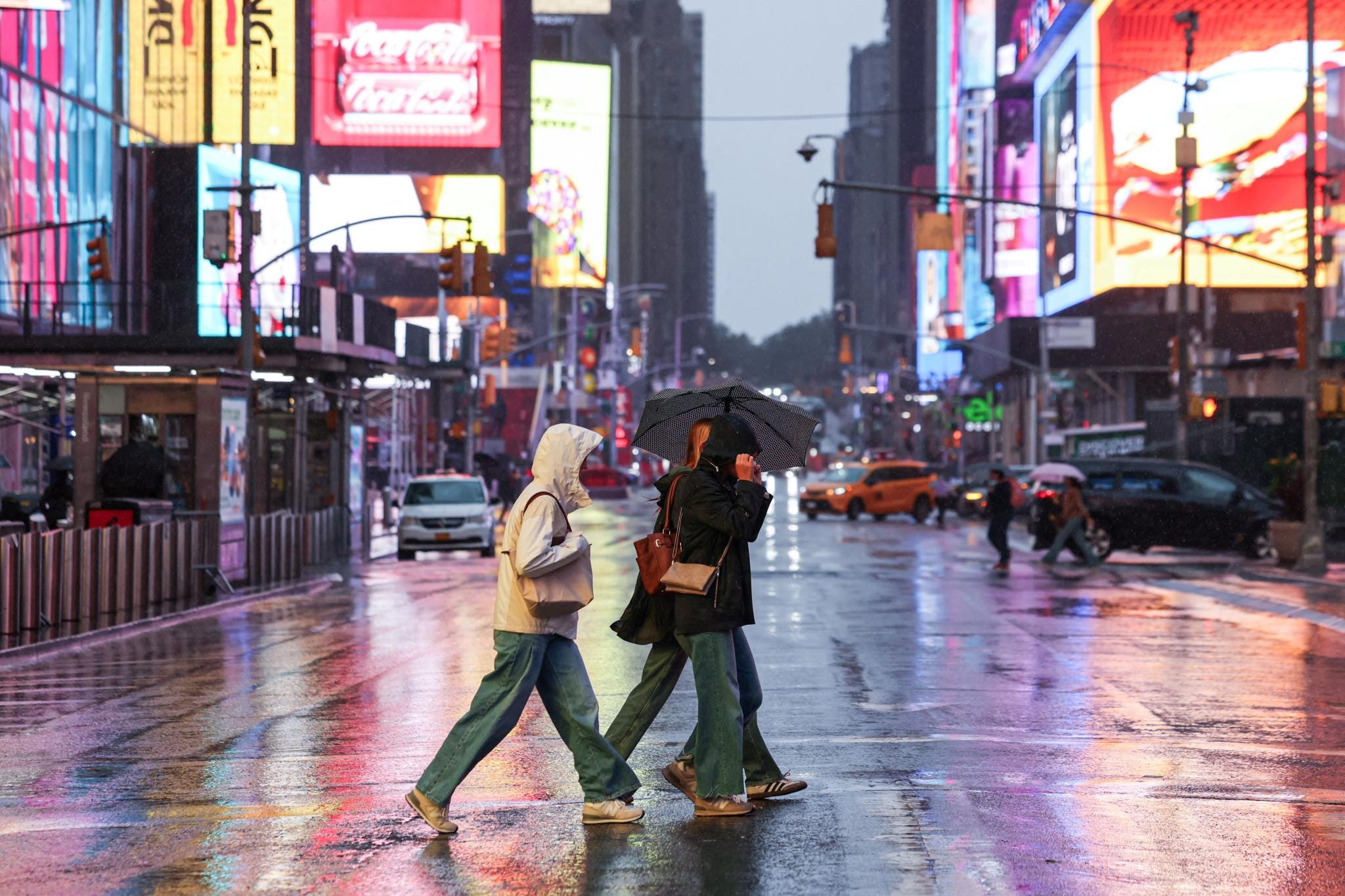
From the moment I landed in New York this year, everything felt off centre. The weather, the temperature, my wardrobe. Nothing was quite what I’d planned for. It rained, and then it cleared up. My jacket was on, then it was off, and on Friday afternoon, the nor’easter rolled in and everyone scrambled – although I’d felt that storm brewing all week.
In September 2025, Manhattan was unseasonably hot, and the UN General Assembly and Climate Week had transformed into a series of crisis meetings in the wake of USAID’s implosion. Global funding was disappearing, and an international aid system that had existed for decades seemed to be collapsing in real time. It was frightening and brutal, but it was also strangely coherent. Disaster is a unifying force. The earthquake hits, and suddenly everyone’s pulling in the same direction.
Development aid fell by 23% in 2025, the biggest annual drop ever. Organisations cut staff, closed offices and scaled back programmes. Philanthropists were begged to fill the gaping holes, and communities were left navigating the fallout, with fewer resources and less certainty. Everywhere I went last year, I heard versions of the same story. The old model was broken and the money wasn’t coming back. Convinced we were witnessing the end of a global chapter, we published a piece called The End of Aid.
So naturally, when I came back this year, I was curious to find out what had happened. If I was looking for a clear picture, though, there wasn’t one. AI was a common thread, but beyond that, all the conversations seemed to be heading in different directions. Whichever room I was in, I had the nagging feeling I should be somewhere else.
The streets of Manhattan in late September are an endless snarl of diplomatic motorcades and high security, and so the best way to get around is underground. I’ve navigated that subway many times in my life, and yet this time, whenever I emerged, I couldn’t work out which way I was facing. Left or right? Even in a city built on a grid, I kept losing my bearings.
I was collecting fragments. I moved from air-conditioned conference rooms to rooftop receptions to crowded coffee shops. I spoke to people working on everything from HIV prevention to plastic control. I bumped into the right contacts at the wrong times. Some people were unexpectedly optimistic while others were bracing for further fallout. And the more conversations I had, the less things seemed to fit together.
The word ‘narrative’ came up a lot. Everyone, it seemed, wanted to change it. That should have been right up my alley (narrative change is a huge part of what we do), except the more I heard the heads of state and the philanthropists and the creatives use it, the less I understood what the word really meant. During one session, I wrote a question across the top of my notebook:
‘What is the story of the world right now?’
Last year, it felt like everyone was responding to the same shock, but 12 months later, they were all experiencing the consequences in different ways, and rebuilding at different speeds. There was no shortage of ideas: everywhere I went, people were finding new ways to tackle old problems. But they were doing it on shifting ground, as the systems they had always relied on, the funding models, the decades-old institutions, the geopolitical priorities, transformed around them.
And while there was plenty of agreement that things needed to change, there was far less clarity about what would replace them, how long it would take, or what would happen in the meantime.
“What does this feel like,” I wondered, “for the people trying to keep things going?” The ones in the audience, who would have to figure out what to actually do for the next 12 months after the big names had packed up their bags and gone home?
A few weeks before leaving for New York, I stumbled across a LinkedIn post about something called The Sidebar. It was the brainchild of Seth Cochran, who wanted to create a space for people who attend these global gatherings (but who rarely end up on the main stage) to connect, exchange ideas and have conversations that mattered to them.
It was exactly the kind of thing we love at Fix The News. People flying under the radar, doing things the rest of the world should know more about. So, at the last minute, I sent him an email and asked to host a session. The format was simple. Pick a topic, invite a few people to get things started, open the doors, and see where 90 minutes takes you. I decided to call it I Had No Idea That Was Possible: What We Can Learn From the People Who Make Change Happen.
On Thursday afternoon, I arrived at a building in Chelsea and made my way to a floor of rooms connected by a narrow hallway. It was filled with people milling around outside closed doors, waiting for their sessions to begin. More Off-Broadway rehearsal space than Serious International Conversations. Our room was empty except for some mismatched chairs, a mirrored wall and floor-to-ceiling windows that, unlike the sealed glass of the conference hotels, let in the muffled sirens and the occasional screech of downtown traffic.
I’d invited three people to help get the conversation started.
Susan Ngoiri arrived first, representing Sanku, an amazing organisation tackling hidden hunger by helping small mills across Africa add essential vitamins and minerals to everyday flour.
Next came Drew McCartor with two of his colleagues from Pure Earth, an organisation that’s spent decades trying to convince the world that lead poisoning isn’t a problem of the past, but a crisis affecting millions of children today.
Aidan Reilly turned up with a large duffle bag, en route to the airport for a work trip. He co-founded The Farmlink Project with a group of friends at college during the pandemic, after noticing that farmers were throwing away perfectly good food while food banks were struggling to keep up with demand. They figured, why not connect the two?
A few more people drifted into the room, and once everyone was seated, we pulled the chairs into a circle. I looked around. Azima was working to make sign language the third language of the internet. Aru was finding ways to deliver more equitable healthcare. Gracy was rethinking community healthcare, Sara was working in emergency health systems, and Alex and Hikaru were figuring out how to build playgrounds for children in disaster zones.
I’d arrived with a handful of questions but didn’t need them, because within minutes the introductions had given way to something much more interesting. People were recognising their own struggles in stories from entirely different worlds.
Susan said that everyone always wanted to hear about their dosifier (the ingenious machine that fortifies the flour), but nobody ever asked about what happens after you install it. The work of convincing millers to use it. Training them, keeping the machines running, bringing governments on board, helping communities understand why fortified flour matters in the first place.
When we interviewed Sanku’s founder, Felix Brooks-Church, in 2023, the organisation was reaching seven million people. Today, that number is around 75 million. But while the dosifier makes for a great story, Susan was reminding us how much of their success depended on the less glamorous work.
Aidan came at it from a different angle. I’d asked him to tell the room about the early days of the pandemic, when he and his college mates were cold-calling hundreds of farmers. But Aidan was much more interested in describing what happened afterwards.
Back in 2020, they had urgency, publicity and an extraordinary amount of goodwill on their side. They were college students doing something good in the middle of a global crisis, and everyone wanted to help. But then the coverage stopped. His classmates graduated and the world returned to business as usual, and that’s when Farmlink had to work out how to keep going. As Aidan said, coming up with the idea was only 10% of the work.
Six years later, Farmlink has moved more than half a billion pounds of food. But I was struck by how little his story was about that enormous number, and how much of it came back to the small, practical decisions that have kept the organisation moving. One truck. One food bank. One farm at a time.
Drew’s story was about the other half of the job: getting people to care. For years, Pure Earth had been building what he called an “evidence mountain” about the devastating effects of childhood lead poisoning, often with very little funding or attention. Then, in 2020, it partnered with UNICEF on a report that estimated that 800 million children had elevated levels of lead in their blood. That’s one in three of all the world’s children – a number that helped make an issue that had been overlooked for decades impossible to ignore.
As Drew told his story, I looked around. He and his team were finally getting the attention and resources they’d spent decades fighting for. Across from him, a photographer and an architect were just beginning their mission. They were all on very different journeys, and yet no one was guarding their hard-won knowledge or hiding their failures.
There was no agreement on what the future should look like. But nobody was waiting for someone else to figure it out. There was something almost unreasonable about the persistence in that room. These were people who had spent years, some decades, pushing against obstacles, finding another way forward when the last one didn’t work. As Drew put it, “We didn’t give up, and that mattered.”
There are much, much easier ways to spend a working life. And yet no one seemed interested in talking about how difficult it was. When I asked what they loved, the room filled with stories. The child in Kenya with cerebral palsy who, after years of support, was taking her first steps and going to school. The Palestinian medical students continuing their education after their universities and hospitals had been bombed. The community health workers across America who kept caring for their neighbours, even when they had no idea where the next dollar was coming from.
I’ve spent years telling stories like this, and I’ve celebrated every one of them. But sitting in that room, I began to feel uncomfortable about celebrating people for overcoming the obstacles that we should be doing a much better job of removing. For years, I’d found comfort in knowing these kinds of people were out there making the world better. Now I found myself wondering what it would take to make their work easier.
Here were people tackling some of the world’s most urgent problems, armed with ideas that actually worked, and so much of their time was spent fighting for the chance to keep doing it. Shrinking resources meant endless grant applications. A relentless demand to prove impact. And the ongoing struggle to get people’s attention, let alone persuade them to care.
There was also a shared impatience with the language used to describe what they do. Why is work in disability described as niche or noble? Why are community health centres a safety net? Couldn’t they simply be excellent healthcare, the kind people would actively choose? And when the conversation turned to building playgrounds for displaced children, Alex asked an even more interesting question. How do you convince a funder that play matters? You can count vaccinations. But how do you measure joy?
At one point, Susan looked around the circle and said, “We’re all doing the same work.” She wasn’t suggesting that lead poisoning, hunger, disability and children’s play were the same problem. But if funding one person’s work comes at the cost of someone else’s, the system isn’t working. What was the point of solving hidden hunger if children still couldn’t access healthcare or somewhere safe to play?
None of what they were asking for needed a breakthrough. Most of it came down to attention and trust. Fewer grant applications, and funding that lasts longer than a year. Money that isn’t tied to a single line item, so it can go where it’s needed most. Funders willing to back more than one problem at a time, rather than making a flour mill compete with a playground.
We wrapped up our End of Aid piece with the thought that behind closed doors, a new world was being born. This year, I’m beginning to appreciate just how long that might take. Last year the funding crisis felt like triage, but amid the shock there had been this tantalising possibility that the collapse of the old model might create an opportunity to build something better. Twelve months and one Sidebar event later, the distance between the opportunity and the outcome is much clearer.
The crisis makes headlines. The eventual breakthroughs are celebrated. But so much of what happens in between is not only invisible, it’s confusing. The slow, uncertain work of rebuilding often happens while you’re managing the next emergency. There are so many experiments that don’t work. So many people holding things together while everything around them changes.
I left New York without any big takeaways this year, or a clear picture of what comes next. We’re in the messy middle, somewhere between the world we’ve known and the one we’re still trying to figure out, and that’s the closest thing I have to an answer to the question in my notebook. Nobody in New York could tell me the story of the world right now, because it’s still being written.
But I did come back knowing what the people in that circle would be doing the following week. Susan would be back with the millers. Aidan would be lining up the next truck. Drew’s team would be adding to their evidence mountain. And Alex and Hikaru would be working out how to get a playground built in a disaster zone.
None of them know how the story ends either, and I’m sure they have their doubts about whether it will all work out. But they all know the next right thing to do. For the rest of us, perhaps the next right thing is to work out how to make it easier for them to do it.
One of the best parts of being in New York was getting to sit down with people thinking deeply about what comes next, and trying to do something about it. From philanthropy and business to social enterprise and international aid, these conversations gave me plenty to think about. We brought some of them together in a special episode of our podcast.