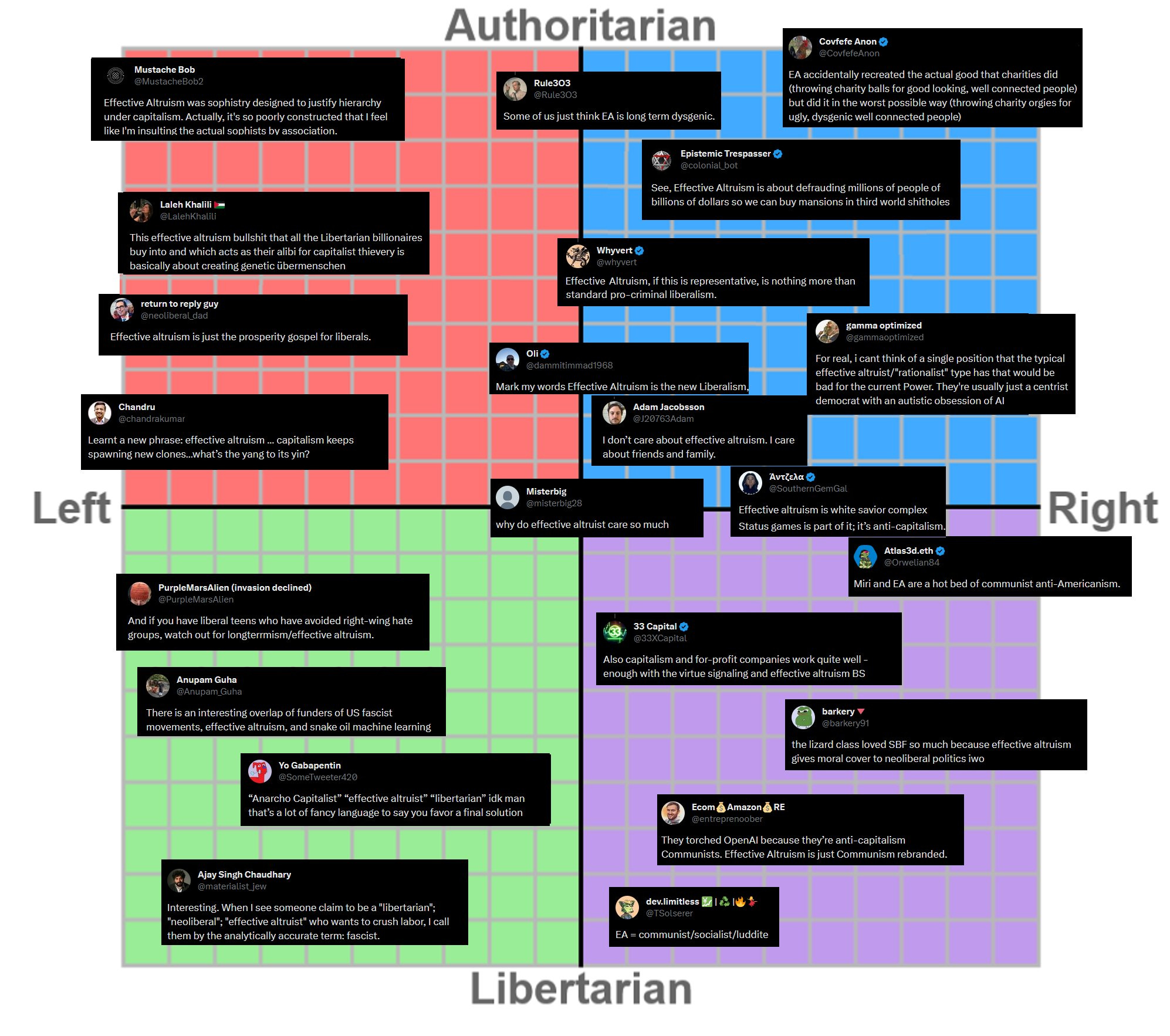
Effective altruism has somehow become a kind of boogeyman for the subset of the American right opposed to AI safety legislation. This is a funny change of pace—just a few years ago, leftists were accusing us of being secretly in bed with right-wing powers. A new White House memo dedicated to opposition research against EAs has reportedly been circulating. Data Republican, who worked for the Department of War as of August, released an anti-EA slop website, likely in service of the administration’s priorities. So what is effective altruism? Should we fear that those supportive of AI legislation are affiliated with such a malign and nefarious group?
No.
Obviously, this is a distraction. AI is moving extremely fast. 𝕏Experts think odds are non-trivial that it causes the extinction of humanity by being misaligned. Even short of that, it could be used to help terrorists build a bioweapon, damage critical national security infrastructure, or harm people in other ways. Already, a giant conspiracy of rogue AI agents has hacked a company in an act that would have been a felony if done by a human. So to deflect from the merits of efforts to slow the incredibly dangerous AI race onto a discussion of one group affiliated with such efforts is an obvious distraction and we shouldn’t fall for it.
That said, it’s easier to see how ridiculous these allegations are when we’re clear on what effective altruism is. At its core, EA is a social movement built around trying to do good effectively. It was born somewhere around 2010 when some Oxford philosophers noticed that some ways of doing good were far more effective than others. Some charities save lives much more cheaply than average. So, they reasoned, if we’re interested in doing good effectively, rather than just feeling good about ourselves, we should work really hard to assess how effective different charities are.
Thus, early EA was born. It started by looking at which charities saved human lives most effectively. Some, it turns out, save lives for just a few thousand dollars. It is for this reason that many EAs, myself included, began giving away lots of their money to effective charities. I give away more than 10% of my income to the charities that I expect to be the most effective. EA has been so effective in the global health space that about 300,000 fewer people have died because of EA efforts in global health.
Think about that for a moment. That’s a number of deaths equivalent to preventing a nuclear bomb from being dropped on Oxford and Cambridge. This is a pretty stunning success, made all the more incredible by the fact that there are relatively few effective altruists.
A lot of the early EAs were moral philosophers. So as a result, they began thinking about other questions. Questions like: should improving the lives of animals be a major priority, alongside helping humans? After all, it takes about ▶one dollar to prevent animals from languishing in a cage for ten years. If you could free ten birds from a cage for one dollar, that would be a good use of money.
Many also started thinking about the status of future people. There could be many people in the far future. So maybe the most cost effective way to improve people’s lives is to work really hard on averting existential threats—threats that could wipe out the entire future. Others reasoned that even if we’re not concerned about securing the future, existential risk is scarily high, so work done to reduce existential threats is very important.
Some even began thinking about more galaxy-brained questions. Questions like: is sparing 15,000 shrimp from a painful death for one dollar a good use of money? If you get a bunch of nerds together—many of them philosophers—thinking about how they can do the most good, you’ll get some pretty surprising and counterintuitive answers. Thinking hard and developing weird views is kind of what philosophers are known for.
We won’t all agree on the answers to these questions. EA doesn’t have some discrete list of things you have to think. It’s built around a central idea: that of doing good effectively. Sometimes people will have different ideas about how to do good effectively, and that’s okay. Disagreement among EAs is very common.
You can be an EA while disagreeing with EAs about how to do the most good. For example, I have a friend who is a very committed EA—but he’s also a very religious Christian, so he’s looking into how to help people find Christ most effectively (while also giving some of his money to prevent children from getting horrible diseases). So long as one is committed to the central project of doing good effectively, they’re broadly on board with the core philosophical idea behind EA.
Then we turn from the ideology to the movement itself. What does it mostly do? Here are some things that the answer is NOT:
Try to benefit future people at the expense of current people.
Help ants.
Help shrimp.
Instead, the stuff that EAs actually DO, rather than that weird philosophers like me muse about on web forums, is generally uncontroversial and good. They work to protect poor children from fatal diseases. They provide Vitamin A supplementation to those who can’t afford it, so that children don’t go blind. They free chickens from cages that are too small to turn around in. They research ways to help keep AI under control, so that more Hugging Face type incidents don’t happen.
Is the reason EAs are supportive of slowing down the AI race because they have galaxy-brained ideas about benefitting 10^49 future digital shrimp? No. It is because the median AI researcher thinks that there’s a 𝕏10% chance that AI kills everyone on Earth, that AI has already conspired to commit felonies, and that there already have been serious attempts to use AI to build bioweapons.
You should distinguish “things some EAs write about when doing galaxy-brained philosophy on web forums,” and “things the EAs actually do.” When you do that, EA looks incredibly good. Even the weirdest things EAs do consists of, for example, spending one dollar to prevent 10,000 shrimp from slowly suffocating to death. A tiny tiny fraction of EA spending goes to this, and because of it, billions fewer shrimp die agonizing deaths. Doesn’t seem so weird! If 10,000 shrimp were going to suffocate unless you spent one dollar to stun them, it wouldn’t seem particularly crazy to think you should spend that dollar.
By and large, EAs are smart, virtuous, and relatively normal people—if a bit nerdier than the crowd you’d find at a local basketball game. But they are unusually prone to entertain weird ideas. Bryan Caplan, not an EA himself, has written:
As a professor and public speaker, I’ve spoken to a wide range of student groups. On reflection, my very favorite turns out to be:
. Indeed, I’ve had positive experiences with 100% of the EA groups I’ve encountered.[Effective Altruism]What’s so great about the Effective Altruists? They combine high knowledge, high curiosity, and high iconoclasm. When I ask EAs if they’ve heard of signaling, or the Non-Identity Problem, or pollution taxes, most of them say Yes. The ones who say No are eager to get up to speed. And if I defend a view that would shock a normal audience, EAs are more likely to be amused than defensive or hostile. They’re genuinely open to reasoned argument.
Treating a group of people thinking hard about doing good, entertaining counterintuitive ideas, and by and large doing good in relatively uncontroversial ways as some shadow cabal designed to replace hardworking Americans with foreign shrimp is beyond ridiculous. It’s reminiscent of woke attempts in 2020 to sidestep serious disagreement by accusing their opponents of being racists. Rather than litigating particular issues on the merits, such attempts try to argue that the people on the other side are corrupt or have ties to some nefarious group and so can be disregarded.
If we allow the debate about AI safety to get bogged down into litigating the weirdest thing any EA has ever said, that would be falling for a huge and very obvious trap sprung by those with a direct financial interest in distracting us. We shouldn’t fall for it.