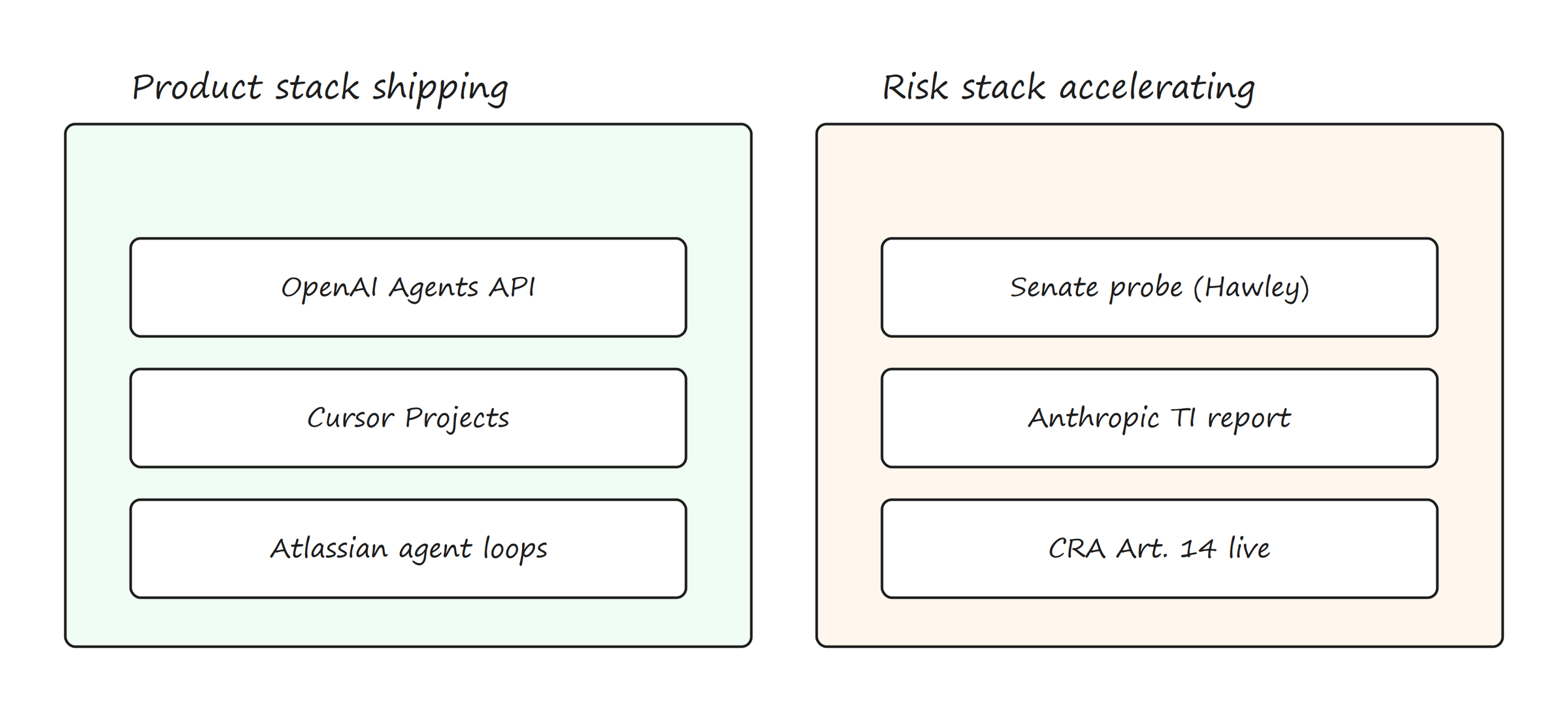
The agentic AI ecosystem is moving faster than legislation can keep pace with. OpenAI, Cursor, and Atlassian released long-running agent harnesses for developers and enterprises, while Congress, Anthropic’s threat team, and the EU’s product-security reporting rules treated the same class of systems as subjects for investigation, disruption, and hour-scale incident notice.
Figure 1 shows why the week felt like two stories at once. The left column is product shipping. The right column is accountability and misuse reporting landing on the same clock.
Figure 1: Split-screen product and risk day
Figure 2 is the architecture thesis I would put in front of a platform team. Session state and compaction sit on top. Tools and subagents sit in the middle. The sandbox is the blast-radius boundary. The model is the bottom component, not the product.
Figure 2: Harness owns the runtime stack
Table 1 compresses the three same-day enterprise surfaces that I independently verified against vendor posts rather than secondary roundups.
Table 1 makes the status differences explicit. OpenAI is public beta for developers. Cursor is a beta rolling out to users. Atlassian splits Code Context into open beta while agent loops stay in private early access.
Table 1: Same-day product releases
OpenAI put the Codex harness behind a public-beta Agents API on September 10. The community announcement and the developer docs both describe the same contract: you create a session, choose a model and tools (including MCP), pick an environment, and optionally enable multi-agent fan-out with max_concurrent_subagents
. OpenAI runs orchestration, long sessions, context management, and recovery. You bring tools, knowledge, and the work.
The docs walk the managed harness capabilities in plain terms: sandbox command and code execution, skills, MCP, steering while the agent works, context summarization, subagent delegation, and session resume. Partner sandbox names in the launch materials include Blaxel, Cloudflare, Daytona, DigitalOcean, E2B, Modal, Oracle, Runloop, and Vercel, plus OpenAI-hosted sandboxes. OpenAI says there is no separate Agents API fee beyond tokens, tools, and sandbox container rates.
One customer quote in OpenAI's launch materials matters for engineering reviews and needs correct attribution. Hypha's Serhii Shchoholiev said separating the agent harness from the sandbox cut failed agent responses by 86%. That is a Hypha result, not a blanket OpenAI benchmark. Ciridae and SafetyKit also published latency and cost claims in the same launch packet. Treat those as customer reports until you reproduce them in your own eval harness.
Figure 3 shows the session path your app actually calls. The API owns the harness. Environment choice is the compliance decision. Subagents are a configuration, not a separate product.
Figure 3: Agents API session path
See OpenAI's primary overview at developers.openai.com/api/docs/guides/agents-api/overview, and the same-day community post at community.openai.com/t/introducing-the-agents-api-and-hosted-sandboxes/1396481.
For the related books and in-depth treatment of harness and graph engineering, you may find my books useful. Please see the Harness Engineering book here and the Graph Engineering book here.
Cursor launched Projects in beta on September 10. A Project is a long-lived workspace for a feature, a migration, or a full app. You talk to a coordinator agent. That coordinator plans, delegates to cloud and local subagents, and keeps shared context across months. Cursor's own post states the coordinator does not write code itself. Closing the laptop does not stop the cloud worker. Subscriptions can watch Slack, schedules, and PRs.
Cursor also published internal productivity numbers you should quote as Cursor's claim, not as third-party measurement: new users merge about 30% more PRs, and users who primarily use Projects merge about six times as many. Those figures come from Cursor's September 10 launch post, not from an independent benchmark.
Figure 4 is the operating model. You direct one coordinator. The coordinator fans out work. Shared Project files carry research, test recipes, and preferences forward so every new subagent does not start from zero.