Agentic AI is creating a new demand center for memory, but “Agentic AI memory” is not one product category. High Bandwidth Memory sits beside an accelerator and supplies data at extreme bandwidth. Server DRAM holds model state, operating-system data, retrieval results, and intermediate workloads. CXL can expand or pool memory outside the normal CPU channels. NAND flash stores models, vector indexes, checkpoints, simulation assets, and historical context. SRAM sits inside processors and provides very low-latency cache. LPDDR and specialized modules serve power-constrained inference in vehicles, robots, personal computers, and edge devices. Processing-in-memory and other emerging technologies may become important, but most are not yet substitutes for mainstream DRAM, HBM, or NAND.
This distinction matters because the different technologies do not share the same economics. HBM has a strong technical connection to frontier accelerators, but it depends on advanced packaging, customer qualification, and AI capital expenditure. Standard DRAM remains a high-volume commodity with a familiar supply cycle. NAND benefits from enterprise SSD demand but remains exposed to bit oversupply and price corrections. SRAM is embedded in processors and therefore follows logic-chip design more than the standalone DRAM cycle. CXL is a system architecture whose demand depends on the memory components attached to it. Newer memory technologies may have strong technical promise but still fail to reach commercial scale.
The most defensible conclusion is that HBM has the strongest structural position in frontier AI infrastructure, but it will not escape cyclical risk. Standard server DRAM and NAND will experience long-term AI demand growth while continuing to exhibit boom and bust behavior. Specialized memory, embedded memory, and system-level integration may be more resilient than commodity bits, although they will not necessarily capture the same extraordinary revenue growth during an AI infrastructure surge.
This report separates physical engineering requirements from market forecasts, supplier announcements, and interpretation. Product specifications and roadmap dates attributed to Samsung, SK hynix, Micron, NVIDIA, Google, Kioxia, TSMC, and other suppliers are supplier-reported unless identified otherwise. Market-share and pricing figures attributed to TrendForce, Counterpoint, or other analysts are estimates, normally based on revenue, sampled market data, or supplier disclosures rather than a complete physical count of every bit produced.
Forecasts for 2026 and later can change as AI capital expenditure, accelerator demand, memory yields, packaging capacity, inventories, and macroeconomic conditions change. A supplier’s product roadmap is evidence that a company is investing in a direction; it is not proof that the product will reach the forecast volume or generate the forecast margin. Similarly, an analyst’s market estimate is useful for identifying direction and relative scale, but it should not be treated as a precise physical measurement.
The conclusions about which memory technologies may survive a boom and bust cycle are scenario judgments. They are based on technical necessity, product differentiation, market concentration, customer qualification, supply elasticity, and end-market diversity. They are not price predictions or investment ratings.
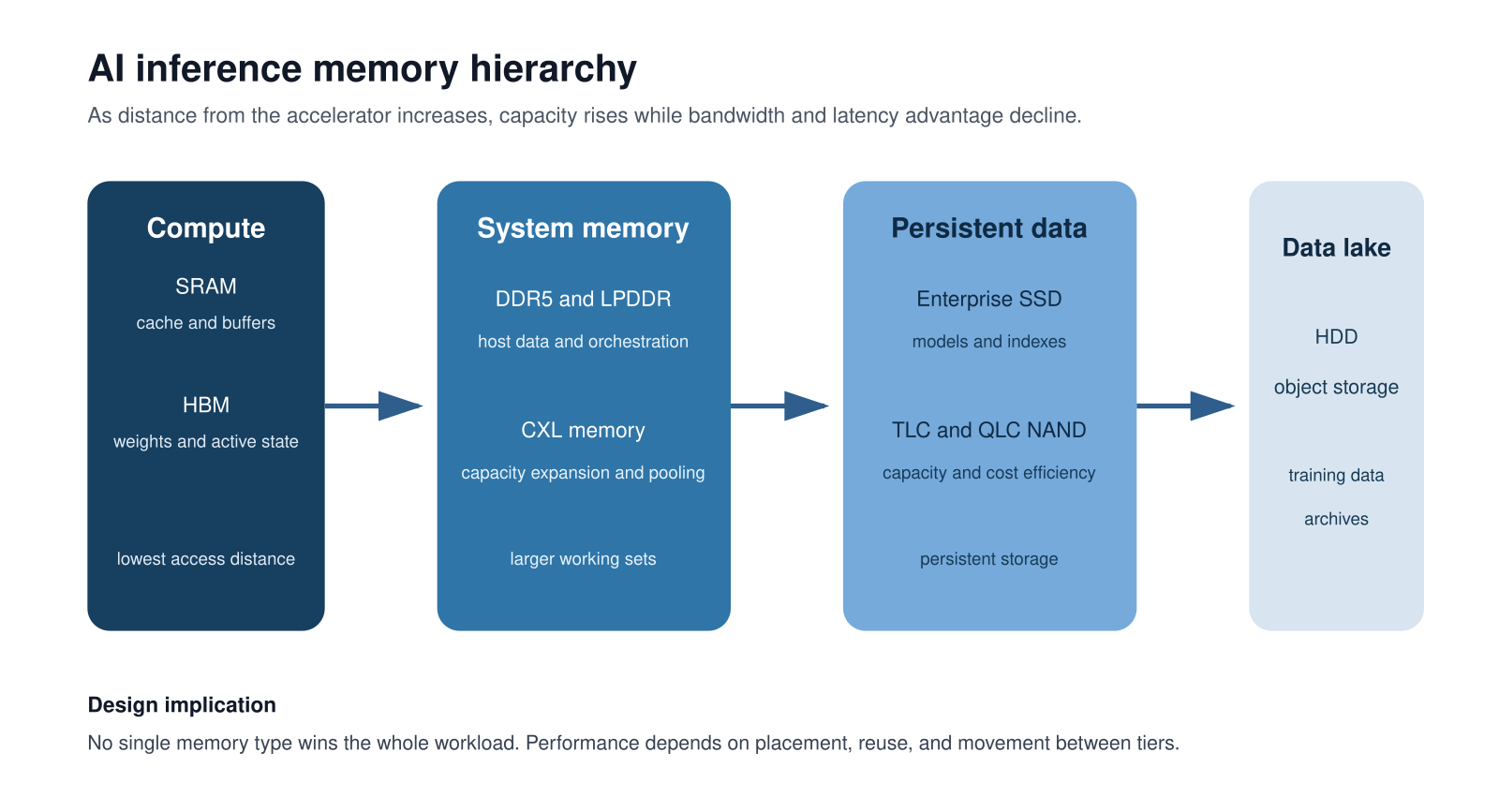
Figure 1. AI inference uses a hierarchy of memory technologies; no single memory type provides the best combination of latency, bandwidth, capacity, persistence, and cost.
AI inference is not a single operation. During prefill, the system processes the user prompt, retrieved documents, system instructions, and previous conversation. This stage can make strong use of parallel arithmetic. During decode, the model generates tokens one at a time. Decode often depends more heavily on memory bandwidth, cache access, and the ability to move model state efficiently.
The model’s weights must be available to the accelerator. The key-value cache must preserve attention information from previous tokens. The host CPU and system memory manage orchestration, data preparation, scheduling, and services outside the accelerator. Storage supplies models, documents, checkpoints, embeddings, logs, and large datasets. The network moves data between accelerators, memory pools, storage systems, and external services.
This produces a hierarchy rather than one universal memory technology. SRAM provides the shortest access path and smallest capacity. HBM provides very high bandwidth close to the accelerator. DDR5, LPDDR, RDIMM, MRDIMM, and SOCAMM provide larger system memory at a greater access distance. CXL can extend or pool memory. Enterprise SSDs provide persistent capacity for models, indexes, checkpoints, and colder context. NAND-based storage is much slower than HBM but far less expensive per bit.
Memory capacity and memory bandwidth are not interchangeable. HBM may provide extreme bandwidth but limited capacity compared with storage. NAND may provide high capacity at low cost per bit but cannot replace HBM for the innermost token-generation loop. DDR5 may hold more data than HBM at a lower cost per bit, but it is slower and farther from the accelerator.
The performance of an inference system therefore depends on placement and reuse. Data that is accessed repeatedly should remain close to the compute engine. Data that is accessed less frequently can move to a larger and slower tier. The system’s software must decide when to retain, compress, evict, prefetch, or retrieve each object.
A complete inference platform uses several memory layers. No single memory technology provides the best combination of latency, bandwidth, capacity, persistence, and cost.
Figure 2. HBM performance depends on stacked DRAM, logic, interconnects, advanced packaging, power delivery, testing, and thermal management.