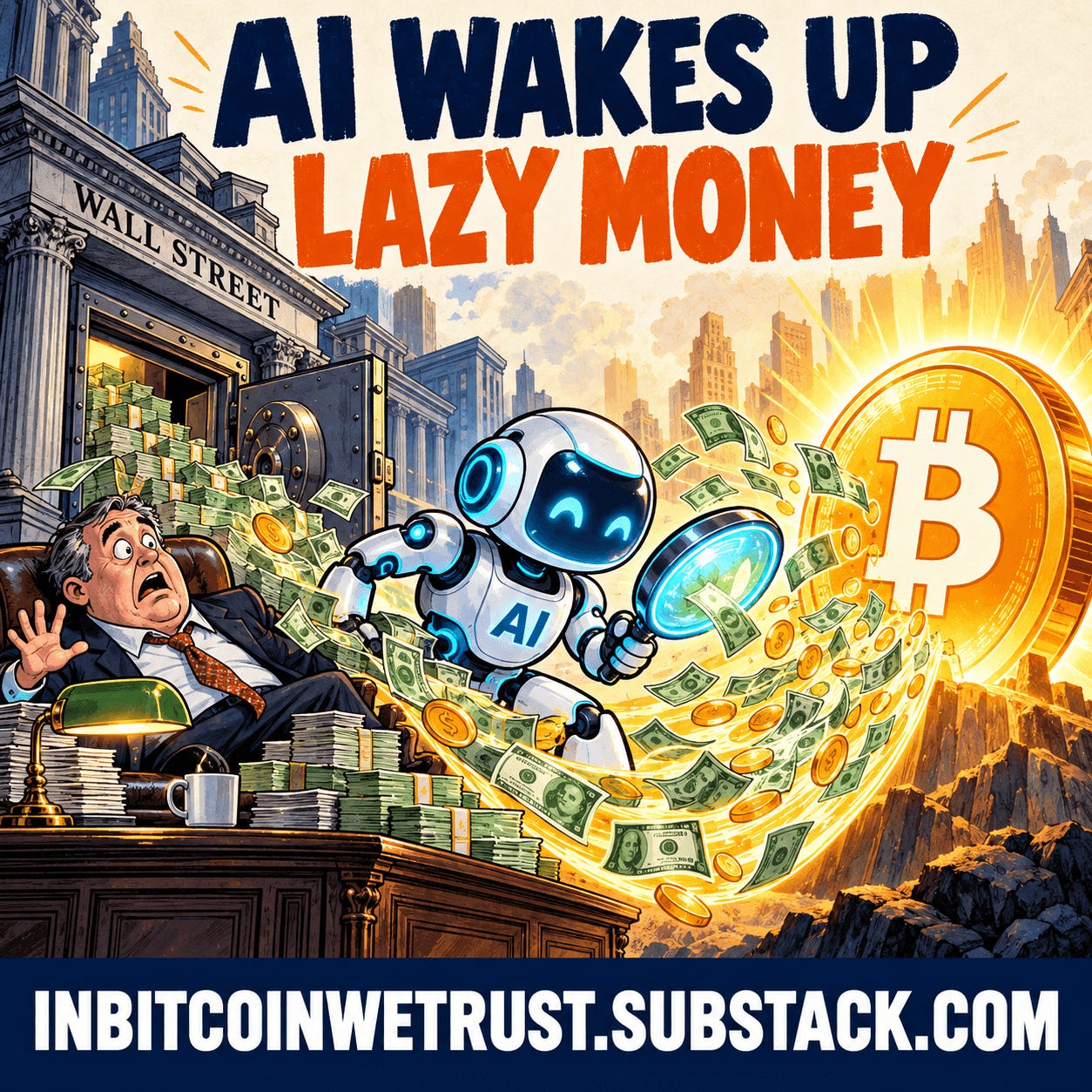
Finance profits from money that never moves and promises nobody rechecks. AI agents could challenge both—and make Bitcoin much harder to ignore.
Your bank’s most reliable asset might be your to-do list.
Somewhere below answering emails, paying the electricity bill, taking the kids to practice, and fixing whatever broke this week, there is a task you keep postponing: figure out whether your money could be doing something better.
Your bank would be delighted if you never got around to it.
You know the savings rate looks disappointing. You suspect the fees could be lower. You vaguely remember seeing a better offer somewhere. But comparing accounts, reading conditions, moving direct debits, checking withdrawal rules, and making sure you have not missed something takes time.
So the money stays.
Multiply that decision across households and businesses, and you begin to understand one of finance’s most durable advantages: customers have other things to do.
Artificial intelligence is coming for that advantage.
And I think the consequences could become one of Bitcoin’s most powerful sources of demand over the next decade.
The connection takes a few steps. Each one matters.
Trusting Corporate Health Over Sovereign Dysfunction.
On September 27, 2026, Apollo chief economist Torsten Slok published a note asking, ** “Is an Agentic Bank Run Coming?”** His concern was straightforward: AI assistants that automatically optimize household cash could pull deposits away from banks relying on cheap funding.
That is a remarkable question for the traditional financial system to be asking.
For years, banks have discussed AI as a way to reduce their own costs. Automate customer service. Process documents faster. Improve fraud detection. Make employees more productive.
Now consider the same technology working for the customer.
Imagine giving an assistant a standing instruction: keep enough cash available for my bills, preserve the protections I need, and tell me whenever the rest could earn more elsewhere after fees and taxes.
That is a much smaller leap than handing a chatbot your entire investment portfolio. It is also enough to make a bank uncomfortable.
Consider a hypothetical $25,000 balance. At 0.1% annually, it earns $25. At 4%, it earns $1,000. The difference is $975 before taxes and fees, assuming the rates last a full year and the alternatives meet the same practical requirements.
The bank has a reason to care about that difference. The customer has a reason to care, too.
Historically, the bank was far more likely to pay attention.
AI could give the customer a permanent attention span.
Cash sweeps and comparison services already exist. Professional investors have used automation for decades. The opportunity is to make that kind of persistent monitoring accessible through ordinary language, with less effort from the person whose money is involved.
Your assistant will not become bored after the fifth account comparison. It will not feel awkward asking why the rate is so low. It will not forget to check when a promotional offer expires.
Reliable execution, account access, security, and customer authorization still have to work. Those are substantial tasks. But the economic incentive to solve them is sitting in people’s accounts.
Banks provide valuable services. Payments, fraud protection, liquidity, and lending all cost money. A lower deposit rate can help pay for services a customer actually wants.
The pressure arrives when a customer can finally see what those services cost—and compare the alternatives continuously.
An institution can defend a good service. Defending a bad deal becomes harder when the customer has someone checking it every day.
That same pressure could move far beyond savings accounts.
The deeper issue is the extraordinary amount of capital committed to assumptions about the distant future.
According to ** SIFMA’s 2026 Capital Markets Fact Book**, global fixed-income debt outstanding reached $160.7 trillion in 2025. That total includes different maturities, issuers, and risks. It is not all thirty-year debt. But it captures the scale of a financial system built around promises to pay later.
Every long-term loan contains a view about the future. A company will retain customers. Its margins will remain sufficient. Its assets will still be useful. Its refinancing options will remain open.
The contract might contain hundreds of pages. The basic economic question is painfully simple: will the borrower still be able to pay?