For daily news, updates, and analysis, be sure to follow us on Instagram. If you are able to support independent journalism, please make a tax-deductible donation to News Not Noise here.
The Trump administration has developed a pretty expansive view of what government should regulate.
Universities and businesses are scrubbing DEI language to protect federal funding. New federal rules and regulations limit when doctors can intervene to protect a pregnant woman’s health. Washington is exerting more control over federal workers and pushing local police to cooperate with immigration enforcement.
So this is not exactly an administration allergic to government intervention.
Then there is AI.
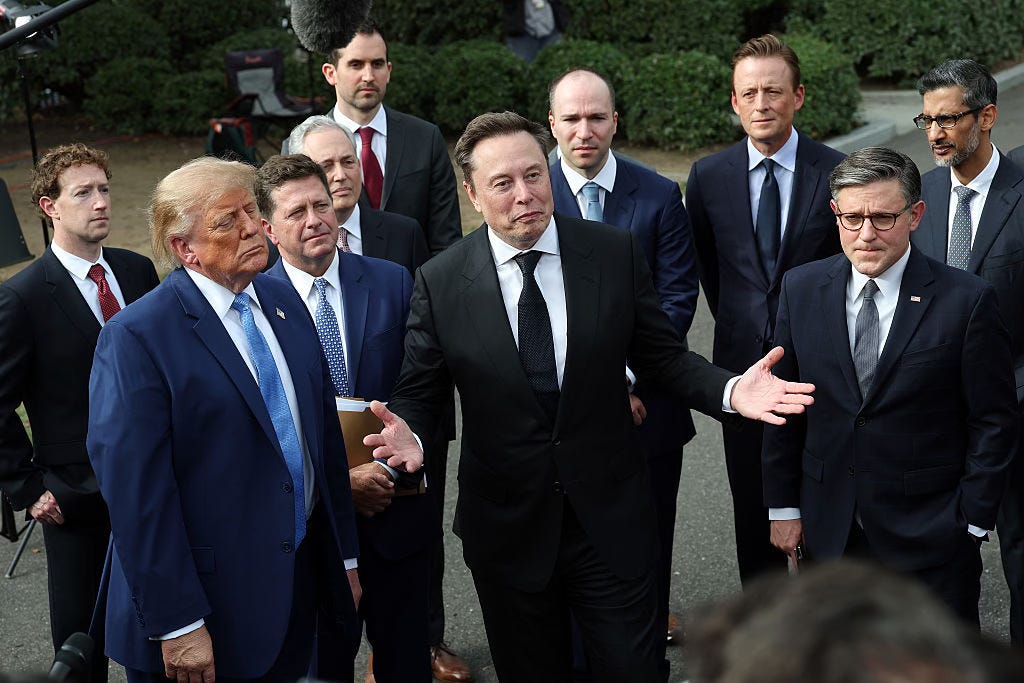
This week, the people building the world’s most powerful technology gathered to agree on rules. The government’s posture? They’re “morally binding.” In other words: We trust you. Please behave.
It’s a remarkable definition of limited government.
Women’s bodies: Proceed with caution. The machines that could transform civilization: Try not to slow the guys down.
Someone may want to clarify what morals we’re binding them to.
In today’s newsletter: Please regulate yourselves. Cornell 7 questions grow. Trump’s bot knows history. A remarkable story in the skies. A very bad audition. Wave hello to El Niño. And America chooses its fattest bear.
Outrage Grows: The New York district attorney who declined to bring charges against the men accused of gang raping a former Cornell studentdefendedhis decision, arguing that even the evidence included in the accuser’s recent lawsuit would not support a criminal case. (Catch up on thathere.) But new evidence raises questions about how much prosecutors really did know when they made that decision. The accuser, referred to anonymously as Jane Doe, told Cornell campus police that while she was “pretty OK” with the initial sexual encounter, she had “100% confidence” that later events amounted to rape, according to a transcript of the interview reviewed byCBS News. The district attorney claims he never saw that transcript. He now says its existence “changes the landscape.” “What more did [he] need to do a thorough investigation?” Jane Doe’slawyer asked. “The failure to do anything is shocking.”We’ll Be Good, Promise: Some of the world’s most powerful AI executives are promising topolice themselvesunder a voluntary safety agreement with Trump that carries no legal force. The agreement, reached at a White House summit,includesinternal controls over AI models and independent assessments by third-party auditors, which will supposedly give everyone “confidence” in AI. (The document also contained a basic spelling mistake, labeling Trump as the “President of the Unites States.”) Trumpsaidthe agreement is “morally binding” and touted the “tremendous self-regulation” it will inspire among a group of AI companies who havefor years promisedand apparently failed to self-regulate. He also announcedplansto set up a 10-person board to oversee AI safety and name an AI czar. House Speaker Mike Johnson, who has repeatedly resisted calls for regulating AI development,arguedAI developers have a “corporate responsibility, as every corporation does, to create safe products.” No doubt a comforting thought for everyone who got more than lettuce in their lettuce this summer. One professordismissedthe voluntary agreement as a “deeply unimpressive” effort that allows AI companies to “define what counts as safety.”Here’s Something: While the White House is relying on promises, the FTC hasopenedaninvestigationinto AI companies, including OpenAI and Anthropic,and METR, a research group used by AI developers to investigate security incidents. The agencyreportedlyplans to demand information from AI developers and testimony from executives as it investigates potential risks to consumers.America Intelligence: Trump alsounveileda new website,America.gov, essentially an AI chatbot to help people get information about federal resources. It’sapparentlypowered by Gemini and Grok. Trumpclaimed, without evidence, that it can’t be hacked. The teambehind the siteincludesvarious DOGEofficials whoreportedly installedcommercial visitor-tracking on other government websites, without required privacy disclosures, as weshared back in June. Meanwhile, theAmerica.govchatbot is already providing users with someinconvenient answers: Biden won the 2020 election and Trump was impeached twice by the House. The botreportedlysometimes refuses to answer what it calls “political inquiries.”Super Powered: Trumpsignedan executive order rebranding artificial intelligence in the federal government as “super intelligence.” He recentlycomplainedthe “artificial” part of the actual name makes it “sound fake.” The rebrandhas caused“.si” domain registrations — that of Slovenia — to skyrocket. (Spare a thought for Anguilla, whichcontrols“.ai.”)Self-Centered: Trump againdismissedwidespread opposition to data centers as a Democratic hoax. He insisted they would “be very popular.”
Stomach Dropped: This sounds like the plot of a disaster movie. A plane flying from Dubai to Tel Aviv diverted to Saudi Arabia after the copilot stabbed the pilot, which Israeli officials say was an attempt to crash the plane. The aircraftplummetedover 17,000 feet in less than two minutes. Passengers say the stabbed pilot managed to unlock the cabin door, and passengers and crew burst in andsubdued the copilot. One passenger says he grabbed the controls and pulled back to stabilize the plane; he claims he knew to do this from watching the TV show “Mayday.” Other pilots who happened to be on board managed to safely land the plane in Saudi Arabia. Authorities there arrested the copilot and hospitalized the injuredpilotandone passenger. Theroughly180 passengers, most of whomwere Israeli, wereflownto Tel Aviv in another plane. The stabbed pilot, Smit Machchhar, who is Indian, is being hailed as a hero for fighting back and having the presence of mind to unlock the cockpit door.Capital Punishment: [Trigger warning: Discussion of extreme violence.] An appeals courttemporarily haltedthe execution of Christa Pike just hours before she was set to become the first woman executed in Tennessee in over two centuries. In 1995, Pike and her boyfriend, then 18 and 17 respectively, tortured and killed fellow teenager Colleen Slemmer. Pike was convicted of murder the following year and sentenced to death. However, Pike’s lawyers argue the jury was not made aware of Pike’slong historyof physical and sexual abuse, which they say could have led jurors to impose a lesser sentence. Her execution isdelayedwhile the appeals court reviews her legal team’s claims.
Keep reading to find out…
What Russell Brand said at a MAHA conference that had Dr. Oz laughingHow a potential 2028 VP for Vance self-immolated in a high-stakes Senate hearingWhat Hegseth directed the Pentagon to do to its generals and admiralsHow a “kelvin wave” is expected to soon raise sea levels off CaliforniaWhich bear was crowned the country’s fattest
All that and more is available to paid subscribers. Your subscription supports independent journalism. Thank you.