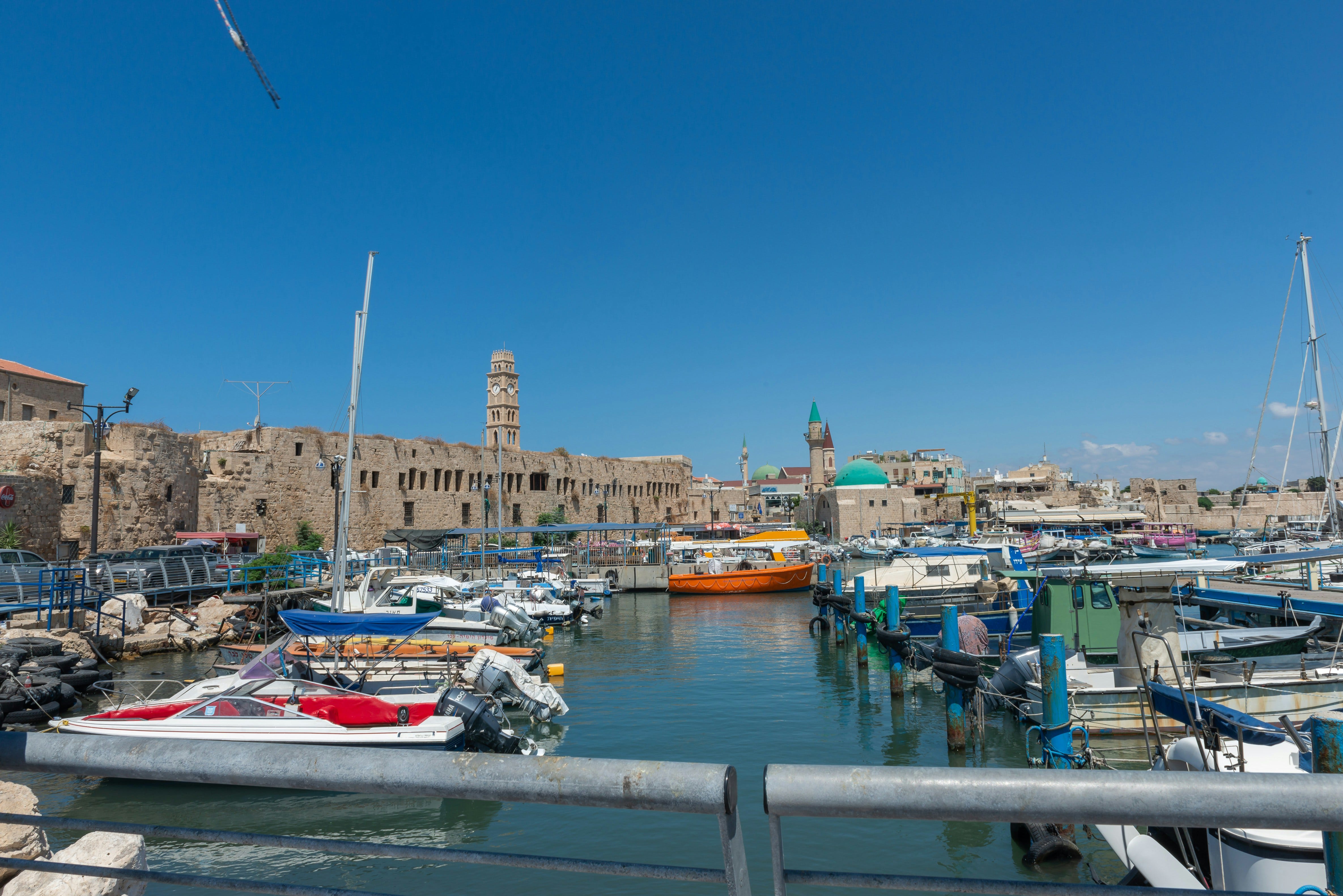
*This is the first in a mini-series inspired by the itinerary for my upcoming trip to Israel. As I looked at the places we’ll be visiting, they all have histories worth exploring long before we ever set foot there. First stop: Akko. *
The Mediterranean reaches Akko in shades of blue and green, breaking against thick stone walls before curling around a harbor that has been receiving ships for thousands of years. Fishing boats rock beside the old seawall. Inside it, narrow passages disappear beneath arches and climb between buildings pressed closely together, while the smell of salt follows visitors into a market filled with fish, coffee, spices, and bread.
The stone is everywhere: walls built against armies, vaults built by knights, Ottoman houses raised over medieval foundations. Passageways end at staircases descending into rooms belonging to another Akko, hidden below the one at street level. Go down far enough, and the eighteenth-century city disappears. Great vaulted halls remain beneath the streets, and a tunnel dug by the Knights Templar still runs underground toward the harbor. Fortifications and chambers belonging to a city destroyed in 1291 survived because later generations built over them.
Akko swallowed its past rather than losing it, and the Crusader city isn’t even close to the beginning.
Ancient Akko developed around Tel Akko, east of today’s Old City, where archaeological remains reach back into the Bronze Age. Its position made its future almost inevitable. The Mediterranean opened westward, roads led inland toward the Galilee and Syria, and its harbor made the city valuable to anyone trying to move goods, people, or armies through the region.
Akko appears in the Hebrew Bible in Judges 1:31, among the cities in the territory allotted to the tribe of Asher. The text says Asher did not dispossess its inhabitants, which fits the broader history of Akko as an established Canaanite and Phoenician coastal city rather than an Israelite-founded settlement.
The city endured as rulers changed. Assyrians controlled it. The Persians followed. Alexander’s successors ushered in the Hellenistic period, when the center of settlement shifted toward the peninsula where Old Akko is located today, and the city became known as Ptolemais. For a period it came under Hasmonean control before Pompey’s conquest brought the region into Rome’s orbit.
Through all those changes, the harbor remained the constant. Armies used it, merchants used it, and Jews used it. Centuries later, Jewish travelers arriving by sea would step ashore at Akko and understand that they had reached the Land of Israel.
One of them was Benjamin of Tudela.
By the time Benjamin reached Akko around 1170, the skyline had changed completely. The Crusaders had captured the city in 1104, and churches, military compounds and enormous fortifications rose behind its walls. Genoese, Venetian and Pisan merchants established quarters of their own. Pilgrims crowded the harbor before continuing toward Jerusalem, while ships unloaded soldiers, clergy, merchandise and immigrants arriving from across the Mediterranean.
Benjamin found an established Jewish community among them. He reported that approximately 200 Jews were present and recorded the names of three of their leading scholars: Rabbi Zadok, Rabbi Japheth and Rabbi Jonah. Akko’s Jewish heritage history describes a community with judges and communal institutions operating inside one of the great Christian cities of the Crusader world.
A few years before Benjamin arrived, another Jewish family had stepped ashore there. Moses ben Maimon came through Akko in 1165 with his father and brother after the family fled persecution under the Almohads. Maimonides didn’t remain permanently, but his connection to the city’s Jews continued. Rabbi Japheth, the same judge Benjamin later named, became his friend.
Picture the harbor during those years: Latin-speaking clergy arriving beside Italian merchants, Muslim traders moving cargo through the port, Christian pilgrims beginning the journey toward Jerusalem and Jewish families stepping ashore after voyages across the Mediterranean. Somewhere among them walked a young Maimonides.
More Jews were coming.
In 1211, a famous wave of Jewish immigration brought rabbis from France and England into the Land of Israel. Jewish tradition remembers the movement as the arrival of 300 rabbis. Akko became an important center of Jewish scholarship, drawing Jews from Europe, Egypt, Syria and North Africa.
Rabbi Yechiel of Paris eventually established his yeshiva there. Jewish legal questions traveled to Akko, and answers traveled back out. Akko’s Jewish Heritage Center describes the twelfth and thirteenth centuries as a Golden Age of Jewish life in the city, a period when scholars were teaching Torah within walls controlled by Christian military orders.
Then, in 1267, Moses ben Nachman arrived in the Land of Israel. The Ramban was already an old man and one of the greatest Jewish scholars of medieval Spain. After the Barcelona disputation and his departure from Christian Spain, he reached Jerusalem and found its Jewish community devastated. He helped reorganize Jewish communal life there and later returned north to Akko.
On Rosh Hashanah in 1269, Jews gathered in an Akko synagogue to hear Ramban deliver a sermon. Outside those walls stood Crusader churches, military compounds and the crowded commercial quarters of a Christian kingdom. Inside, one of the most important rabbis in Jewish history was teaching Torah. His family remained connected to Akko; the city’s Jewish history places his grandson there when everything came apart in 1291.
In the spring of 1291, the Mamluk army surrounded Akko. Siege engines battered its defenses while soldiers fought their way toward the walls. Refugees crowded the harbor looking for ships, and on May 18 the defenses finally broke.
The destruction was immense. People who reached ships escaped; others were killed or captured. Churches, military compounds and fortifications were torn apart as the last great Crusader stronghold on the mainland collapsed. Akko’s Jewish community disappeared along with the city around it.
For generations, the once-crowded port sat largely ruined. Buildings collapsed, debris accumulated and entire rooms and streets vanished beneath the ground. The great Crusader halls became buried chambers, sealed beneath the remains of a city that no longer existed.
That destruction is part of the reason so much survives today. When Akko rose again centuries later, its builders constructed another city above the medieval one. Walk through the Knights’ Halls now, and you’re moving through rooms that disappeared beneath later Akko. Follow the Templar tunnel, and you’re walking underneath streets and houses occupied by people who live in the city today.
Eventually, people returned to Akko. Jews did too.
In 1741, Rabbi Abraham Ishmael Ḥay Sanguinetti of Modena, Italy, arrived in Akko with the group led by Rabbi Chaim ibn Attar, the Or HaChaim. Sanguinetti wrote home to his father, leaving us something far better than a later description of Jewish Akko: the words of a Jew who was actually standing there.
He described an established Jewish community and a large, tall synagogue with twelve windows known locally as the Knesset of Ahab. Within a few years, that synagogue was taken from the Jewish community and converted into a mosque. The Jews received a much smaller building nearby. Sanguinetti’s 1741 letter in the Posen Library
Then Rabbi Moshe Chaim Luzzatto arrived.
The Ramchal was born in Padua and was already known as a rabbi, kabbalist, and writer whose Mesillat Yesharim would become one of Judaism’s most influential works of ethical thought. After years of controversy surrounding his mystical writings in Europe, he reached Akko in 1743 and spent the final years of his life there.
The smaller prayer house became associated with Ramchal and survives in the Old City. Akko’s Jewish community also maintained communal institutions including a bathhouse and mikveh, leaving physical traces of Jewish life through the Ottoman centuries. Ramchal died during a plague in 1747, only a few years after arriving.
A few decades later, another Jew would become one of the most powerful men in Akko. His world had little to do with the quiet study of Ramchal’s synagogue.
His name was Haim Farhi.
Farhi came from an influential Jewish family in Damascus whose members had experience as financiers and government officials. He entered the service of Ahmad al-Jazzar, the Ottoman governor who ruled from Akko and whose nickname, “the Butcher,” captured the reputation he had earned.
Farhi became al-Jazzar’s financial adviser and minister. He helped administer Akko’s finances and building projects and became deeply involved in the government of the Galilee. Jews gathered around a wing of his residence known as Dar al-Muallem, and a Jewish neighborhood developed around it. From his position inside the Ottoman administration, Farhi also supported Jewish communities in Akko and elsewhere in the Galilee.
His position offered no guarantee of safety. Al-Jazzar eventually turned on his adviser and had him mutilated, costing Farhi an eye and parts of his ear and nose. Farhi nevertheless returned to the ruler’s service. He remained there in 1799 when word reached Akko that a French army was moving north along the Mediterranean coast.
Napoleon was coming.
This article is part of a mini-series inspired by the itinerary for our June 2027 Israel trip, which is open to members of this community with a paid subscription. We’ve put together 10 days of history, archaeology, food, culture, volunteering, incredible access, and much more.
Paid subscribers can head to the subscriber chat to find out dates, itinerary, and how to join us in Israel. 🇮🇱
And now, back to Akko...because its next chapter takes us inside the prison walls.