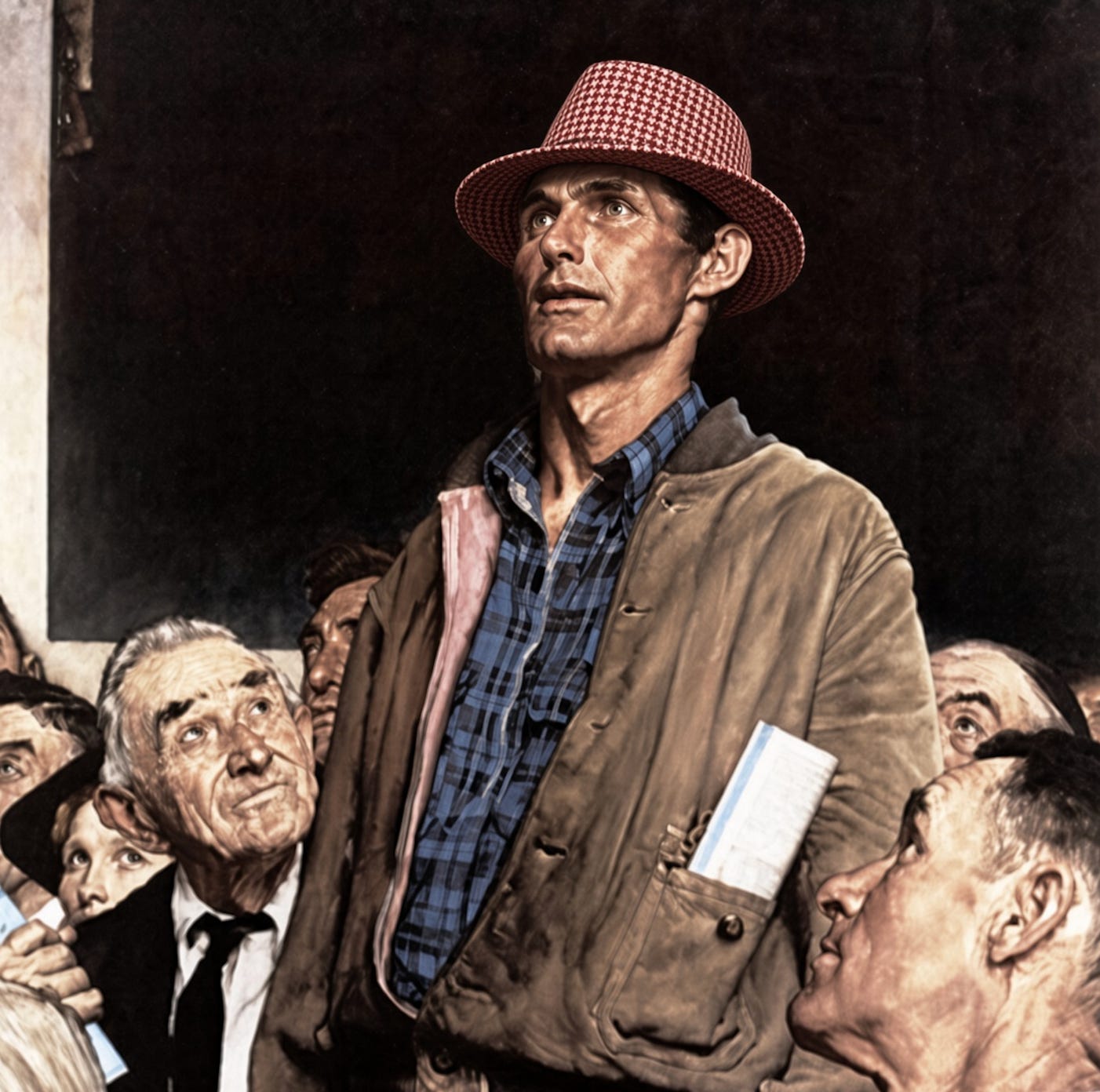
My friend Lee last night took me to a town hall meeting in the small town of Westover (pop. 2000). About 300 people — that’s over 10 percent of the town — gathered in an Assemblies of God church to meet with four men representing the developers of a proposed data center, which is strongly opposed by many. I tell you, it was enough to renew your faith in democracy.
What are data centers, and why are some people so angry about them? Grok defines them thus:
Data centers are specialized physical facilities (buildings, rooms, or campuses) that house computer systems, servers, storage devices, networking equipment, and supporting infrastructure. They serve as centralized hubs for storing, processing, managing, and distributing large volumes of digital data and computing workloads.
Basically, giant warehouses storing servers. Doesn’t seem like it should be that big of a deal, but people* really* hate them. 𝕏Look at this:
Opponents fear that these things will use up too much water (to cool the servers), introduce constant low-level noise into the environment, use so much electricity that it will drive up their electric bills, and various other problems. All of that came up in last night’s two-hour meeting. But mostly it was this, as described in this excellent interview with a Silicon Valley journalist who traveled throughout the Midwest recently to find out why so many local folks hate the things:
But what did I see? There was a bunch of stuff that was surprising, and again, it kind of shows what a bubble I was in. One is that a lot more people were really furious not just at the AI companies, but at their local governments. I kind of thought that everyone would hate AI because of the job stuff, or that they were really suspicious of OpenAI, Meta, whatever. And there was a general negative-ish sentiment toward AI and AI companies. But when I asked activists what riled you up, or why are you frustrated with this data center, it was much more about: we hate how our local council or our mayor kind of bent over and sold out to these tech companies. So it was much more a story of dark money and politics and corruption, and your democratically-elected officials selling you out to some big corporation who shows up with a check and an NDA, more so than anger about the technology.
I actually heard very little about the technology unless I explicitly prompted people — hey, what do you think of ChatGPT, do you use it? Some people were like, yes. Some people were like, no. Most people were like, sometimes it’s not that useful, but it’s fine. That was kind of the median response I got about ChatGPT. As someone who spends a lot of time in the tech world, all we think about is “big model scary”, but over there it’s much more “big corporation scary”. And so I found that really surprising.
Oh, yes indeed. The crowd in the jam-packed church last night was about as angry at its town council members as it was at the four data center men on the stage! Before I get into it, here is a map, from a website run by the activist Erin Brokovich, on the number of data centers either existing or under development in the US. I had no idea there were so many!
Last night’s meeting was a very Alabama thing, and honestly, it was a great exercise is civic action. They held it in a church, and opened the proceedings with a prayer. At several points in the evening, people asked their fellow citizens to pray for the town council and civic leaders as they try to figure this out. But when one of the four data center men pointed out in his remarks that “Jesus Christ is my Lord and Savior,” folks in the audience seemed to feel patronized (I don’t blame them).
So, what’s this about? A couple of years ago, it seems, some property developers bought up over 400 acres of nearby land, and worked with the then-mayor, the planning commission, and the city council to start the process. At some point more recently, local people woke up to what was happening, and many of them hit the roof with anger. They came to believe that they had been deceived, that all of this happened without their knowledge.
It was pointed out several times last night that all the planning meetings had been posted and open to the public, but some citizens pointed out that they weren’t well publicized, and the public announcement was done in a minimal way, such that you would have to be paying close attention to know what was going on. The entire issue has really roiled the small town. It cost the previous mayor his job, and judging by the comments last night, locals have been savaging each other on Facebook over it. (Though by show of hands, nearly everybody in that church last night was against the data center, two or three people over the course of the evening begged their fellow citizens to stop abusing each other on Facebook.)
I didn’t get the name of the four data center men onstage. Over the course of the evening, they answered people’s questions. No, the center will not draw water from the aquifer, but from the municipal pipe running along the highway. It will use a “closed loop” cooling system that recycles the water, changing it out every few years. The tree line planned to buffer the site from the highway will lower the decibels, they said, and anyway, they’ve all agreed in writing that the center has to abide by standards that exceed what the EPA requires. Anyway (they said), the buildings will only cover about 120 acres on the 400+ acre property; the rest is for buffer. The county’s civil engineer remarked that this planned site “far exceeds” anything required of it by the local building codes (meaning that the building will be much better than it has to be by law). And so forth.
The four men also pointed out that the data center will produce hundreds of millions of dollars in tax revenue for the county to use in its schools, or whatever it wants.
None of this placated the crowd. Addressing the crowd, one local man said, “They have been deceitful from the get-go, in my opinion.” Applause all around. One local woman said she had spent hours going through public documents — documents she said the city made her pay $20 per each hour she searched them, even though they’re official government documents — and it looks to her like the city council pushed this thing through improperly. A well-known plaintiff’s lawyer from Birmingham who owns property in the town showed up, and said from his examination of the documents, it looks like city officials improperly approved it. “That guy is a big-deal lawyer,” my friend whispered in my ear. Not the kind of figure you want against you, if you’re the data center people.
There was some crazy talk, as there always is. One woman complained that the data center is a “military target” that will put them all at risk. Another woman demanded to know if this thing might end up being “another Chernobyl.”
But mostly, it seemed to me that the questions asked and the concerns expressed were legitimate. The issue of NDAs (non-disclosure agreements) kept cropping up. Apparently in some of these cases around the nation, city officials have signed NDAs to hide from the public who is behind building the data centers. Why the NDAs? From that great Nate Silver interview with Silicon Valley journalist Jasmine Sun:
[Sun:] The data center developer would be evaluating a bunch of different potential sites in different cities, and they would present it as an economic development thing.
We’re going to contribute so much to your tax base. Who wants it? Who’s going to hand us some subsidies? Who’s going to build out some roads?So they would often engage in a competitive bidding-style process where they’re evaluating multiple towns or cities at once, and during that process the NDAs would prevent towns and cities from talking to each other. Another reason for the NDAs was that sometimes you need to buy out farmland, and as soon as farmers know that it’s a data center showing up and not some other project, they’re like, wow, let me add another zero to that price tag. So I think the NDAs were really a way to create a power asymmetry, frankly, in the negotiations between the data center developers and the people they were negotiating with.
In this new podcast interview, Brockovich tells David Remnick that these data center builders come into small towns and overwhelm local elected officials, in part by promises of a big tax payday for the municipality.
The four men in Westover last night emphatically denied that NDAs were involved in their project. Even if they were being truthful, you can see why local people are mistrustful. Several who stood to speak expressed cynicism about what they were hearing. One woman said that once the data center goes in, if things don’t turn out as nicely as the four men promise, what happens then? One of the four pointed out that there are remedies in law if the data center fails to live up to the codes. But then one man responded, “I feel like if y’all break your promises, you’re just going to pay a fine, and keep on making a profit.”
(At this point, my friend, an Alabama native, leaned over and whispered that people have long memories of how Monsanto poisoned the river in a nearby part of the state by pumping into the water cancer-causing PCBs, which internal company documents proved that the Monsanto knew was dangerous. Monsanto settled the lawsuit for $700 million back in 2003. The point is, local people have experience with exploitative corporations.)
Here’s the thing: are data centers really as bad as people think? Because people think they’re *really *bad — so bad that they would rather have a steel plant built in their neighborhood than a data center. Seriously:
At the meeting last night, one woman on the planning commission stood up and, addressing the crowd, said that she wonders why nobody came out to fight the 3,000-house subdivision that just got approved for the area. In the only grumpy comment of the evening from the data center men on stage, one of them mused, no doubt correctly, that if they were putting a Walmart super center in on that property, nobody would care.
I confess that I haven’t been following this story at all. A year or so ago, I found out a data center is going in down in West Feliciana, my hometown. It’s going to be in an area some distance from where people live, and is going to bring hundreds of millions of dollars in tax revenue to the parish (county). I thought this sounded like a good idea. The parish is not industrialized, and this is a great source of needed tax revenue from a non-polluting industry. Nobody will even have to see the thing. Interestingly, it’s going to be near the site of a now-closed paper mill, which during my childhood often made the air smell horrible. (“It’s the smell of money,” people would say, coping.)
But it’s a big, big story. After the meeting last night, I got to thinking that this phenomenon is not about data centers per se. I completely get why someone would have concerns about such a thing turning up locally, but it doesn’t make a lot of sense to me that people would rather have much noisier and more polluting industry go in than a data center. At the meeting last night, the four men on stage patiently explained that yes, there are some “bad data centers,” but listed how this one will be different — and gave details. Someone in the audience wanted to know why these people were choosing to come ruin a nice rural area with their data center. One of the men on stage pointed out that the area where the data center will go in has long been zoned as industrial, as it lies along a major highway.
You could make a good case that the fears of the people in that room about this particular data center are largely unfounded. But see, that’s why I don’t think this issue is about data centers themselves, in general. I think it’s about two bigger issues, of which data centers are a condensed symbol:
General lack of trust within American society****Fear of AI
One man named Emmitt said from the podium last night, “In America, we are in the middle of a trust crisis. People stand up and say one thing, and then it doesn’t happen.” Another woman, with long gray hair, said that she has spent most of her life fighting to preserve the Cahaba River watershed, and that she has learned not to trust corporations, developers, and public officials. Said she, “They’re going to tell you anything they want” — then do what they damn well please.
It was very, very clear last night that lack of trust is the main issue in Westover. All the people in that room last night believe, rightly or wrongly, that the city council was all in the bag for the developers, and hustled this project through. One of the four data center guys said that the town’s city council members traveled to other data center sites around the country during the approval process, to see how things work, and were satisfied that this could be a good thing for Westover.
“But did they go to any of the bad data centers?” a man in the crowd asked.
A woman said near the end that it seems wrong to her that small-town people should be forced to master complicated planning documents and concepts, and not given enough time to understand what’s being proposed. “We should not have to be experts,” she said.
The mayor of a nearby small community stood to affirm this, saying the people who govern little towns like his just don’t have the expertise to grasp the technical details of projects like this, and need time to study them. (Last week, under public pressure, the Westover city council passed a six-month moratorium on proceeding with their data center.)
And then there’s the fear of AI. The woman with the long gray hair said that she loves her iPhone, but that she doesn’t need all the other conveniences promised by AI, not at the cost of her peace of mind and the tranquility of their rural paradise.
That was as close as the evening came to questioning the benefits of AI itself, but I sense that this has a lot to do with the opposition, even if the opponents don’t really know it. This tweet captures what I think is really going on here:
I’m old enough to remember how widespread fear of nuclear power in the wake of the Three Mile Island disaster in 1979 shut down building nuclear power plants in America. Boy, in this era of global warming, don’t you wish we hadn’t done that? When I think about data centers, I hope that we aren’t doing the same thing: allowing fear of a new technology to cause us to harm the long-term good. I’m not saying that I favor data centers, please understand; it’s just that I am somewhat skeptical of the panic.
That said, people aren’t wrong at all to worry about the accelerated rate of change, especially around AI. They aren’t wrong to worry that in our democracy, they are losing control over their own destinies to faraway tech oligarchs, corporations, and the politicians who support them. And they damn sure aren’t wrong to worry about what the coming of AI is going to do to wreck our way of life. It could be that people tell pollsters they would rather have a steel smelter close by than a data center because they understand what steel-making technology is. No steel plant ever threatened to destroy half of all white collar jobs, as Anthropic’s Dario Amodei said AI would likely do, and soon.
At the end of the evening, the town’s mayor closed the event out by saying that he was on the town planning board when the two votes…