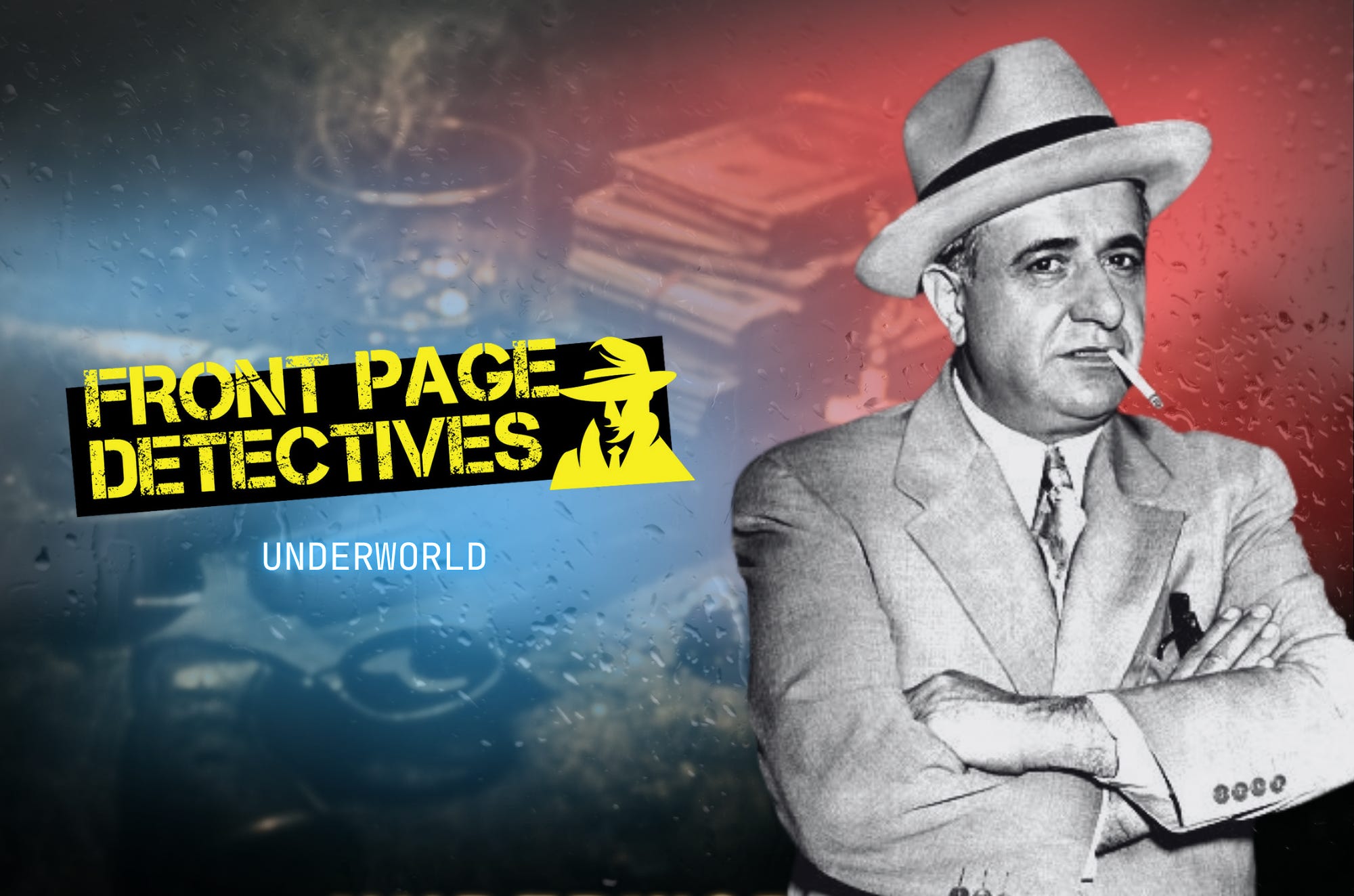
There were men in New York who killed because they were angry, men who killed during robberies and men who killed because another gangster had strayed onto the wrong street. Albert Anastasia belonged to something considerably more unsettling. In the underworld that took shape around him, a man could die because somebody he had never met had decided, in another room, that his continued existence had become inconvenient.
By the 1930s, that decision might set an extraordinary machine in motion. A name could be passed from one criminal to another. Somebody would locate the target. Somebody else might provide a car. A weapon could appear. Men with no personal grievance against the intended victim would receive an assignment and wait outside an apartment, a candy store, a restaurant or a union hall. When the killing was finished, the people who had ordered it might never have gone anywhere near the corpse.
The newspapers eventually found a name for this world: Murder, Inc.
It sounded almost too good to be true, as though somebody had invented a gangster story in which homicide had been transformed into a corporation. There was no office bearing the name, no payroll department for assassins and no switchboard where Mafia bosses ordered murders. Yet the reality exposed by prosecutors was disturbing precisely because it required so little mythology. New York contained groups of professional criminals for whom killing could become another piece of organized work, carried out in the service of rackets that generated enormous amounts of money.
And somewhere close to the center of that story stood Albert Anastasia.
He was a Calabrian immigrant who had come ashore in New York as a teenager and simply failed to return to his ship. Within a few years he had been convicted of murder and sentenced to the electric chair. He survived. Over the decades that followed, witnesses changed their stories, cases disintegrated and bodies accumulated around the criminal worlds through which he moved. His power spread from Brooklyn’s streets to its waterfront, where thousands of men depended upon a labor system vulnerable to intimidation, corruption and violence.
Anastasia became one of those gangsters whose reputation eventually grew larger than the evidence that created it. Newspapers called him the “Lord High Executioner.” Later accounts would attach him to an extraordinary number of deaths. Stories portrayed him as the commander of an army of killers, a man capable of having somebody erased with a few words.
Some of those stories became legend. Others were frighteningly close to reality.
The important question was never simply how many people Albert Anastasia personally killed. It was how a man repeatedly associated with murder managed to become more powerful each time authorities failed to stop him — and how violence itself became incorporated into the business of American organized crime.
The answer leads through the Brooklyn docks, the Mafia wars of Prohibition, ice-pick murders, disappearing union reformers, assassins sent across state lines and frightened witnesses who had every reason to reconsider what they had seen. It leads to Lucky Luciano, Lepke Buchalter, Dutch Schultz and a collection of killers with names such as Pittsburgh Phil, Happy Maione and Kid Twist. Eventually, prosecutors would persuade some of those men to explain how the machinery worked.
For a time, it appeared that the machinery might finally lead them to Anastasia.
That was always the danger in a system built upon professional murder. Sooner or later, somebody might start talking.
And once that happened, there were only two ways to solve the problem.