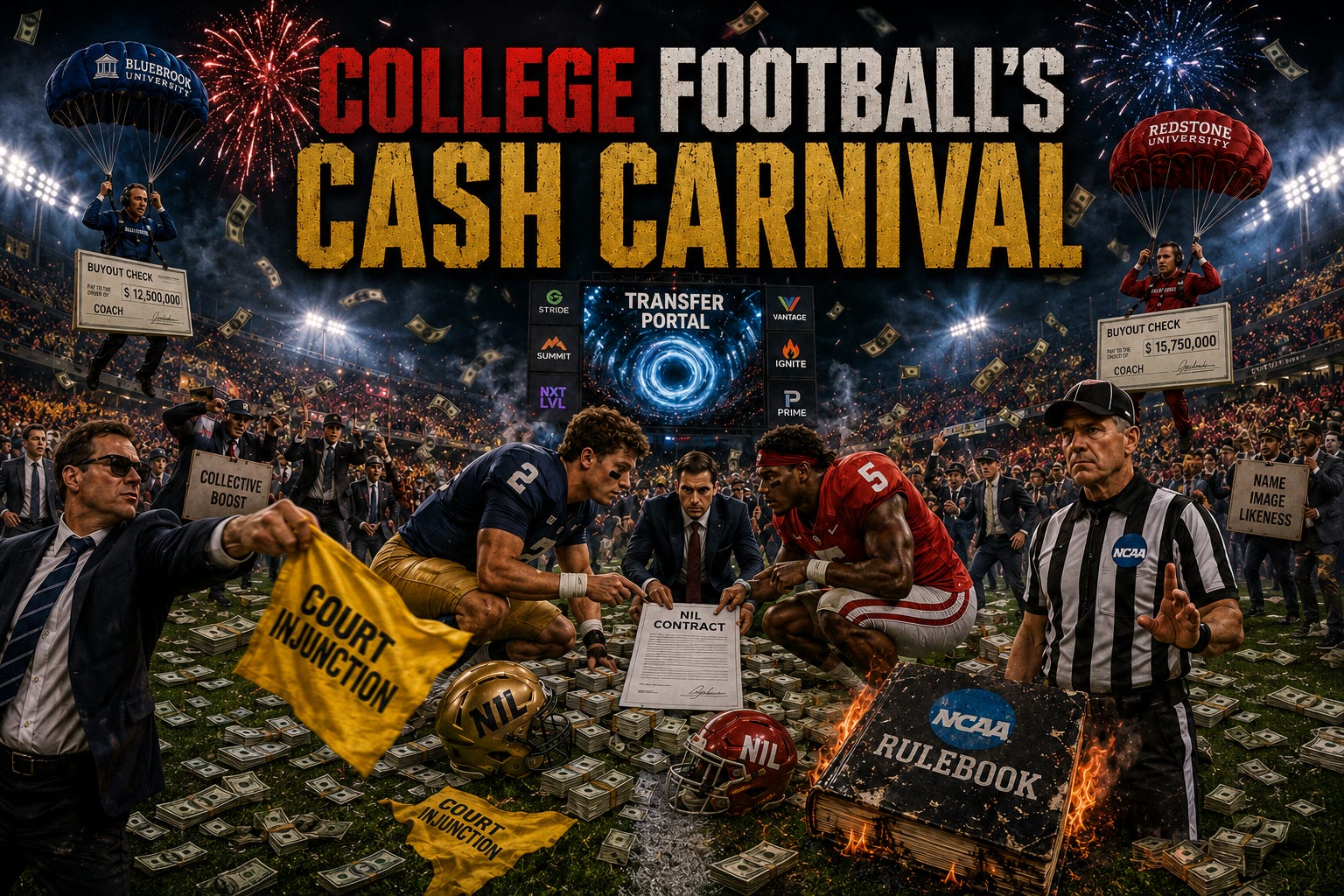
LUTHMANN NOTE: College football has completed its metamorphosis into professional entertainment while clinging to the tax treatment, pageantry and institutional prestige of higher education. I don’t begrudge the players their money. They were the indispensable labor force in a multibillion-dollar machine that spent decades pretending scholarships settled the account. The scandal lies in the governing class. The NCAA resisted reform until litigation broke its grip, then replaced its antiquated rulebook with a new maze of caps, loopholes and courtroom emergencies. The sport remains magnificent. Its management is a cash-soaked burlesque. This piece is “All-American Mayhem,” also available on FL Gulf News.
College football officially kicked off this weekend after an offseason that made it seem like the sport had been locked in a room with an angry leprechaun. To say it was loud, chaotic, or anything resembling the game anyone grew up watching would be the understatement of the year.
It was, however, very entertaining.
The NCAA, in its boundless quest to prove it can always make a bad situation worse, rolled out a new “age-based” eligibility policy this summer. Athletes generally receive a continuous five-year eligibility window beginning when they enroll full time or at the start of the academic year following their 19th birthday, whichever comes first.
Simple? Never.
This is the NCAA.
Instead of assuaging the legal firestorm that has been simmering since 2024, the new rule triggered another avalanche of lawsuits from athletes in the high school Class of 2022. They fell into an eligibility ditch between older players who received pandemic relief and younger players covered by the new system. A federal judge initially granted relief, an appellate court paused it, and athletes began pursuing additional injunctions in state courts.
In turn, football programs spent July and August frantically adding eligible players like they were stocking up for a hurricane.
Plenty of programs went shopping in the “Fifth-Year Senior” discount aisle. Meanwhile, the NCAA remains in court trying to reverse the eligibility of players who are already practicing. As we enter the season opener, nobody will admit that they truly know who is allowed to play.
For the second straight year, players can earn NIL money and revenue-sharing money. The revenue-sharing cap is approximately $21.3 million across all sports, with loopholes big enough to drive an overweight booster’s yacht through.
Third-party NIL deals have become the sport’s preferred avenue to pretend the cap exists while largely ignoring it. The College Sports Commission remains stuck in legal purgatory, clearing thousands of agreements, rejecting hundreds more, and issuing strongly worded statements nobody reads. Its authority and standards remain entangled in litigation and arbitration.
The results have been predictable. Multiple power-conference football programs are reportedly pushing payrolls of $40 million or more once school revenue sharing and outside NIL arrangements are combined.
And those numbers will only increase.
Last season’s coaching carousel wasn’t a carousel; it was a demolition derby. Fired FBS coaches were owed an estimated $167.7 million in buyouts, underscoring how athletic departments treat money like confetti, except when it comes to the media’s pregame meal.
UCLA dumped DeShaun Foster. Florida dumped Billy Napier. Penn State dumped James Franklin and handed him about $49 million as a parting gift. LSU fired Brian Kelly and agreed to a buyout so large it probably required congressional approval. Then LSU hired Lane Kiffin, who left Ole Miss on the eve of a historic Playoff run because money is creed.
Bob Chesney of Kulpmont, Pennsylvania, is running UCLA. Kiffin now leads LSU. Pete Golding took over Ole Miss. Franklin landed at Virginia Tech. Matt Campbell slid into Penn State. Jon Sumrall is at Florida. Napier is at JMU.
Michigan fired Sherrone Moore, who was later sentenced to 18 months’ probation after pleading no contest to malicious use of a telecommunications device and trespass in the most bizarre coaching story in a generation. More serious charges were dismissed under the plea agreement. Kyle Whittingham took over in Ann Arbor armed with a fire hose.
With roster costs exploding and buyouts reaching lottery numbers, programs need new revenue streams. Enter jersey patches, because nothing says “tradition” like slapping a crypto logo on your jersey.
Effective Aug. 1, Division I programs can display up to two additional commercial logos on uniforms and apparel and another logo on equipment during regular-season competition. Power-conference programs jumped immediately. Others followed. Even Army got in on the action through a partnership with USAA. The Big 12 went full NASCAR and signed a multiyear agreement with Monster Energy reportedly worth $20 million annually.
College football is back.
It is messy, expensive, and litigious, making it an all-American must-watch.