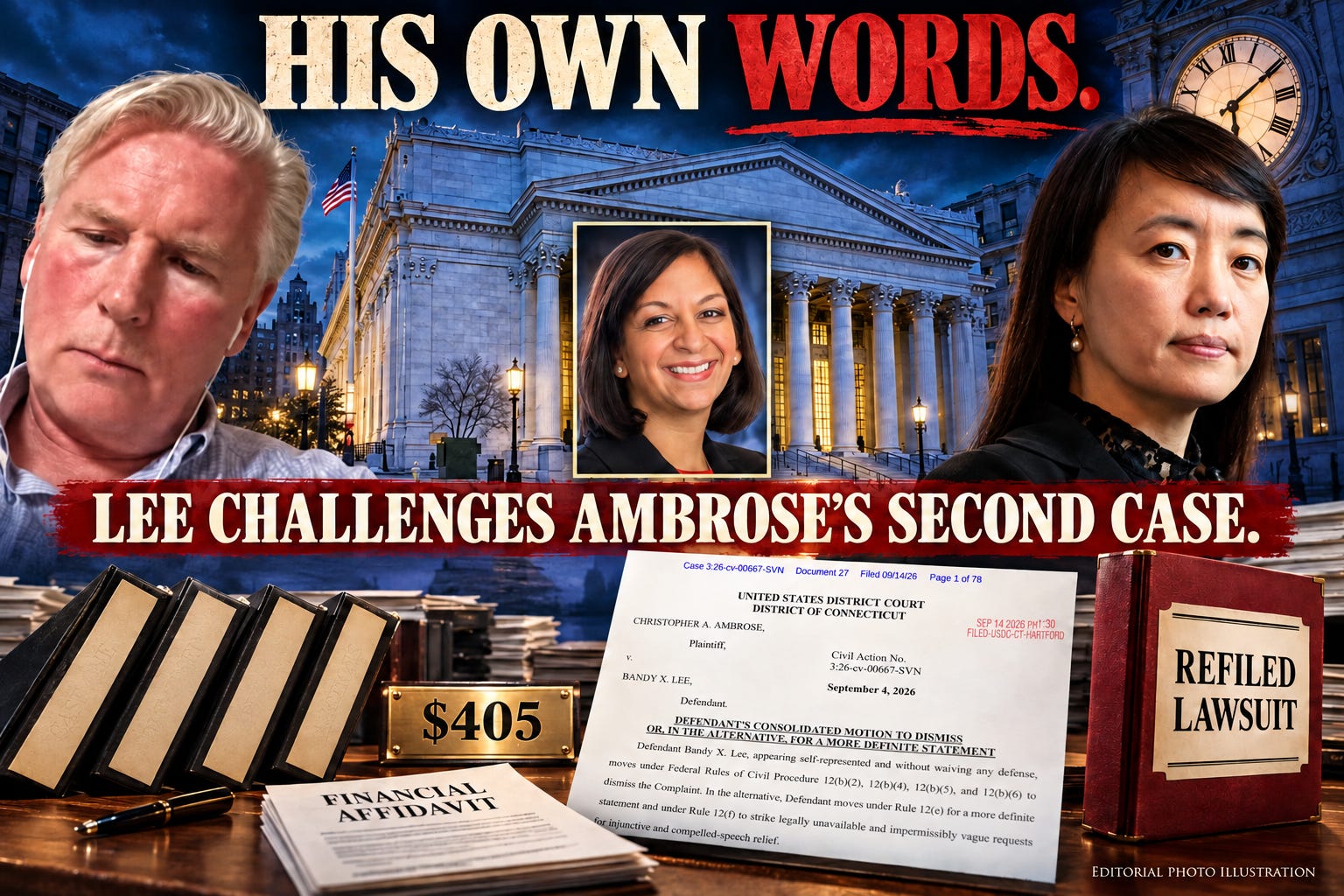
LUTHMANN NOTE: I have interviewed Dr. Lee, criticized Ambrose in published reporting, and sued him in separate litigation. Readers deserve that disclosure. They also deserve to know whose findings brought down his first case: Judge Nagala’s. Ambrose demanded accountability for false statements while submitting financial answers the court found untrue. His own records exposed the contradiction. Now he wants another chance to pursue the psychiatrist who took his daughter’s sexual abuse allegations seriously. He’s entitled to argue his case. He isn’t entitled to have the reason for its first dismissal forgotten. A $405 receipt cannot make a false sworn affidavit true. This piece is “Ambrose’s $405 Gamble Comes Due,” first available on The Family Court Circus.
Christopher Ambrose’s own false financial representations killed his first federal lawsuit against Dr. Bandy X. Lee. They should also keep him from using Connecticut’s savings statute to revive expired defamation claims. A litigant who loses his case because his sworn answers contradict his financial records has a serious problem calling that failure an accident.
Ambrose sued the psychiatrist who took his daughter’s abuse allegations seriously and warned about his potential dangerousness. He wanted a federal court to hold Lee accountable for statements he said were false. Instead, U.S. District Judge Sarala V. Nagala examined his finances and found his own representations untrue. She dismissed the case on April 15. Two weeks later, Ambrose paid $405 and filed again.
Lee’s September 14 motion to dismiss attacks that second action on several grounds, including Connecticut’s two-year deadline for defamation claims. Her argument is straightforward: the older publications are outside the deadline, and the financial misrepresentations that destroyed the first case should disqualify Ambrose from the statutory protection he needs to rescue them. His response in the refiled action is due Monday, October 5.
The motion remains undecided. The findings that brought down the first case are already on the record, and they give Lee a substantial argument against another round of litigation over expired claims. Ambrose obtained permission to submit another complaint. He still must establish that the law allows him to pursue it. Paying the filing fee bought entry into a new case; the court must now decide what survives inside it.
Ambrose filed his original action on March 17, 2025, seeking to proceed without prepaying court fees. That benefit required truthful financial disclosures. When Lee challenged his application, Nagala ordered him to produce records. Those records exposed contradictions involving income and securities that Ambrose himself had represented he did not have.
The judge identified a $169.45 royalty payment from November 2024 that contradicted his answer concerning income. More consequentially, she found substantial stock holdings in a Fidelity IRA after he had affirmatively denied owning stocks, bonds, or securities. His application mentioned drawing down a modest retirement account, but that disclosure did not cure the separate denial. The problem was visible in his answers and the records supplied to verify them.
Ambrose invoked federal student-aid guidelines to explain why he thought retirement assets were excluded. He also said he had been rushed. Nagala rejected those explanations, finding no reasonable basis for applying the asserted exclusion to the court’s question. She described the securities representation as “patently untrue.” Under 28 U.S.C. § 1915(e)(2)(A), dismissal followed. Offering to pay after the problem surfaced could not save the action.
Nagala dismissed without prejudice and declined a criminal referral and attorney’s fees. She did not enter a criminal fraud judgment. What she did find was damaging enough: Ambrose’s financial representations failed scrutiny, and federal law required dismissal. His principal civil claims had survived the March 31 pleading ruling. His own disclosures then brought the case down. That sequence puts responsibility for the lost action squarely on the plaintiff seeking another chance.
Behind the defamation claims stands Mia Ambrose’s account of life with her father. In her May 29, 2023 written statement, she alleged unwanted sexual touching, invasions of privacy and intimidation that made her afraid to seek help. She described objecting to the contact and said her father treated her objections as an overreaction. She also accused him of removing bedroom doorknobs and secretly recording the children.
Her statement described threats involving police, child-protection authorities, and separation from their mother, Karen Riordan. Mia also reported degrading insults, restrictions on communication with her mother, and delayed treatment of an injured toe. She said she left her father’s home on April 22, 2023. In a later petition reproduced publicly, she sought protection and identified recordings, photographs, journals, and witnesses she said supported her accusations.
These were detailed allegations from the daughter describing the conduct, made well before her father filed his federal lawsuit against Lee. They supplied events, conduct, and potential sources of corroboration for investigators to examine. Ambrose denies abuse. His denial does not dispose of that firsthand account, any more than the existence of the account establishes every accusation as fact.
Mia’s voice belongs at the center of this history. The dispute concerns what she said happened to her, how adults responded, and whether the available evidence received adequate scrutiny. Ambrose’s lawsuit targets a psychiatrist who treated those concerns as serious. Readers evaluating his claim of reputational injury should understand whose allegations preceded the disputed publications and why Lee became involved. His complaint cannot rewrite the sequence of events that brought those allegations into public view.
Lee’s May 3, 2023 letter to Riordan described five hours of interviews and four hours reviewing Ambrose’s communications and other documents. While evaluating Riordan, Lee encountered Mia after the teenager had left her father’s home. Lee wrote that the safety concerns interrupted the evaluation and led her to recommend an assessment of Ambrose. She identified interviews, written communications, and collateral material as the basis for her concerns.
Her preliminary assessment used the Hare Psychopathy Checklist–Revised and recorded a prorated score of 32 out of 40. Lee characterized the result as strongly suggestive of psychopathic features. She had not personally examined Ambrose and expressly called for an attempted interview, additional collateral interviews, and a definitive evaluation by a qualified professional. The score was her preliminary assessment, not a court-adopted diagnosis. In subsequent commentary, she argued that the children’s reports required intervention.
Ambrose had a significant custody ruling in his favor. The April 26, 2022 decision awarded him sole custody, found that the abuse allegations then examined had not been substantiated despite investigations, and noted determinations of coaching. Nagala recounted that history in her March 2026 ruling. Those findings are part of the record against which the later allegations must be assessed.
The dates matter. Mia’s departure, her 2023 statements, and Lee’s assessment followed the custody decision. The earlier findings do not answer every question raised by subsequent events. Those questions require examination of the children’s accounts and supporting evidence. A lawsuit against Lee does not perform that work. It requires her to defend her statements while leaving the underlying questions about the family’s experience unresolved.
Connecticut gives a plaintiff two years to bring a defamation action. Lee’s motion uses the new complaint’s April 29, 2026 filing date to challenge publications before April 29, 2024. The 2023 publications fall outside that period. To pursue those claims, Ambrose needs a valid basis to preserve them despite the deadline.
His anticipated answer is Connecticut’s accidental-failure-of-suit statute, § 52-592. It allows another action in specified circumstances when a timely lawsuit fails without a decision on the merits. It can reach earlier actions filed in Connecticut federal court. Ambrose’s quick return to the courthouse addresses the statute’s refiling period, but the reason his first action failed remains central to whether he qualifies for relief.
That is where his financial representations become decisive to Lee’s argument. The first dismissal resulted directly from the untrue answers supporting his request for fee-waiver status. Ambrose now needs the court to treat the resulting failure as one the savings statute excuses. The documents that caused his dismissal are therefore also evidence against the protection he needs in the second case.
Nagala’s permission to refile gives him an argument, not an automatic extension. The judge noted his limited familiarity with fee-waiver proceedings and the survival of most claims under her earlier ruling. She nevertheless found his financial answers untrue. Her order did not decide a § 52-592 defense to a future complaint. The distinction has practical consequences: permission to file leaves the new action subject to limitations, and Ambrose must confront the conduct that created his need for statutory relief. A new case number does not resolve that question.
Connecticut precedent gives the court a clear reason to reject rescue. In Ruddock v. Burrowes, 243 Conn. 569 (1998), the state Supreme Court required examination of the conduct producing the earlier dismissal. Mistake, inadvertence, and excusable neglect can support relief. Sufficiently egregious misconduct can defeat it. The plaintiff receives an opportunity to establish that the failure qualifies for protection.
Plante v. Charlotte Hungerford Hospital, 300 Conn. 33 (2011), extends that analysis beyond disciplinary dismissals. There, egregious conduct involving a deficient medical-malpractice opinion requirement defeated statutory rescue. The misconduct inquiry therefore reaches the substance of the failure, rather than stopping at the procedural label. Plante supplies additional support for the analysis; Lee’s filed limitations argument cites Ruddock.
Ambrose’s record fits the argument against relief. He affirmatively denied securities that his own records showed he held. His explanation relied on an exclusion the judge found had no reasonable basis. His legal training strengthens the expectation that he would read and answer a sworn financial question accurately. These circumstances support a finding of egregious conduct, and his explanation should be tested against the actual documents.
The connection is direct: the false representations caused the dismissal for which he now seeks forgiveness. Granting relief would excuse a missed limitations deadline after his own misleading sworn answers destroyed the timely action. The court should reject that result under the misconduct principles Connecticut has established. No separate criminal conviction is required to make the argument. Ambrose must explain why this failure deserves statutory protection; paying $405 afterward supplies no explanation for the answers that caused it.
The clock is only one problem addressed in Lee’s 78-page filing. She also challenges Ambrose’s practice of linking publications without adequately identifying her responsibility for the statements inside them. In reviewing the first complaint, Nagala noted that a vast majority of the linked articles carried the names of Frank Parlato or Janine Morrison. Suing Lee requires allegations explaining her own actionable conduct.
A person can supply or republish a defamatory statement without writing the article that contains it. Ambrose still must connect Lee to the words he challenges. Her alternative request for a more definite statement would force him to identify the statement, speaker, date, platform, audience, alleged falsity, and harm. That demand goes to the foundation of the case: what, precisely, does he claim she said or published that makes her liable?
Lee invokes litigation privilege, protections for good-faith child-abuse reports, fair reporting, substantial truth, and protected opinion. Those defenses depend on the communication and its circumstances. A court filing, a report to child-protection authorities, and a statement to the press require separate analysis. Grouping them together obscures the questions the court must answer about each challenged statement.
She also disputes service, citing a process server’s inventory that omits the complaint and allegedly inadequate efforts before papers were affixed and mailed in New York. The court allowed her to raise that objection despite earlier scheduling orders. These defenses await adjudication. Together, they require Ambrose to do more than assemble hostile coverage: he must establish timely claims, proper service, and legally sufficient allegations against the particular defendant he has chosen to sue.
Ambrose’s response is due October 5 before the same judge who examined his financial submissions. The September 28 docket supplied for this reporting contains Lee’s motion and the response deadline, with no opposition or decision yet entered. The deadline gives Ambrose his opportunity to answer. It does not promise a ruling that day.
Lee has lost arguments in this litigation. Nagala rejected most of her original dismissal motion and found a preliminary basis for personal jurisdiction. That history makes Ambrose’s financial failure more damaging: he had an action whose principal civil claims were allowed to proceed, then lost it over his own sworn representations. Our April report and subsequent coverage documented that collapse. The new motion puts its consequences before the court again.
The two-year defense targets older defamation claims. Later publications and other tort counts require their own analysis, and the savings issue may require further factual development. The argument for denying relief nevertheless rests on an established record: contradictory financial submissions, rejected explanations, and a dismissal caused by the plaintif…