History of the Present — The Intellectualist Premium Series
For most of the postwar era, Europe knew which direction to look. The principal military danger lay to the east, while the power capable of guaranteeing Western Europe’s security lay across the Atlantic.
Governments changed, wars ended and new ones began, and Europeans periodically wondered whether Americans would really fight for countries thousands of miles from their own shores. But beneath those doubts stood one of the central assumptions of the postwar order: the United States had a strategic interest in preventing Soviet expansion and preserving a secure, politically integrated Europe.
NATO transformed that interest into a transatlantic security architecture built around collective defense. Geography separated Europe from North America; an attack on one could implicate the security of all.
Europe now has to contemplate something more complicated.
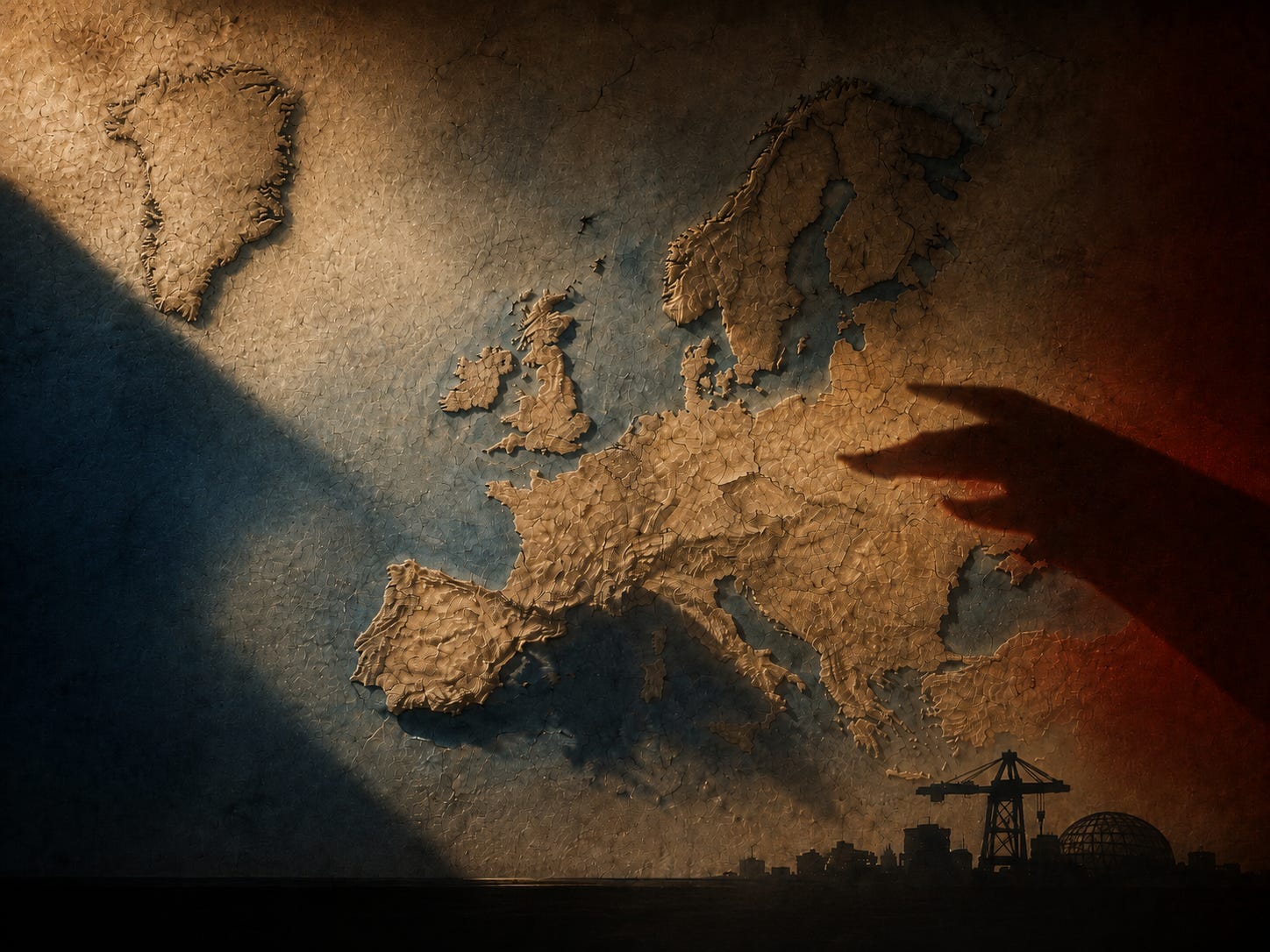
The military danger from Russia is intensifying just as the president of the United States has repeatedly made American protection sound more conditional. His administration has formally told Europeans that they must assume primary responsibility for more of their conventional defense, while Washington has begun reconsidering, reducing or redirecting parts of the American force posture on the continent.
Trump, meanwhile, has repeatedly demanded American control of Greenland, a self-governing territory within the Kingdom of Denmark, even though the United States already possesses extensive military access there. Farther afield, he has described U.S. arms sales to Taiwan as a “very good negotiating chip” in dealings with China.
These are different policies, directed at different countries for different reasons. Their significance for Europe lies in the possibility that they may nevertheless alter the same strategic calculation.
That combination requires an important distinction.
No public evidence cited here establishes that Donald Trump, Vladimir Putin and Xi Jinping are coordinating their policies to weaken Europe or the Western alliance. The argument does not depend on such coordination.
The three states are not equivalent actors. The United States remains NATO’s largest military power and its central strategic anchor. Russia is the alliance’s “most significant and direct threat” and is already waging war against Ukraine. China is a strategic competitor whose pressure on Europe is primarily economic, industrial and technological rather than military.
That asymmetry makes uncertainty about Washington more consequential, not less. Deterrence depends not merely on the existence of a treaty but on a potential aggressor believing that the alliance will act when the treaty is tested. At Ankara, NATO’s leaders reaffirmed their “ironclad commitment to our collective defence” and declared: “An attack on one is an attack on all.”
Yet treaty language and political signaling are not identical things. Trump has repeatedly made American protection sound conditional, while his administration has told Europe to carry more of the burden of its own conventional defense. The result is not American abandonment of NATO.
It is a more unsettled question about the political conditions under which American power will be deployed—and about how confidently Europeans can continue treating that power as the fixed element in their own defense planning.
The timing matters because a deliberate Russian test of the alliance is no longer merely a theoretical scenario in Washington’s assessments. American intelligence officials now assess that Putin could attempt some form of limited test of NATO during a period beginning in the fall of 2026 and extending through 2029.
The scenarios reportedly include cyberattacks, operations involving unmarked forces and, at the more extreme end, a limited incursion onto allied territory. The assessment does not establish that Putin has decided to attack NATO, and the likelihood of the most extreme scenario remains low.
It does not say that Russia will invade Europe this fall.
It says something serious enough without exaggeration: American intelligence now considers it plausible that Moscow could deliberately test whether NATO’s collective-defense promise holds when subjected to carefully calibrated pressure.
“The past is never dead. It’s not even past.”
William Faulkner
Power moves before it is named.
Institutions fail before they admit failure.
Public narratives harden after the choices that shape them have already been made.
History of the Present is The Intellectualist’s flagship premium series for readers who want to understand the forces shaping the world before they become headlines, scandals, crises or consensus.
Membership includes early access to major pieces, deeper analysis before public narratives settle and The Intellectualist’s complete premium editorial portfolio.
Limited to the first 1,000 Founding Members.
Become a Founding Member
https://theintellectualistofficial.substack.com/subscribe?coupon=8f060a60
Power and events before they become settled history.
Voting rights, representation, reform and whose voice counts.
Corruption, institutional failure, elite impunity and accountability.
Evidence, falsehood and what survives contact with reality.
Brian Daitzman on power, democracy, technology and the future.
Debt, rates, credit, currencies and the price of trust.
Artificial intelligence, emerging technology and what comes next.
Members will receive expanding access to:
Early briefings.
Curated events.
Member discussions.
The editorial process behind The Intellectualist’s work.
The first 1,000 members will be permanently recognized as Founding Members of The Intellectualist’s next chapter.
Save 33% on your first year and become one of the first 1,000 Founding Members.
Become a Founding Member
https://theintellectualistofficial.substack.com/subscribe?coupon=8f060a60