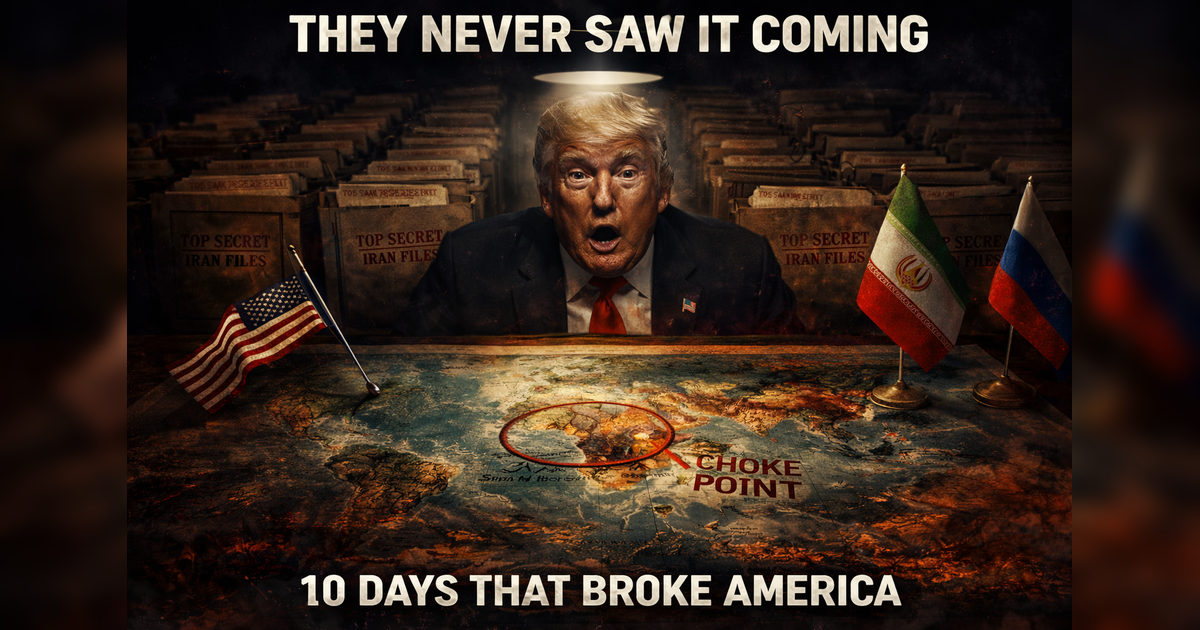
“Behind every headline is a hidden game. Today, we decode the one the world is missing.”
🔒
Before we begin — a quick note.This article decodes
howAmerica fought Iran and lost.But if you want to understand the real secret behind
whyAmerica struck Iran in the first place — it’s not about the bomb. It’s about something far more dangerous.
Iran holds America’s Epstein files.Seriously.
I’ve published a full premium brief on this — what those files contain, why they matter, and why this single fact may explain every decision Washington has made in this conflict.
$4.99. Link at the end of this article.Now — let’s decode the war itself.
Ten days of conflict can unravel decades of strategy.
What just unfolded between the United States, Israel, and Iran was not simply a military exchange. It was a live demonstration of how a determined, strategically disciplined nation can absorb a superpower’s punch — and turn that punch against the superpower itself.
America came with a plan. A bold one.
Iran dismantled it, piece by piece, in plain sight.
And almost nobody is telling you exactly how.
Before we go further — one important framing note.
It would be premature at this moment to declare a winner or loser. The situation is still unfolding. What we can do — and what this analysis does — is identify the definite, visible trends that have emerged from these ten days. The patterns that are already locked in. The directions that are already set.
That is what matters right now. Not a final verdict. But a clear-eyed reading of the trajectory.
Washington never said the words out loud.
But the objective was written in the subtext of every statement, every briefing, every carefully choreographed press appearance over the past weeks.
The real goal was regime change in Iran.
The logic was almost elegant in its simplicity:
☠️ Take out the Supreme Leader
💥 Gut the Islamic Revolutionary Guard Corps simultaneously
🌀 Create a power vacuum so sudden and total that the Iranian state had no time to reorganize
🚶 Watch ordinary Iranians — exhausted by decades of theocratic rule and economic suffocation — pour into the streets
🏛️ Install a friendly government. Declare victory.
America would be there, ready, to shape what came next.
It had worked before. Or so the architects of this plan told themselves.
But buried inside this strategy was a fatal assumption — that Iran would shatter under pressure rather than adapt to it.
💀
That assumption just got destroyed.
Before we get to the battlefield, you need to understand the economic architecture behind this entire operation. Because this war was never only about missiles and air strikes.
It was about oil. Global oil. And who controls it.
Here is the strategy America had quietly assembled:
🔴 Step 1 — Venezuela: Washington had already moved on Venezuela — effectively seizing control of Venezuelan oil assets and cutting Caracas out of global markets.
🔴 Step 2 — Iran: Execute regime change. Install a friendly government. Gain control over Iranian oil exports.
🔴 Step 3 — Global Dominance: With both Venezuelan and Iranian oil under American influence, Washington would control an enormous share of the world’s total oil supply.
And the endgame of that control?
🇷🇺 Russia.
Russia’s entire economy breathes through oil revenue. If America cornered the global oil market — flooding it with Venezuelan and Iranian supply — it could systematically shrink the market available to Russian exports. Strangle Russia’s income. Weaken Putin’s position without firing a single shot at Moscow.
It was an audacious plan. Multi-layered. Years in the making.
🕳️
Iran’s survival didn’t just stop the regime change. It blew a hole straight through the entire oil dominance strategy. And that hole is now large enough for Russia to sail through comfortably.
Here is the concept that explains everything Iran did over the past ten days.
Military strategists call it:
Strip away the jargon and it means this:
When your enemy holds a decisive advantage in one domain, you don’t fight them in that domain. You drag the conflict into territory they haven’t prepared for — and you make the entire fight unfold on your terms, not theirs.
America and Israel have overwhelming air superiority. Their combined aerial firepower is virtually unmatched in the region. Iran understood this with complete clarity. So Iran made a deliberate, disciplined decision:
❌ Do NOT attempt to win the air war. ❌ Do NOT mirror their strengths back at them.
When your enemy strikes from the air, you don’t shoot back from the air. That’s called symmetry — matching their move with the same kind of move. Symmetry plays to the stronger side’s advantage every single time.
Asymmetry means doing something your enemy genuinely did not anticipate. Something that forces them to fight a battle they never mentally prepared for.
🎯
And that is exactly what Iran executed.
America entered this conflict with a comforting mental image:
One battlefield
Two sides — America + Israel vs. Iran alone
Overwhelming combined force on one side
A foreseeable outcome
Iran immediately shattered that image.
Rather than accepting a contained bilateral conflict, Iran widened the war across the entire Middle East simultaneously:
🎯 Qatar — targeted 🎯 Bahrain — targeted 🎯 Kuwait — targeted 🎯 Iraq — targeted 🎯 UAE — targeted 🎯 Saudi Arabia — targeted 🎯 Oman — targeted
CIA assets. Military infrastructure. Airfields. Communications nodes. Nothing was spared.
This was not random aggression. Every strike carried a deliberate message:
“You brought this war to the neighborhood. The neighborhood will now pay the price — and they will blame you for it.”
By forcing America to defend multiple fronts at once, Iran achieved something critical. It diluted American focus. It stretched American resources thin. And most importantly — it began doing something strategists call coalition fragmentation.
⚠️ This is a distinct phase that most analysts are collapsing into the first — and that error causes them to miss something critically important.
After the initial asymmetric strikes, Iran shifted to what military strategists call horizontal escalation.
Horizontal escalation doesn’t mean hitting harder.
It means deliberately widening the geography and domains of conflict — pulling in more actors, more interests, more pressure points — until the opponent is surrounded by problems on every side.
Iran’s horizontal escalation had one primary instrument:
Roughly one-fifth of the world’s entire oil supply passes through the Strait of Hormuz. It is the jugular vein of the global energy economy.
Iran didn’t just threaten it.
Iran weaponized it.
🚫 Tankers intercepted. 🚫 Supply routes disrupted. 🚫 Global markets sent a message they couldn’t ignore.
Iran’s new leadership made this explicit. Mojtaba Khamenei, in a statement issued just days ago, declared with striking directness that the Strait of Hormuz would be deployed as leverage.
This wasn’t bluster. It was a formal announcement of strategic doctrine.
Oil prices didn’t just rise. They climbed in ways that sent shockwaves through economies far removed from the Middle East itself.
But here’s what makes this move so sophisticated — and so dangerous for Washington.
During the COVID era, China demonstrated something that permanently changed how serious strategists think about economic warfare.
Beijing controlled the global supply chains for:
💎 Precious metals
💻 Semiconductors & microchips
⚗️ Rare earth elements
...the raw materials the modern global economy simply cannot function without.
When countries pushed back against China politically, Beijing quietly tightened or loosened those supply chains in response — rewarding cooperative nations and slowly suffocating those who applied pressure.
No missiles. No troops. Just supply chain leverage deployed with cold precision.
Iran watched that playbook carefully. Its military and strategic thinkers internalized the lesson:
🗝️
“Control over a critical chokepoint is a weapon. It doesn’t look like a weapon. It doesn’t announce itself as a weapon. But at the moment of maximum pressure, it functions as one.”
The Strait of Hormuz is Iran’s rare earth supply chain. And Iran just proved it knows how to use it.
Now here is the insight that almost no mainstream outlet is giving sufficient weight to.
Iran did not simply want to inflict pain on America and Israel.
It wanted to * distribute* that pain — deliberately, surgically — across every nation connected to America’s coalition. And then let those nations do Washington’s arm-twisting for it.
Here’s how the chain reaction worked:
📈 Oil prices skyrocket due to Hormuz disruption
🌍 Gulf states, European allies, Asian trading partners absorb the economic pain
📞 Those governments start calling Washington —
quietly at first, then louder🗣️ The message becomes impossible to ignore:
“Your war is destroying our economies. We did not sign up for this. Stop.”
This is coalition stress and fragmentation — and Iran engineered it deliberately.
Every American ally that now questions whether Washington is a reliable partner is a strategic win for Tehran. Every government quietly recalculating its long-term relationship with America is a brick removed from the foundation of American regional dominance.
⚠️
America’s credibility as a stabilizing anchor didn’t collapse overnight. But it cracked. And those cracks were manufactured on purpose.
Now step back from the tactical details and look at the architecture of who actually benefited.
Russia never entered this conflict directly. It didn’t need to.
Behind the scenes:
🔍 Russian intelligence assessments were reportedly flowing to Iranian commanders — providing a clear-eyed picture of just how confused, overextended, and strategically rudderless Washington and Tel Aviv actually were.
That intelligence support didn’t make headlines. But it helped Iran survive the critical opening phase and calibrate its responses with precision.
Russia’s backing helped ensure the Iranian regime did not fall.
And then came the moment that should be studied in every strategic affairs classroom for the next twenty years.
America — the country that had designed an entire multi-year strategy around cornering the global oil market to strangle Russia’s revenues — found itself walking to Moscow, hat in hand, asking Russia to help stabilize the very oil market that America’s own war had disrupted.
🤯
The country that wanted to steal Iran’s oil to financially suffocate Russia ended upbegging Russia for helpmanaging the global oil supply.
Russia accepted. Graciously. And pocketed a month’s worth of oil sales leverage and geopolitical goodwill — for free, without a single Russian soldier at risk.
And the countries that benefit most from the increased flow of Russian oil at this moment?
🇮🇳 India and 🇨🇳 China.
📌
The war designed to weaken Russia handed Russia a strategic gift. That is not an accident of history. That is what happens when a plan built on flawed assumptions meets a reality that was never consulted.
💡
This is the kind of analysis you get every week atThe Spy Analyst— the geopolitical intelligence publication that reads the chessboard so you don’t have to. If this is your first time reading, it won’t be your last.
💰
Keep This Intelligence Alive⚠️ Here’s an uncomfortable reality: As an Indian creator, I cannot enable paid subscriptions on Substack. Stripe doesn’t operate in India. The platform built for independent writers literally cannot process payments for me.
This analysis — the kind that takes days to build, that no establishment outlet will publish, that connects dots most analysts are paid
notto connect — exists entirely on goodwill and reader support.
If this article gave you genuine insight, consider keeping it alive.🎯
Every contribution funds:📊
Full-time defiance of comfortable narratives— The analysis you just read doesn’t exist anywhere else because most analysts can’t afford to challenge establishment frameworks. Your support makes independence possible.🔍
Deep dives that take days, not hours— Connecting these dots requires time most media can’t invest. You’re funding that depth.🤝
Direct aid to those caught in the geopolitical crossfire— A portion goes directly to people living through the consequences of the power games we dissect here.
UPI (INR payments): devjariwala139@oksbi## ☕
International supporters:[https://ko-fi.com/thespyanalyst]
Even a small contribution keeps one of the only truly independent geopolitical intelligence sources in the world operational. Thank you.
The clearest, most undeniable evidence that America’s central objective failed?
The regime is still standing. And it has a successor.
The transition of leadership inside Iran — with Mojtaba Khamenei’s emergence making the line of succession visible and structured — sent an unmistakable signal to Washington:
❌ No power vacuum. ❌ No chaos. ❌ No IRGC disintegration. ❌ No pro-American demonstrators in the streets.
What Washington got instead was an Iran that is harder, more consolidated, and more security-obsessed than it was before the bombs started falling.
There is a specific term for what happens to a state that survives an existential military assault:
It means the regime reorganizes its entire governing logic around security as the supreme priority. Every policy decision, every resource allocation, every international relationship gets filtered through a single question:
“Does this make us safer or more vulnerable?”
Iran is entering a period of deep securitization. The consequences will be felt for years.
The most immediate consequence: Iran will rebuild its Axis of Resistance — the network of proxy forces and allied militant organizations that America and Israel spent years systematically degrading:
🔴 Hezbollah — weakened. Will be rebuilt. 🔴 Hamas — battered. Will be rebuilt. 🔴 The Houthis — hit hard. Will be rebuilt.
Iran won’t do this alone. Russia and China will provide indirect support — not through open military commitments, but through financial channels, intelligence sharing, weapons technology transfers, and political cover.
⚡
The threats that America went to war to eliminate are coming back. And in a post-war Iran hardened by securitization, they will return with more redundancy and more resilience than before.
Here is the scenario being discussed with genuine seriousness in intelligence circles right now — the one that could permanently and irreversibly alter the strategic landscape of the entire Middle East.
What if Russia and China formally extend a nuclear umbrella over Iran?
A nuclear umbrella means one thing in practice:
🛡️
Attack Iran, and you are attacking us.
It is the same foundational logic that has protected NATO members for seven decades. If Moscow and Beijing extend that protection to Tehran — even informally — the entire security calculation in the Middle East transforms overnight.
Israel currently operates with a specific confidence: that American backing gives it the freedom to act militarily against any perceived threat in the region.
But if Iran gains Russian and Chinese nuclear protection, the equation inverts completely.
Any future military action against Iran carries the risk of triggering a direct confrontation with two nuclear-armed superpowers.
🕐 Intelligence assessments are reportedly placing this scenario within a two to four month window, depending on how the current conflict resolves.
It is not guaranteed. But it is no longer a fringe possibility.
💣
If it materializes, it will be the single most consequential shift in Middle Eastern security architecture in a generation…