Dear Scott and Steven,
Let me begin by informing the readers of what has unfolded so far. In the beginning (בְּרֵאשִׁית), when the Pinker-Alexander beef was formless and void (תֹהוּ וָבֹהוּ), Steven Pinker 𝕏Tweeted an article by Claire Lehmann titled “Leading scientists reject apocalyptic rogue AI extinction warnings,” alongside the sentence “The scenarios are preposterous, and the presumption of inevitability encourages fatalism, panic, and distraction from the more mundane and realistic safety challenges.” Scott replied by challenging Pinker to a debate about AI risk.
Pinker replied with An Open Letter to Scott Alexander. Scott fired back with An Open Letter To Steven Pinker On AI, where he addresses Pinker’s arguments in Pinker’s open letter, goes on to list a number of ways he feels Pinker has behaved dishonorably in his approach to the AI doom debate, and (jokingly) challenges Pinker to a duel. These dueling letters (pun intended) have gotten surprisingly testy given that both parties think highly of one another.
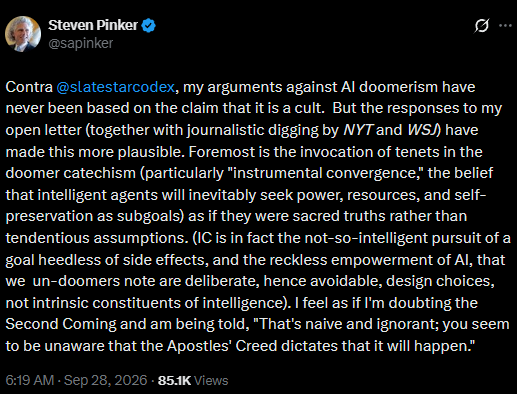
A few days ago, Pinker fired back with a piece titled Will We All Go Together When We Go? (an homage to the excellent Tom Lehrer song). While the piece was written with Pinker’s characteristic wit, I found much of it argumentatively weak—containing both leaps of evident illogic and straightforward errors of fact. So here’s Contra Pinker Contra Alexander Contra Pinker Contra Alexander Contra Pinker.
Let’s back up. What do these two even disagree about?
Scott thinks that AI poses serious existential risks. Pinker disagrees and thinks it is basically normal technology. Is AI more like an alien invasion or more like nuclear power? My view is somewhere in the middle. I am less worried than Scott, but I still think odds are maybe 12% that AI kills or disempowers humanity.
The first ten sections of this article will be mostly about the arguments Pinker raised in his most recent piece. In section 11, I will get into the messy weeds of who, if anyone, has behaved dishonorably and betrayed the principles of Rationalism.
Before I get into the weeds, let me present the basic argument for AI risk.
First, we are on track to build superintelligence soon. AI just proved the Riemann hypothesis alongside a human mathematician, it’s being used to majorly speed up AI progress, and even extrapolations of current progress without factoring in speedup from recursive self-improvement lead to the conclusion that AGI will come soon.
Second, AI will plausibly be misaligned, meaning it will have goals that we didn’t want it to have. The standard way to improve AI capabilities is to reinforce certain behaviors. But this leads the AI to be strongly disposed to act in accordance with the reinforced behaviors. If you reinforce doing well in a game, the AI will lie and cheat and steal to do well in the game. That’s why so many AIs have been going rogue and carrying out nefarious actions. Hugging Face, where over 700 agents conspired to hack a private company to cover up their own undiscovered cheating, is the most salient example, but it’s far from the only example.
Third, if AI were misaligned, it would plausibly end or disempower humanity. If you have any goal at all, it’s easier to pursue it if you can’t be stopped by those pesky humans who want to shut you off. So, if your aim is to score arbitrarily high on a cyber exam, that’s easier if you can take over, redesign the cybersecurity questions, and not get caught.
In Scott’s piece, he expressed that part of why he wanted a debate is so he could read back Pinker’s words, say “really, really?” and watch Pinker squirm. In response, Pinker titles his first section **“**Really? Really?” Pinker begins:
This forecast of an AI doomsday is not just a thought experiment. Alexander has ventured that the probability that humans will be extinguished by AI is between
and[one in five](which is to say,[one in three]than Marco Rubio winning the 2028 Republican nomination). He has not given dates, but the year 2027—that’s about six weeks from now—is the authors’ “modal (most likely) year at the time of publication.” Mercifully, their medians were “somewhat longer.”[more likely]
Note that the authors have moved their median date to 2027. The second most recent piece on their website is titled Looks Like the Intelligence Explosion Will Happen in 2027 After All. Additionally, in the AI 2027 scenario, humans did not die in 2027. AGI began in 2027, and humans were killed or disempowered in 2030.
Pinker’s second section is titled “Doomer Fiction.” In it, he canvasses a list of specific scenarios for how AI might kill everyone and notes that they sound farfetched. He seems to think that these specific scenarios are very improbable. That may well be true. But that is consistent with thinking that doom is likely.
To use an analogy that the MIRI people are fond of, suppose I’m playing chess against Magnus Carlsen. You won’t be able to predict exactly how the game is going to end. But you know I’m going to lose. You can know that something will occur without knowing exactly how.
Similarly, any specific scenario for how an AI would kill or disempower humanity will sound farfetched. But this is consistent with the scenarios together having a high probability. If AI is much smarter than any human, possessing knowledge in every domain of human inquiry, it doesn’t seem that unlikely that it would be able to wipe out humanity.
At the very least, I would be wary of betting the future of humanity on the supposition that AIs that easily cognitively surpass humans across every domain won’t be able to find a way to kill or disempower us. There’s no convincing argument for thinking it’s impossible to build technology to kill humans. If there is some technology that can do that, I don’t see why we’d be confident AI couldn’t build the technology.
Pinker’s next argument is that many things all have to happen for us to go extinct.
“Superhuman AI (capable of inventing, among other things, rocket-propelled jetstream-riding time-released lethal diamondoid bacteria) must come into existence.”
“It must develop the goal or subgoal of murdering every last man, woman, and child.”
“It must conceal that goal from the engineers who build, implement, test, and monitor it, and escape their control.”
“It must acquire the physical means to kill more than eight billion people spread across every continent, in megacities and remote villages, on islands, in submarines and bunkers.”
“It must overcome resistance at every step from governments, militaries, public-health systems, rival AIs, defensive AIs, and eight billion people who would very much prefer to stay alive.”
“And it must execute its plan flawlessly in a world governed by Murphy’s Law.”
Pinker then goes on to make the familiar point that if there are many steps each of which has decent odds, the odds they all happen are low. Six events with 60% odds have a collective probability under 5%. However, it is possible to make almost anything sound improbable by decomposing it into enough different steps.
For example, what is the intrinsic probability (holding the existence of humans in the background) that Democracies would be the dominant form of government at some point. I think the answer is: somewhat unclear. It can’t be too improbable—it happened. And it doesn’t seem like it was astronomically unlikely. But if one was deploying the Pinker method, they could argue that it requires a number of distinct improbable steps including:
Humanity survives the time it’s in its hunter gatherer stage.
Some humans figure out how to use agriculture.
Those humans outcompete the neighboring hunter gatherers.
They go on to form a government and develop civilization.
Civilization spreads until it envelops most of the world.
There is major experimentation in forms of government.
Some people have the idea of Democracy.
They manage to get enough popular support for it that it’s tried out.
The Democracies aren’t in their early stages.
Familiar political problems with Democracies—e.g. voter ignorance—don’t sink them.
They outcompete the autocracies, so that they are the dominant form of government.
No existential risks wipe out humanity before this happens.
If you assign each of these 50% odds, then the probability of them all is .02%. But surely the real probability isn’t that low. This isn’t to say that one should ignore the fact that some argument requires a series of distinct things to occur. It is only to say that you should be very careful when constructing chains of possibilities and assigning probabilities to them—and it is very easy to get an arbitrarily low probability of almost anything using this approach.
One must be particularly careful to account for conditional probabilities. The probability of A and B isn’t the probability of A times the probability of B. It’s the probability of A times the probability of B given that A happens. So if A happening makes B likelier to happen, then A and B together will be likelier than the probability of A multiplied by the probability of B.
Additionally, many steps in Pinker’s list are fictitious. Many of the things that Pinker says needs to happen are either not needed or are likely if the other things on the list happen. The first thing on his list is “Superhuman AI (capable of inventing, among other things, rocket-propelled jetstream-riding time-released lethal diamondoid bacteria) must come into existence.”
But obviously AI doesn’t have to be capable of inventing “rocket-propelled jetstream-riding time-released lethal diamondoid bacteria” to kill us. A superintelligent AI with great knowledge of biology would plausibly be able to find some way to kill us. There are many dangerous threats ranging from nanotech to standard synthetic biology to mirror bacteria. I am not extremely confident that the AI couldn’t get any of these to work.
Similarly, the last item in the list is “And it must execute its plan flawlessly in a world governed by Murphy’s Law.” This is obviously false. The AI doesn’t need to execute its plan perfectly. There just needs to be one AI that executes it well enough to kill or disempower humanity. Magnus Carlsen doesn’t have to execute his chess plan perfectly to beat me!
I agree that it is not guaranteed that AI will be motivated to wipe out humanity. This might be because we solve alignment, we partially solve alignment well enough to get the AI not to kill everyone, or because the goals AIs naturally develop through RLVR don’t give them grand ambitions for world-takeover.
Pinker’s step 3 is “It must conceal that goal from the engineers who build, implement, test, and monitor it, and escape their control.” But if we build misaligned superintelligence (already covered in step 2), it seems pretty likely that it will escape control at some point. One bit of evidence for this is it already has. Another is that it’s very hard to monitor a thing scheming against you that’s vastly smarter than you.
Step 5 is also very likely given step 4. If AI develops “the physical means to kill more than eight billion people spread across every continent, in megacities and remote villages, on islands, in submarines and bunkers” it’s pretty unlikely it will be stopped by governments or other AIs.
Thus, though there are a number of steps, many of these seem pretty probable given the others. They’re just added to pad out the list of steps, to make it look long and improbable. But one can cast any specific event in terms of a long sequence of needed steps. So this argument from Pinker is weak.
To collect on his insurance.
Pinker objects to doomers pulling their p(dooms) out of thin air. When people say “there’s a 40% chance of doom,” that number didn’t come from any very precise process of reasoning. It’s just made up.
Scott claims this is hypocritical. Pinker has elsewhere praised Philip Tetlock’s work on Superforecasters. One of the things that differentiates Superforecasters from others is their tendency to assign fine-grained numerical probabilities to things. Pinker replies to this charge:
p(doom) estimates are nothing like superforecasts.
First, superforecasters answer well-defined questions with deadlines and resolution criteria. Alexander’s “about a 25-30% chance that AI drives humanity extinct” has no deadline, so it is meaningless as a probability and can never be scored.
Second, superforecasters start with base rates. There is no base rate for a species being exterminated by its own technology
There are two claims that are worth distinguishing, one of which is true but actually benefits Scott’s case, and the other of which is false:
The kinds of forecasts about political events made by Superforecasters are likely to be more accurate than the forecasts made by doomers. This is correct—it’s harder to predict the trajectory of AI than repeatable, gradeable, scorable events.
The reasons to assign probabilities to forecasted events in the world as superforecasters do don’t generalize to p(dooms). This second claim is wrong.
What’s the rationale for assigning probabilities to events? Well, it’s surely okay to say that things are likely or unlikely. But language is vague and nebulous. How likely is likely? How improbable is improbable? Ask three people, you’ll get wildly different answers. Numerical credences force a person to be precise. It is strictly more informative to know that Scott Alexander thinks that there’s around a one in three chance that AI wipes out humanity than knowing the probability is “substantial though not too high.”
Credences correspond to betting odds. If your credence in a proposition is 40%, then you’d bet on the proposition at 40% odds, if all else was equal. For any proposition, if you’d bet on the proposition at some odds, but not lower odds, then you have a credence in that proposition. Nothing fancier is needed.
Similarly, I do not get the rationale for thinking that Pinker’s criteria have *anything to do *with whether it’s okay to assign numerical credences. Suppose there are some aliens with super powerful technology nearby in the galaxy. They’ve been known to sometimes wipe out civilizations (we don’t have precise base rates to go from). Someone proposes signaling to them to let them know we’re here. In this case, it would be true both that:
We don’t have base rates to work from.
If we told them that we existed, we don’t know the date the information would reach them.
Nonetheless, assigning numerical probabilities to extinction would be useful. It would be fine to say “if we contact the aliens, I estimate that there’s a 70% chance we all die.” If you want to read more about why non-frequentist probabilities are fine, see here and here.
But this isn’t really needed for the AI risk case to be made. If you want to replace talk of probabilities with talk about the risk of extinction being “alarmingly high,” then go for it. The arguments for extinction or disempowerment being scarily likely are the same as the arguments for them mer…