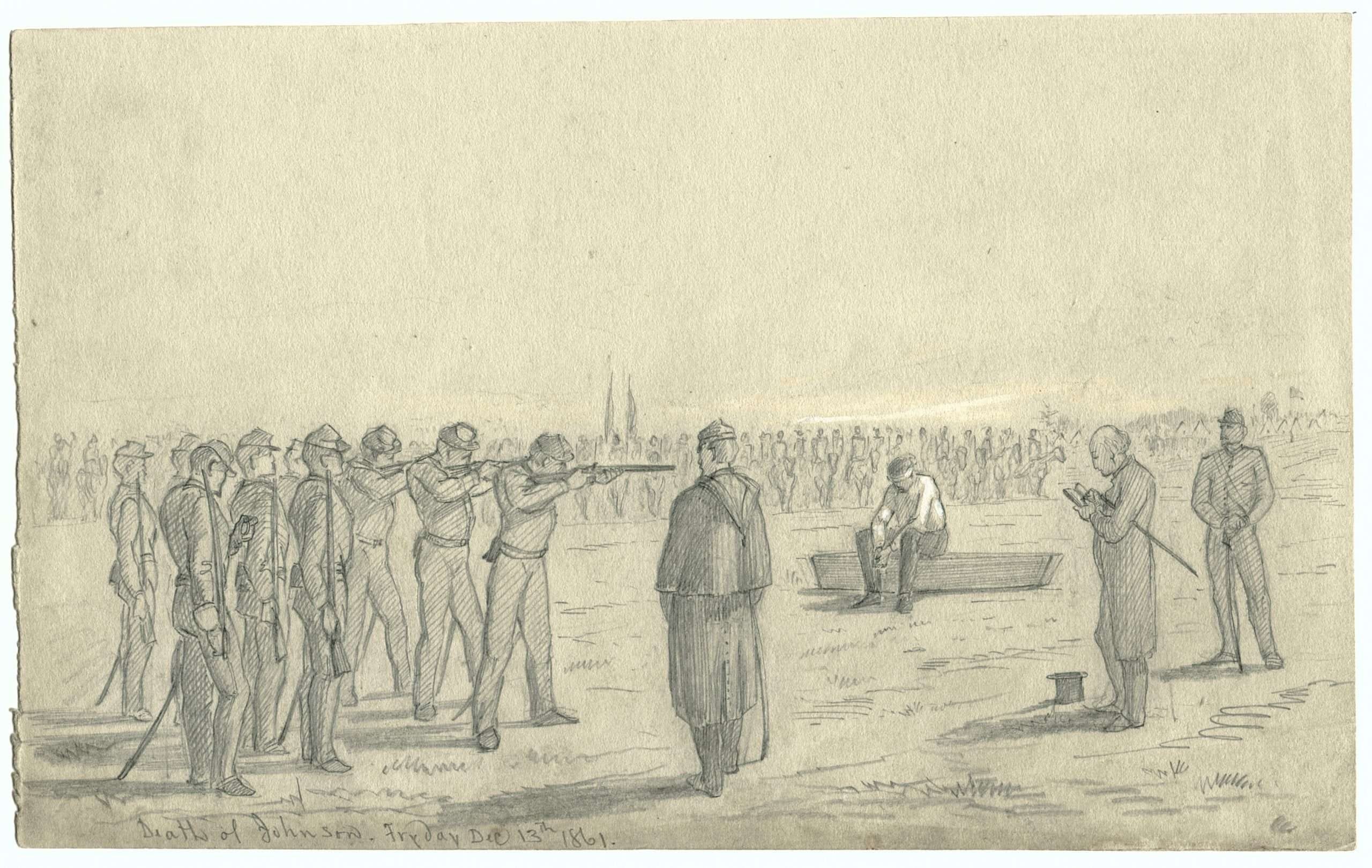
On February 6, 1864, Samuel A. Burney wrote the following to his wife from Tennessee:
I witnessed yesterday one of the most solemn and shocking scenes that is to be seen in this army. It was the execution of a deserter. His name was W.H. Roberts of the 21st Mississippi. He was arraigned before and tried by a board of court martial for desertion. He was found guilty and sentenced to be shot to death with musketry. The whole division was present to witness the tragic end of the doomed man. The division was placed in line on the two large hillsides, and the deserter was shot in the valley between where all could see. Before the execution he was marched in front of the division just behind his coffin with a strong guard before and behind him accompanied by his chaplain. At the head of the procession was a brass band which played the death march. It was a solemn sight. After they had finished marching around, they read out the order for his execution. The chaplain then prayed with him, and after that they bound up his eyes with a handkerchief, shook hands with him, and left him to his fate. Some six or eight men stood before him with guns, and the poor fellow was on his knees, his hands resting on his legs—ready, aim fire, and the ball sped through him and he fell on his face. I looked at him until he was blindfolded and shook hands with the chaplain, then I turned back and closed my ears. (pp. 267-68)
Nothing contained in this description of the execution of a Confederate soldier came as a surprise to me, but what I read next stopped me in my tracks.