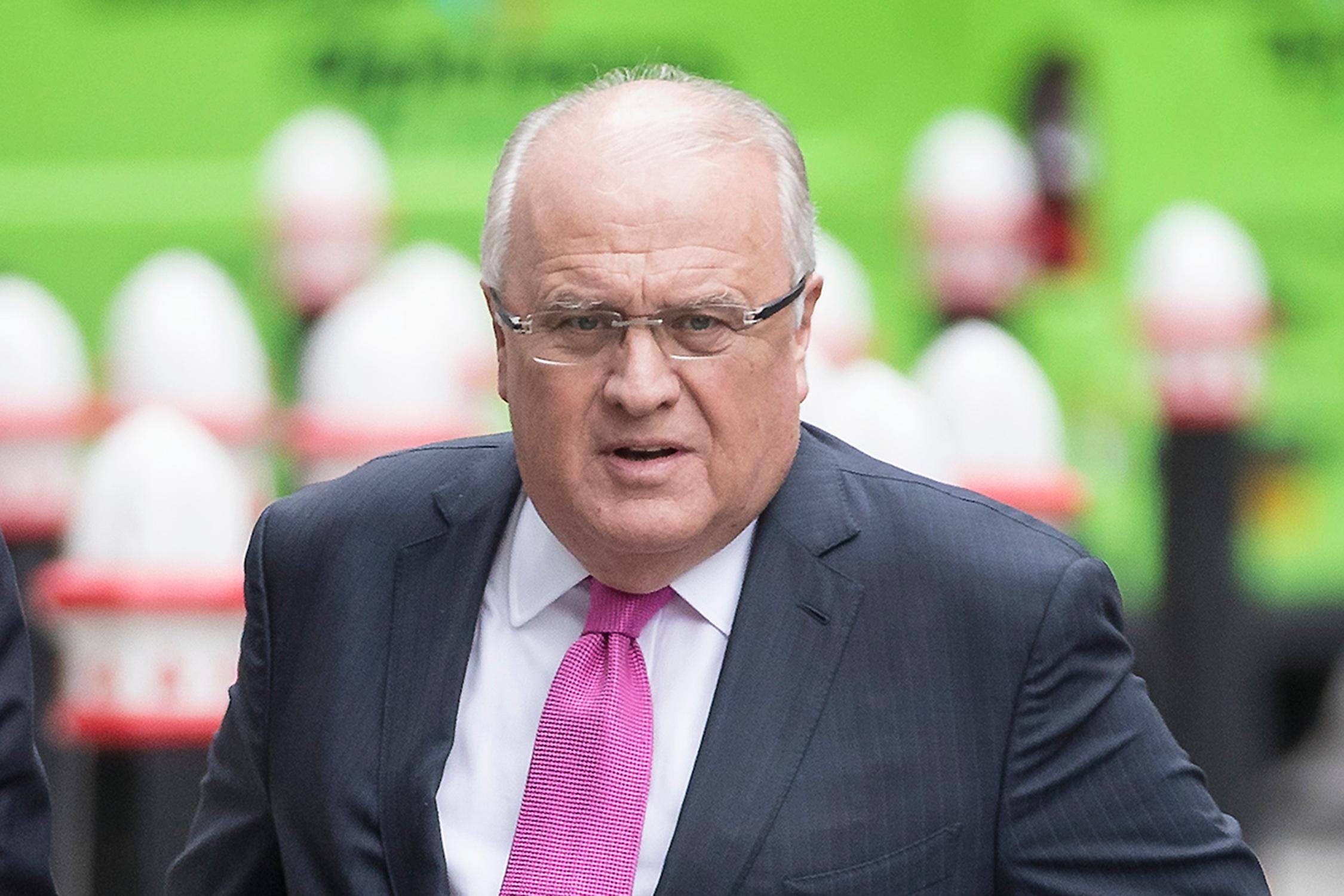
Andrew’s Money Man: How David Rowland Kept the Millions Rolling In from China and the Middle East
One of Andrew’s key financial relationships is with David Rowland – nicknamed ‘Spotty’ because of his acne – who has a chequered business history.
Per-article narration is paused while we focus on the 9 daily compilation episodes. Listen to today's News daily brief — the story below is covered there alongside the rest of the day's reads. The full article text is below — read along while we ramp narration back up.
One of Andrew’s key financial relationships is with David Rowland – nicknamed ‘Spotty’ because of his acne – who has a chequered business history.
Andrew is known to have been friends with Rowland since at least 2005, when he unveiled a life-size bronze statue of the businessman smoking a cigar at Havilland Hall, Rowland’s estate in Guernsey, and there have long been suspicions that Andrew and the Rowlands have been financially in league together.
David Rowland has accompanied Andrew on several private visits to the Middle East and once officially to a meeting of the Middle East World Economic Forum in 2008 in Sharm El Sheikh, where they dined with the president of Kazakhstan. In the same year, David and his son Jonathan Rowland accompanied Andrew on a trip to Azerbaijan. Afterwards Jonathan emailed a relative of the president’s wife who ran the country’s largest company, Pasha Holding:
‘We are business advisors to HRH and travel with him on various engagements globally where we believe we can operate as independent investors/advisors with his assistance through his unique network.’
Andrew and the Rowlands returned to the country in November. According to local media reports, Andrew ‘has his own business interests’ in Azerbaijan and Kazakhstan. Leaked emails show that Pasha invested $5 million in a fund controlled by the Rowlands that had an account at Banque Havilland, a bank set up by David Rowland to provide private banking and wealth and asset management fund services to private clients and institutions.*
In September 2009, on a trip to Saudi Arabia leading a delegation of more than twenty vice-chancellors from UK universities, Andrew lobbied the king of Bahrain to help Jonathan fulfil the Rowlands’ plan of launching a Middle Eastern banking operation – one that Andrew was due to have a stake in. The man who was approached to facilitate this business was Steve Harrison, Andrew’s former assistant private secretary and now working as the executive director for the Bahrain Economic Development Board.
Rowland claimed in his communications that Andrew was ‘facilitating’ the whole project and arrangements were made for the duke to accompany the Rowlands to Saudi in mid-November to discuss Banque Havilland opening a branch in Riyadh. According to the Court Circular, Andrew arrived in Riyadh on 14 November in his role as the UK’s special representative for international trade and investment. Jonathan Rowland then emailed Prince Sultan bin Salman bin Abdulaziz al Saud, the second son of King Salman:
‘HRH suggested that you might like to become our partner in KSA, and like him, have an involvement in the operation we create.’
Rowland claimed the Rowland family had been investing globally for forty-five years through offices in London, Guernsey and Luxembourg:
‘We advise HRH exclusively on all his business matters and travel with him regularly and often act as an intermediary between the British Royal Family and other families around the world including Royal families and heads of state.’
Rowland concluded:
‘With our close links to HRH DOY we have many opportunities and possibilities other institutions/families are unable to execute.’
Ahead of a visit to China in March 2010, to witness the signing of a $35 billion gas deal between BG Group, the British multinational oil and gas company, and the China National Overseas Oil Corporation, a huge state-owned oil firm, Andrew emailed Jonathan Rowland with an outline of his programme, asking which events Rowland would like to attend.
Rowland then suggested to Andrew’s private secretary, Amanda Thirsk, that a meeting with Louis Cheung, then president of the world’s biggest insurance company, be inserted into the itinerary.
‘Ping An is the largest insurance company in China and a good partner for all of us going forward.’
Rowland had already met Cheung at an event in Shenzhen in February, but now wrote to him:
‘I would like to explore ways of working with Ping An in the future and would like to invite you to meet with me and HRH Prince Andrew in Beijing in March. The Rowland family are the exclusive adviser to HRH and all his business interests and investments.’
According to the Court Circular, one of Andrew’s first appointments in a packed programme on his Chinese visit was with Mr Cheung.
Rowland was afterwards passed by Amanda Thirsk a copy of a Foreign Office diplomatic cable, intended only for government officials, detailing Andrew’s one-to-one conversations with senior Chinese politicians – information that is still not in the public domain. Royal accounts show the cost to the taxpayer of Andrew’s flight to China – and then on to the United Arab Emirates for a day to attend the Dubai World Cup horse race – was £23,586. The visit cost UK Trade & Investment another £7,700. For Jonathan Rowland the visit had opened doors and helped forge potentially important business relationships.
In 2011 David Rowland paid for a jet that flew Andrew to Saudi Arabia and in the same year flew to Libya with the prince to meet Colonel Gaddafi. Plans to take Andrew on a trip to Cameroon, Equatorial Guinea and Gabon that year to scout for business had to be abandoned when the Virginia Giuffre photograph was published in the press. ‘Disappear for a while,’ advised Jonathan Rowland.
Andrew had a 40 per cent stake in a firm based in the British Virgin Islands called Inverness Asset Management, owned by the Rowlands’ Blackfish Capital Management, which operated between April 2007 and March 2019, and was given to the duke in return for his contacts and consulting.
‘Contacts’ of the company, which included royal families, heads of state, government institutions and wealthy individuals, were targeted as potential investors in a separate investment fund to be based in the Cayman Islands and promised a tax-free income. The prince told Jonathan Rowland in one leaked email that ‘he had proposed using Inverness as a vehicle for Qataris interested in investing in a property company associated with his brother Charles’.
Chris Bryant MP, one of Andrew’s fiercest critics, felt this disclosure was more damaging than the 2017 ‘Paradise Papers’, which revealed the Queen’s private estate had been invested in a Cayman Islands fund.
‘This is far more significant because it is a senior member of the Royal Family engaged in offshore shenanigans … The word that comes to mind is entitlement, really. Because he is a Duke, he can get away with anything.’
Lou Theodore, a businessman based in the Caribbean, claimed Andrew, who knew many of the richest people in the world, had put Epstein and Rowland together to the mutual benefit of all three.
After the press questioned why Andrew should have opened a private bank in Luxembourg, Jonathan Rowland wrote to the duke in March 2011:
‘Told them you attended bank as Trade Envoy supporting a British owned business’, adding: ‘We just need to reinvent the relationship to circumvent these idiots.’
When Andrew was facing the sack from his envoy role because of the Jeffrey Epstein scandal, he and Rowland discussed how the duke might be free to ‘act without much accountability’.
Jonathan Rowland suggested their commercial activities could continue ‘under the radar’. Andrew’s response? ‘I like your thinking.’
The updated paperback of Entitled is out now and is this week’s Number One Sunday Times Bestseller! Order your copy here with 50% off!