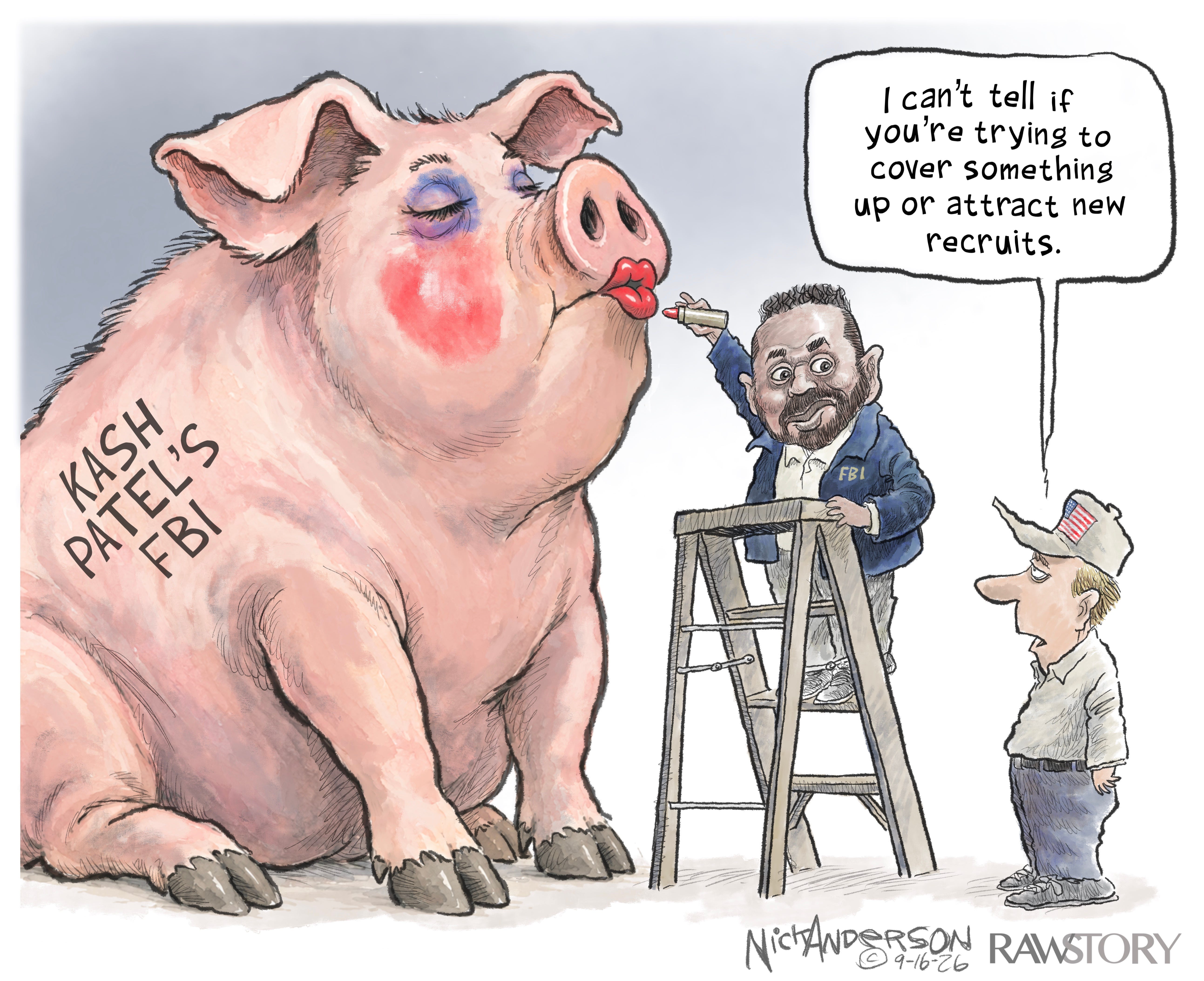
I wrote Monday on this platform about a couple of sketches that didn’t make the cut with freelance clients. They concerned the FBI’s decision to change its applicant-screening process so that conduct involving bestiality, once an automatic disqualifier, would instead be considered on a case-by-case basis.
Can you imagine if this change happened under a Democratic administration? Trump would claim that Democrats are forcing sex changes on your children at school, then making them perform indecent acts with sheep. Or they’re engaged in human trafficking to force them into sexual acts with animals for their depraved entertainment.
We’re now so far through the looking glass, with a fresh outrage competing for our attention every day, that a story like this can somehow pass almost unnoticed.
But yesterday the story got a second wind. A Senate oversight hearing intended to examine FBI Director Kash Patel’s leadership, taxpayer-funded travel, the Epstein files and politically sensitive investigations took the unexpected turn when senators from both parties pressed Patel about the FBI’s decision to loosen several automatic hiring disqualifiers. The most attention-grabbing change involves bestiality: conduct that previously could automatically eliminate an applicant is now subject to further review under some circumstances.
Patel’s explanation was that the old rule was written too broadly and could exclude victims of human trafficking who had been forced to participate in sexual acts involving animals. “We did not want to punish victims of bestiality, victims who were trafficked,” he told the Senate Judiciary Committee.
This statement regarding the “victims” of bestiality produced the most hilarious moment of the hearing when Senator John Kennedy, a Republican, responded, "So you disqualified the animal?"
Patel clarified that someone who voluntarily engaged in bestiality could not become an FBI agent; the policy change, he said, was intended to remove the automatic disqualification so the bureau could distinguish victims of coercion from voluntary participants.
But the hearing exposed a communications problem: the language of the revised standards apparently refers to applicants who have “engaged” in the conduct rather than clearly separating perpetrators from coerced victims. Democratic Sen. Dick Durbin challenged Patel on precisely that point, while Republican Sen. John Kennedy repeatedly pressed him to explain why the bureau had written the rule this way. Patel ultimately told Kennedy that voluntary participation remains disqualifying.
The controversy also extends beyond bestiality. Senators questioned broader changes to FBI suitability standards involving theft from employers and solicitation of prostitution, part of an effort Patel has previously defended on the grounds that the bureau was losing potentially qualified candidates under overly rigid standards. The episode therefore raises a legitimate policy question beneath the sensational headline: which past conduct should permanently disqualify someone from serving in the nation’s premier federal law-enforcement agency, and which should permit individualized review?
The problem for Patel is that the explanation proved difficult to communicate even to senators inclined to give him the benefit of the doubt. Kennedy eventually asked why Patel hadn’t simply responded to the proposed change by asking, in effect, what planet its author had come from. Patel said that had initially been his reaction, too, until officials showed him cases involving trafficking victims.
And the story has now escaped Capitol Hill. PETA President Ingrid Newkirk publicly condemned the change and called on Patel to reverse it, interpreting the revised rule as potentially opening FBI employment to people who sexually abused animals.
The bizarre hiring-policy exchange overshadowed much of a consequential four-hour oversight hearing. Patel also faced Democratic questions about taxpayer-funded travel, the FBI’s handling of Epstein-related files and accusations that he has politicized the bureau; Republicans questioned him about investigations involving earlier federal probes of Trump and the 2020 election.
The bestiality controversy nevertheless became the memorable headline—an object lesson in Washington communications: if a federal personnel policy requires the FBI director to explain to Congress which side of bestiality an applicant was on, the policy probably needed another round of editing.
But the larger question remains: why did the director of the FBI feel compelled to change a policy that must affect an infinitesimally small number of potential applicants? It’s a baffling change that makes little sense unless, perhaps, there was someone specifically affected by it that Patel wanted to bring into the FBI. Do we even want to know more?
So the challenge with this cartoon was to hint at something indecent, without saying it too explicitly. That required a double entendre with enough subtlety to get published.
Did I succeed?