Two major robotics breakthroughs arrived last week, showing how fast AI agents are escaping the confines of digital screens and entering physical reality.
First, eWeek reported on Generalist's GEN-1.5 foundation model, marking a "ChatGPT moment" for physical machines. GEN-1.5 achieves one-shot robot learning through "physical prompting." Rather than requiring tens of thousands of reinforcement learning iterations or hard-coded trajectories, the model ingests a single 3-to-12-second visual demonstration into a 30-second context window. It immediately achieves a 59% zero-shot task success rate on physical hardware, jumping to 83% after just 10 gradient steps that alter less than 0.15% of the model's weights.
Second, San Francisco startup Nori Robotics opened preorders for its bimanual home robot at a breakthrough price point of just $1,688. Beyond bringing dual-arm physical manipulation into consumer kitchens for cooking assistance, pouring, fetching items from the refrigerator, and folding laundry, Nori introduced a decentralized Skills Marketplace. Through the Nori Lab application, owners can train custom skills and share them across the entire fleet, unlocking network effects for household physical automation.
These two developments validate the core thesis of our upcoming Springer volume: physical intelligence is not advancing as a single, isolated technology curve. It is a whole-system convergence where in-context physical prompting, accessible consumer hardware, and modular skill libraries meet real-world physics, economics, and safety governance.
Before I introduce my new book. A quick background could help. When I finished editing my previous book titled Agentic AI: Theories and Practices in 2024 (which Springer published in 2025 and has reached over 66,000 downloads on Springer alone), I documented how software agents reason, plan, use tools, write code, and orchestrate complex digital workflows. Yet those agents remained weightless. They could not pick up a glass of water, steady an elderly person, repair a circuit breaker, or cook a meal.
That physical boundary is now dissolving.
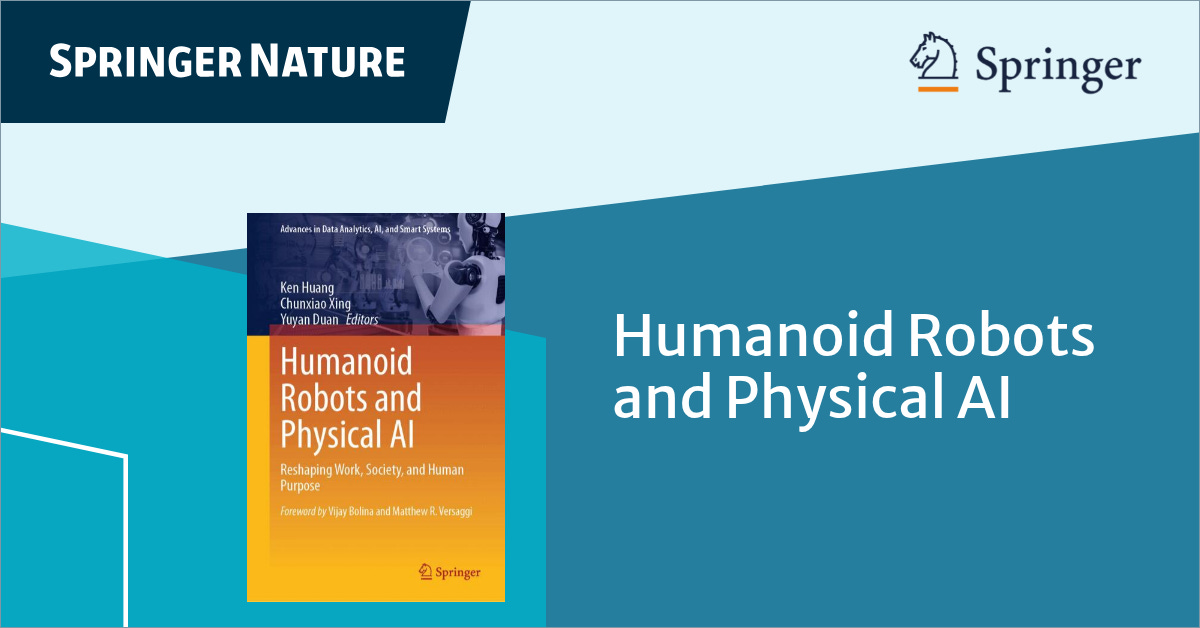
I wrote one central question in the preface of our new volume, Humanoid Robots and Physical AI: Reshaping Work, Society, and Human Purpose: What happens when agentic AI acquires a physical body? That question led me to assemble an international team of roboticists, security leaders, hardware architects, and economists to treat physical AI as a complete end-to-end system rather than a series of isolated stage demonstrations.
Springer will officially publish the hardcover and eBook editions on October 14, 2026. Readers can preorder the book directly from Springer today. Springer has provided our community with an exclusive 20% discount code: SPRAUT. Enter SPRAUT during checkout on the Springer store to receive 20% off with free worldwide shipping on the hardcover edition.
In this free section, I share why we wrote this book, introduce the editors and contributors behind it, and explain how to claim your 20% preorder discount. After the paywall, I take paid subscribers deep inside Chapters 1 and 2, breaking down the five enterprise adoption gates, the true economics of "cost per useful hour," actuator tradeoffs, battery duty cycles, and the six operational metrics required before approving any physical deployment.
A humanoid robot powered by agentic intelligence differs fundamentally from a traditional industrial arm. A classic factory robot repeats pre-programmed paths within an isolated, safety-caged cell. Physical AI, by contrast, must perceive unstructured environments, interpret natural-language intent, formulate multi-step plans, manage physical contact dynamics, detect execution failure, and adapt in real time before its physical mass harms a person, product, or facility.
The architecture diagram in Figure 1 contrasts the weightless digital agent loop with the multi-sensory closed-loop physical execution model, highlighting how in-context physical prompting bridges perception and real-time actuation.
Figure 1: The Embodiment Discontinuity & In-Context Physical Prompting
That physical execution path extends far beyond foundation models. It traverses sensors, electric actuators, structural dynamics, thermal limits, battery discharge curves, real-time control loops, cybersecurity perimeters, and human relationships. An exceptional vision-language-action model cannot compensate for an overheated motor, a slipping gripper, or an unstable joint controller.
The system topology in Figure 2 maps the whole-system engineering perspective that structured our ten chapters, detailing the five functional tiers from cognitive reasoning down to mechanical actuation and power management.
Figure 2: The Whole-System Physical AI Architecture Stack
The democratization of physical hardware—exemplified by Nori's $1,688 platform—signals a fundamental transition in how robotics software is distributed. Rather than deploying hard-coded monoliths, modern physical AI platforms treat skills as modular, downloadable micro-policies.
Figure 3 illustrates the decentralized skill creation pipeline, showing how user-taught household demonstrations are compiled in Nori Lab, verified against safety envelopes, and distributed across a global robot fleet.
Figure 3: The Decentralized Robotic Skill Marketplace & Network Flywheel
While I served as Editor-in-Chief, this volume represents the collective work of leading academic scholars, industry practitioners, and executive leaders across the robotics landscape:
Co-Editors:ProfessorChunxiao Xing(Tsinghua University) provided rigorous academic grounding and research leadership.Yuyan "Lynn" Duan(product executive, AI/robotics investor, and community builder) contributed essential market perspective on capital allocation, enterprise adoption, and commercial scale.**Forewords:**Vijay Bolina(former CISO of Google DeepMind and interim CISO of Isomorphic Labs) framed physical AI security at the boundary where neural networks touch physical matter.Matthew R. Versaggi(White House Presidential Innovation Fellow, Distinguished Engineer, and AI healthcare leader) connected this volume toAgentic AIand challenged readers to evaluate robots through operating evidence rather than viral demo videos.Chapter Authors:Grace Huang(enterprise finance, product strategy, and adoption risk),Bo Tian(board-level architecture and AI inferencing for Tesla Optimus),Manish Bhatt(AI security, CyberSecEval, and OWASP AISVS vulnerability scoring),Tongzhou Mu(world models, robot simulation, and ManiSkill),Chuer Pan(Stanford University research on contact-rich manipulation from human demonstrations),Bhavya Gupta(information security, governance, and OWASP Agentic AI safety),Víctor Mayoral-Vilches(robot cybersecurity, hardware security modules, and teardowns),Jerry Huang(machine learning, scalable systems, economics, and long-term technological convergence), andModar Alaoui(founder of ALM Ventures, the Humanoids Summit, and Bay Area Robotics Association).**Reviewers:**Jasmine Lombardi(25+ years in customer success and robotics operations),Nikhil Abraham(CEO of CloudChef, former co-founder of Rephrase AI), along with anonymous engineering leaders from frontline humanoid companies who tested our frameworks against live production lines.Springer Editorial Team:Sincere thanks toJialin Yan, Sneha Arunagiri, Brian Halm, and Ruth Milewskifor their editorial stewardship.
Springer currently lists the hardcover and digital editions for preorder ahead of the October 14, 2026 release date, including free worldwide shipping on print copies.
To claim your 20% discount:
Visit the official
Springer Book Page for Humanoid Robots and Physical AI.Select the hardcover or eBook edition.
Enter the discount coupon code
SPRAUTin the checkout discount box.Confirm that the 20% discount is applied to your order total before finalizing your purchase.