📢** Sponsor | **💡
Good Morning.
Ansem says his wallet was hacked through Bullpen, the terminal he co-founded, but with no loss figure, no named wallet and no word from Bullpen, the $2M memecoin sell-off is still only a claim, and it raises two awkward questions: how safe imported keys are, and how exposed a token is when one person holds most of it.
check out our latest podcast episode!
In Today’s Email:
**What Matters:Ansem Claims Bullpen Wallet Hack 👀Case Study:Abraxas Quits Hyperliquid After Lighter Leak 🔎Governance & Features:**Anchorage Moves Into Asset Management 📰
You read and share. We listen and improve. Send us feedback at marco@launchy.app.
TOGETHER WITH
Automate your perp DEX market making.** Arbital **helps you run passive market making strategies across Hyperliquid, Pacifica, Extended, Decibel, Hotstuff, GRVT, and HIP-3 markets - generating volume, and farming points.
Start running your automated strategies today
WHAT MATTERS
State of play: Ansem says his Pump wallet was hacked through Bullpen, the trading terminal he co-founded, which makes his personal loss a test of whether any terminal that holds imported private keys can be trusted by its other users.
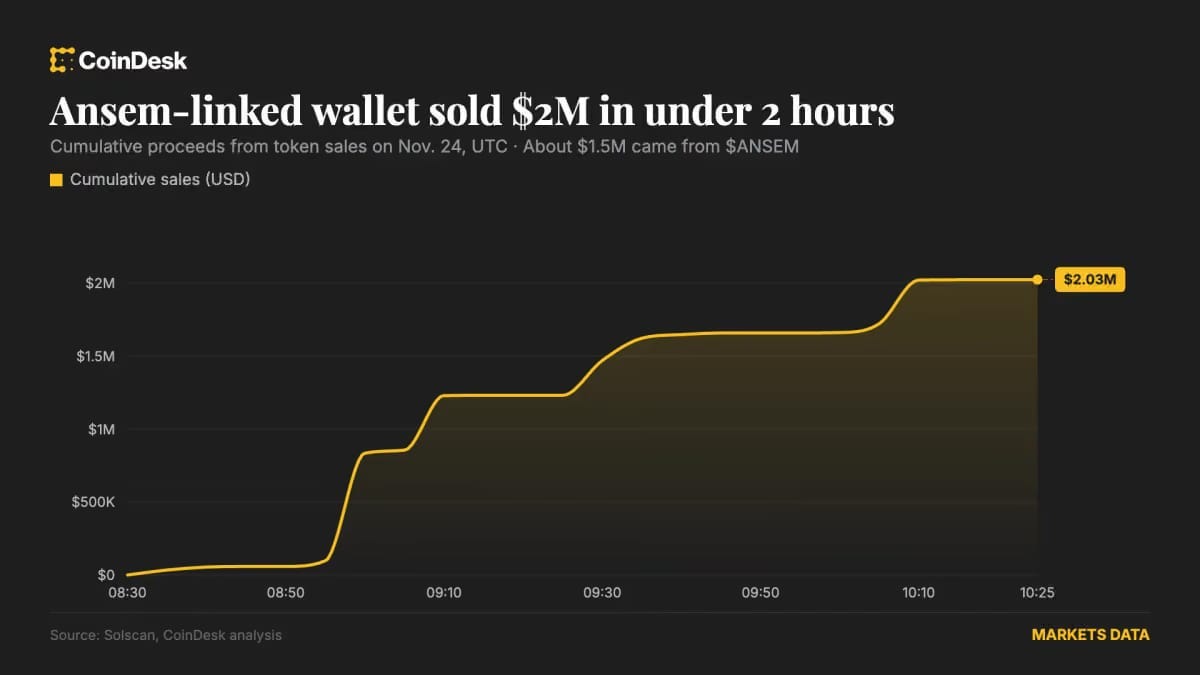
A Solana wallet that Arkham identified as his made 877 sales across 124 tokens starting at 08:34 UTC, selling about $2M in memecoins.
About $1.5M came from selling 87.5M ANSEM tokens, which sent the token down 39% to 2.4 cents and cut its market value to roughly $10.8M.
Ansem said in July that he held about 58% of ANSEM’s supply, so sales from his wallet can move the price hard for its roughly 152,000 holders.
About $1.39M in USDC was bridged to an Arbitrum address through
Relay.link, less than Lookonchain’s estimate of 2.15M USDC, which CoinDesk could not reproduce.Ansem hasn’t said how much he lost or which wallet was hit, and Bullpen hasn’t said whether other users were affected.
Why it matters: Trading terminals ask users to import private keys so trades go through faster. If a co-founder’s own account can be breached, that convenience layer is the weakest point in the setup.
Our take: The bigger risk is the 58% concentration, not the hack itself. If one wallet holds most of a token’s supply, the token fails whenever that wallet does, and from the outside 152,000 holders cannot tell a hack apart from an exit.
For builders and investors: Builders should replace raw key imports with scoped session keys. Investors should treat a token heavily held by its creator as a single point of failure, however famous the creator is.
CASE STUDY
**State of play: **Onchain analysts have linked Abraxas Capital to the Lighter account drained through a leaked API key, and the firm has since emptied its Hyperliquid book, though Abraxas has not confirmed the loss or said why it left.
Mlm onchain says the drained account belongs to Abraxas Capital and puts the loss at $15.5M, while other reports put it at $17M, so the true figure is still unclear.
According to Lighter’s Nov. 16 security update, exposed trading keys enabled an account drain through public-pool shares, meaning the attacker never needed withdrawal access.
Over nearly two years, Abraxas traded $13.4B on Hyperliquid and made $530M, including at least $67M from funding, as one leg of a market-neutral arbitrage strategy.
Its Elysium Global Arbitrage Fund reports net returns above 20% for that period, while Hyperliquid collected about $2M in fees and $3.2M in reserve yield on Abraxas’ USDC.
Abraxas pulled $134M from Hyperliquid after the drain, but no source has shown the exit was a direct response to the Lighter breach.
Take a peek at our referral reward at the bottom of this issue. Share this newsletter and receive our list of 500 crypto VC individuals 👇
INSIGHTS
**State of play: **South Korea’s FSC wants to end its 2017 ICO ban, in effect admitting the ban mostly pushed Korean projects out to Singapore and then back to local investors, and is betting that a supervised regime built on disclosure can bring that capital home.
Issuers would have to file white papers covering token supply, use of funds and risks, along with shorter prospectuses for retail buyers.
Issuers and their executives could face civil damages, fines and criminal prosecution for false or missing disclosures.
The FSC would review filings and could demand corrections, and issuers would have to wait a set period, possibly seven days, before selling to buyers.
Exchanges would have to publish information on listed tokens and disclose major events such as hacks and changes in token supply.
The plan is part of the same Digital Asset Act that would limit won stablecoins to bank-led consortiums, and it still needs parliamentary approval.
FEATURES & GOVERNANCE UPDATE
**State of play: **Anchorage Digital is launching 61st Parallel Asset Management, the latest sign that pure custody is becoming a commodity business and that even the first federally chartered crypto bank now needs more than custody fees to protect its margins.
The subsidiary is due to start operating by early December with a fund denominated in bitcoin that lets custody clients earn yield on their holdings.
Anchorage has filed a Form ADV, the disclosure document advisers use to register with the SEC or state regulators.
CEO Nathan McCauley said clients increasingly want to earn on the assets they hold at Anchorage, which is standard practice at large traditional institutions.
Just over a week ago, Anchorage also applied to the CFTC to register as a swap dealer, the status for firms that make markets in swaps.
The firm already holds seized digital assets as custodian for the Justice Department and works with M0 on regulated stablecoin issuance.
Other notable feature updates:
Solflare𝕏hasPrivate Mode live.LayerZero𝕏openedZRO staking.Hylo𝕏launchedxONYC on Solana.Curvance𝕏launcheda High Yield USDC Vault.Citrea𝕏completedits Pomelo mainnet upgrade.Rune Christensen𝕏repaid3M USDS to stUSDS holder.Sky lenderproposesbuyback of up to $50M to fund stUSDS withdrawals.
QUICK BITES
South Koreaproposesbank-led stablecoinsSouth Koreaproposesending 2017 ICO ban.New York senatorproposes10% tax on prediction market fees.BTCSsellsmore than half its ether to repay $43.8M in Aave debt.Anchorage Digitalto unveilnew asset-management subsidiary.Ansemsayshis wallet was hacked as $2M in memecoins were sold.Bitcoindropsas November spot ETF outflows increase to record $4.71B.BlackRocklaunchestokenized money market fund accepting stablecoins in HK.
NOTEWORTHY READS & MEME
Guy Wuollet’s𝕏readon Building networks for agents.Niko’s𝕏readon Aave vs Morpho: An Asset Issuer’s Guide.Fiodar’s𝕏readon Who’s Building the Onchain Vault Economy?
If you enjoy reading this issue, please consider subscribing. It takes 1 minute of your time, but it would mean the world to us 🙇
Disclaimer: All the information presented in this publication and its affiliates is strictly for educational purposes only. It should not be construed or taken as financial, legal, investment, or any other form of advice.