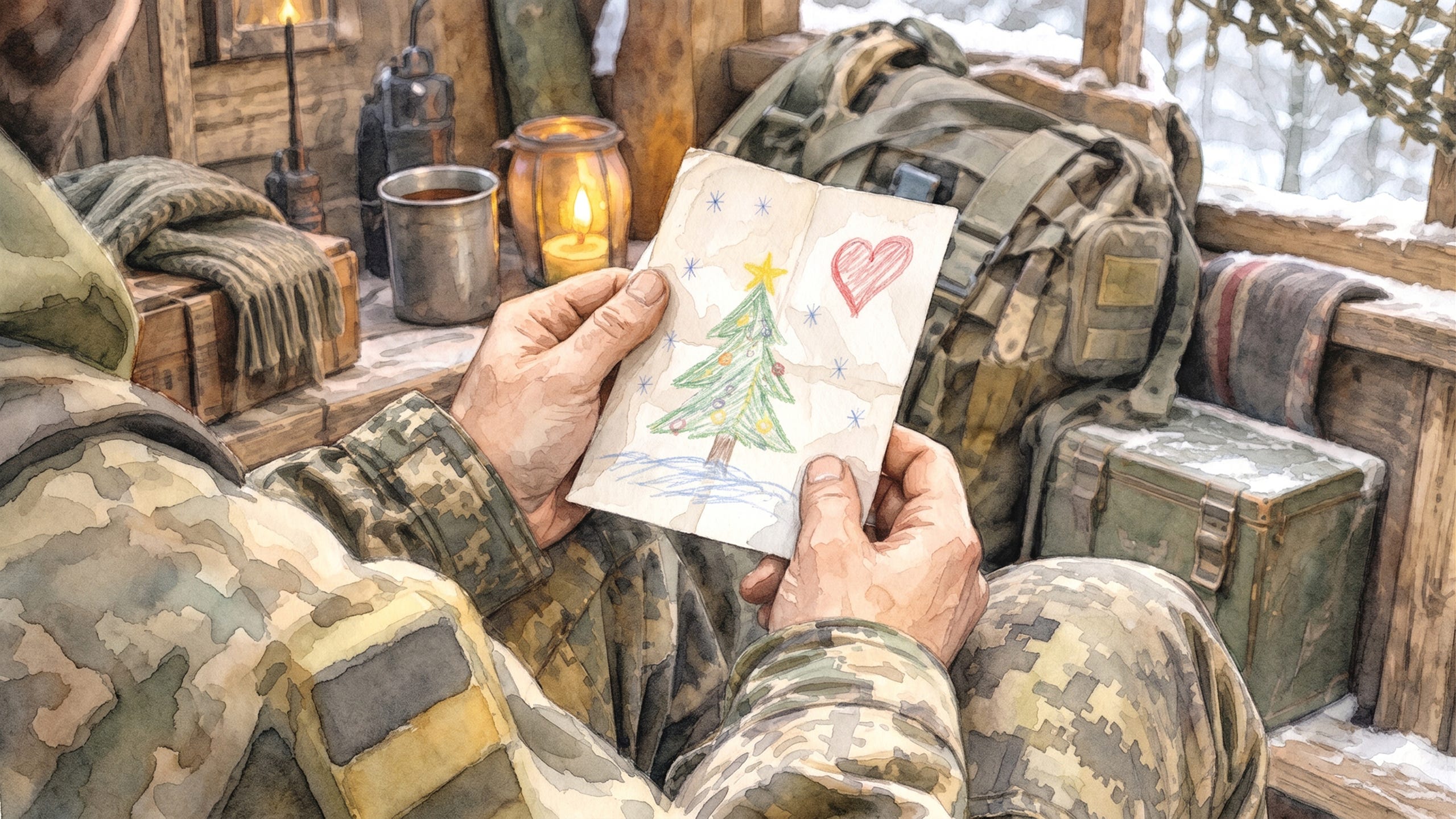
ODESA—November has begun, and Christmas is starting to creep into people’s minds. Across the United States and Western Europe, shop windows are changing. Families are discussing who will host, when to book the journey home, and what the children might like. Soon, Christmas markets will open and familiar songs will become impossible to escape.
We publish this newsletter every day at 9:05am NYC time / 4:05pm Kyiv.Your subscription fuels our work.
Here in Ukraine, people are thinking about Christmas, too. Many of their preparations will be familiar. There will be presents to choose, food to prepare, and disagreements over arrangements. But getting everyone around a table may depend on military leave, a journey from exile, or whether the family home still exists.
For some households, a successful Christmas will mean hearing from someone at the front. For others, it will mean keeping the apartment warm enough for the children. Alongside those worries, people will prepare the traditional wheat dish Kutia and the dried fruit compote Uzvar. They will teach carols, and bring out decorations saved through another year of war. They want their children to inherit Christmas with its pleasures and traditions intact.
Last year, on Christmas Day, Olena Pokotiuk walked through central Kyiv carrying a star with a dead soldier’s name on it.
Around her, people wore traditional costumes and carried Christmas stars through the capital as another air raid alert sounded. Pokotiuk, a charity worker, had come with her son to remember Dmytro, her friend’s brother.
“I carry this star in his memory,” she said. Later, footage showed people singing in a metro station. The traditions continued above and below ground.
Ukraine is approaching its fifth Christmas since Russia launched its full-scale invasion in February 2022. For families whose war began with the occupation of Crimea and fighting in the Donbas in 2014, the count is longer.
One photograph taken on Christmas Eve 2025 shows an 11-year-old girl named Kira sitting on an evacuation bus leaving Kramatorsk. While other children were waiting for the holiday to begin, she was leaving home.
Five Christmases are a substantial part of a childhood. A child who started school when the invasion began is approaching adolescence. Holiday memories are being formed around relatives joining by phone, interrupted sleep, and adults checking whether it is safe to go outside. Parents have had to learn how to make a celebration possible without promising things they cannot guarantee.
The first wartime Christmas allowed people to hope that the next would be different. Repeated year after year, that hope becomes harder to explain to a child.
Christmas makes separation difficult to ignore. Our rituals assume that people can come home, gather in a familiar room, and sit where they have always sat. But by February 2026, almost 2.6 million Ukrainian children remained displaced. About 791,000 were elsewhere inside Ukraine, while nearly 1.8 million were refugees abroad. Among displaced adolescents surveyed, one in three reported having moved at least twice.
“In many ways, the war is following these children,” said Regina De Dominicis, a regional director overseeing humanitarian work for children across Europe and Central Asia.
For these families, preparing Christmas may mean recreating a household tradition in a rented apartment or explaining why a grandparent cannot join them. Returning home can be impossible because the town is occupied, the house is destroyed, or the journey would expose the family to danger.
One photograph taken on Christmas Eve 2025 shows an 11-year-old girl named Kira sitting on an evacuation bus leaving Kramatorsk. While other children were waiting for the holiday to begin, she was leaving home.
For military families, the distance is governed by deployment and leave. The person everyone wants at the table may be unable to say when they can call. A conversation can be brief, and plans remain provisional.
President Volodymyr Zelenskyy described that waiting in his Christmas address last year. For families with someone defending the country, he said, the most precious message was simply: “I’m okay.”
Other families are waiting for news of a prisoner or someone missing. They cannot make the ordinary arrangements of a reunion, and they cannot mourn with certainty. Another Christmas marks another year without an answer.
In Lviv last Christmas, the municipal choir Homin accompanied relatives at the graves of fallen soldiers in Lychakiv Cemetery. The city’s “Mourning Carol” brought the holiday to those who
would never come homefor it.
Even where a family can gather, the practical work of Christmas has changed. Heating and electricity depend on what Russia targets and what Ukrainian air defenses intercept.
On December 25, 2024, Russia launched a coordinated attack on Ukraine’s energy infrastructure, killing an energy worker and injuring six civilians. In the Kharkiv region, more than 2,677 residential buildings lost heating. Nearly 100,000 subscribers were still without heat the following afternoon. It was the thirteenth large-scale, coordinated attack on the energy system that year.
Such attacks make ordinary preparations uncertain. Cooking requires a usable window of electricity or an alternative source of heat. A charged phone is needed to reach relatives and receive warnings. Candles may be on the table because the lights have gone out.
The preparations for this winter show how far those pressures extend. A humanitarian appeal for the winter of 2026–2027 sought $358.4 million to help 2.1 million people.
“Endurance alone cannot heat a home, restore electricity or repair the damage caused by the ongoing war,” said Matthias Schmale, the humanitarian coordinator in Ukraine.
Yet people still make Christmas plans. They prepare food, put up decorations, and teach children the songs they learned themselves. There is pleasure in those things, even when grief accompanies them. Nobody should have to perform cheerfulness to prove that the war has failed to break them. Nor should enjoying an evening require an apology.
In Lviv last Christmas, the municipal choir Homin accompanied relatives at the graves of fallen soldiers in Lychakiv Cemetery. The city’s “Mourning Carol” brought the holiday to those who would never come home for it.
At the front, Christmas depends on what duty permits. For people abroad wondering how to acknowledge those spending another holiday away from their families, there is a personal way to take part.
Lviv-based charity Dzyga’s Paw is collecting soldiers’ Christmas letters through its Secret Santa for Soldiers initiative. Readers can choose a letter and fulfill the wish, either by funding the gift or buying and sending it through the charity. Smaller contributions are pooled to cover letters that have not found a Santa.
One soldier, Sokyra, has asked for toys for children for the second year running. He wants nothing for himself. His own experience as a father shapes his request for children whose families and homes the war has taken away.
At Under Fire News, we are already working with Dzyga’s Paw on Wolves on the Hunt. Secret Santa is another cooperation between our teams, inviting our readers to do something personal for the soldiers whose war we cover.
The deadline to join is November 12. Dzyga’s Paw arranges delivery, and participants can include a letter of their own.
By Christmas, that letter could be in the hands of someone spending another winter at the front. It will not bring them home. It will give them something from a person who remembered they should have been there.
You can join the campaign here.
Nikolaus Muchitsch is chief of staff and strategy at Under Fire News.
**Russian Strike Turns Humanitarian Hub Into Mass Grave—**The death toll fromRussia’s bombing of an aid distribution point in Komyshuvakha has risen to 53, acting Zaporizhzhia regional governor Mykhailo Semikin said on November 6, as search and rescue operations entered their fifth day. The November 2 attack struck a school compound serving as a humanitarian hub, with victims recovered from an underground shelter. It ranks among the deadliest Russian strikes on civilians this year.Ukraine’s emergency service had previously reported 50 deaths and said crews were continuing their work despite difficult conditions and the persistent threat of further Russian attacks. The location compounds the consequences: a facility used to distribute assistance and provide shelter has itself become a disaster site, drawing emergency personnel into an area where they remain exposed. The rising toll also shows how long the scale of such attacks can take to establish, with recovery work continuing days after the bombing. Beyond those killed, the destruction removes part of the infrastructure sustaining a frontline community, making civilian survival harder while imposing further demands on the services attempting to keep residents alive.