Anthropic introduced the protocol that every other stack in this series now uses, and Anthropic adopts a layered policy strategy. This is the fifth article in the series
Article 1, AWS Agentic Security Tooling, Mapped to MAESTRO: A Kit, Not a Shield, established a central Cedar gateway and one rule: routing decides coverage.
Article 2, Microsoft Agentic Security Tooling, Mapped to MAESTRO: Policy Lives in Four Places, established the split alternative: policy lives in identity, content, connector, and framework controls.
Article 3, Google Agentic Security Tooling, Mapped to MAESTRO: The Gateway Is Real, the Semantics Are Not, established a gateway that enforces identity, destination, and tool name for bound traffic.
Article 4, OpenAI Agentic Security Tooling, Mapped to MAESTRO: The Control Lives in Your Code, established the SDK alternative: guardrails, approval, and tracing live in application code, and a tool without those marks runs unchecked.
Anthropic sits closest to Article 4 and differs on one point: Anthropic gives the most complete local permission system in the series, with hooks, allow and deny rules, six permission modes, and managed settings that cannot be overridden, and Anthropic still allows every one of those controls in local configuration.
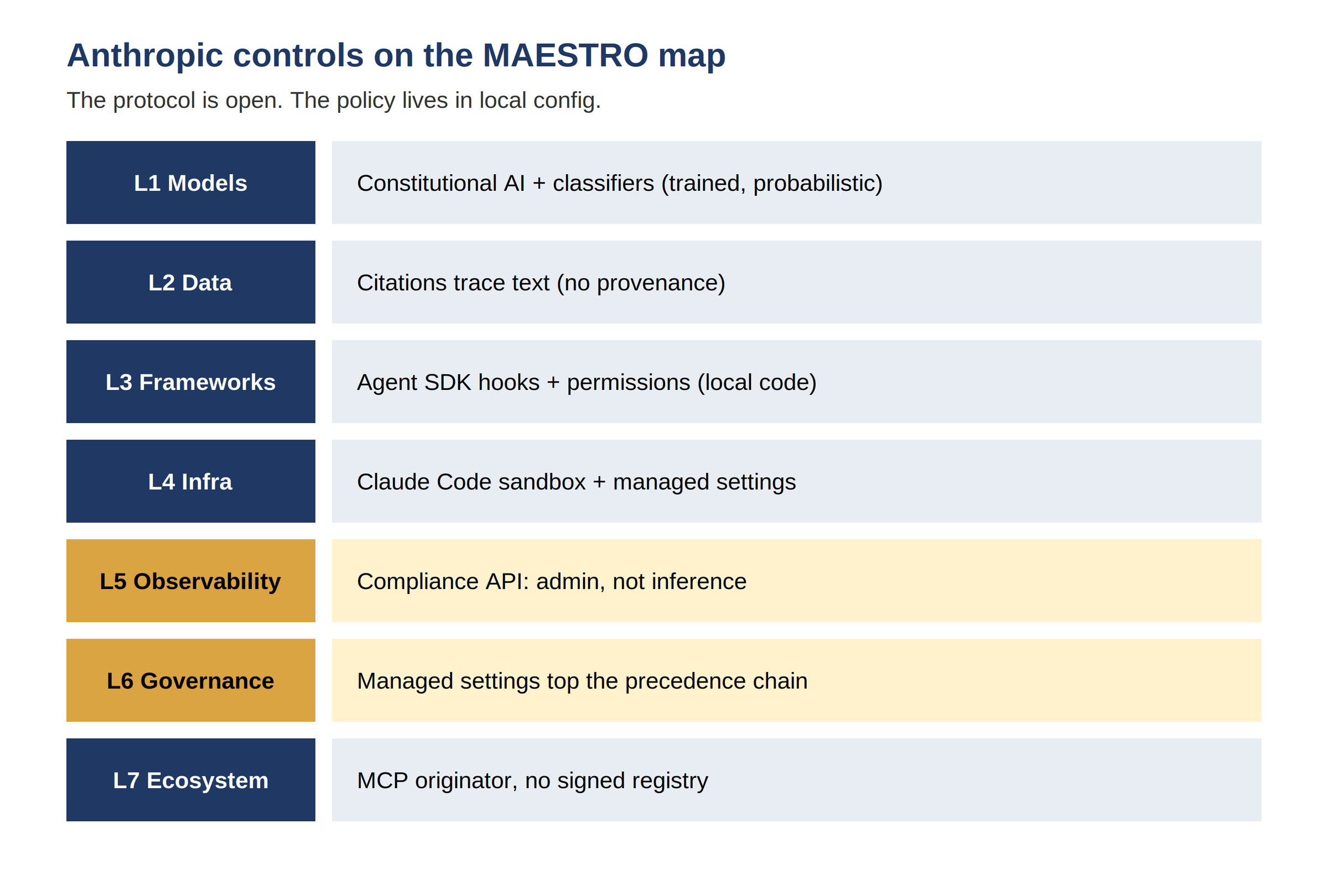
Figure 1 is the Anthropic stack on the MAESTRO map: hooks carry L3, managed settings carry L6 as examples.
Figure 1: Anthropic controls map to MAESTRO layers, with L6 cutting across all layers. Hooks and managed settings carry control, and no gateway sits between them.
Anthropic Constitutional AI gives the model a written set of principles and a self-critique loop, and Anthropic PreToolUse hooks give a developer a deny decision before a tool runs. Those two facts show the pattern of this article in miniature: Anthropic trains strong model behaviour, and Anthropic leaves the enforced decision at the tool to a hook a developer writes and a settings file a team maintains. A team that checks the feature name alone will overstate coverage. A team that checks where the check runs, what the check sees, and who can change the check will see the real coverage.
L1 Foundation Models — the stake is model output. A model can follow a harmful instruction with fluent, confident text. The paid L1 section states what Constitutional AI trains, what Constitutional Classifiers detect, and what neither control can do to a tool argument.
L2 Data Operations — the stake is retrieved text. A document, a memory record, or a tool result can carry an instruction. Retrieval turns untrusted text into model context. The paid L2 section states what citations trace, what the memory tool stores, and what no Anthropic control validates.
L3 Agent Frameworks — the stake is tool action. A plan becomes real impact only when a tool runs. Tool permission decides that impact. The paid L3 section states where hooks run, where permission rules win, where a mode bypasses prompts, and where managed settings restore the break.
L4 Deployment and Infrastructure — the stake is runtime privilege. An agent process runs with a key and a working directory. That key and that directory decide lateral movement. The paid L4 section states how Claude Code sandboxing, project scoping, and managed settings fit together, and which defaults a team must change.
L5 Evaluation and Observability — the stake is proof. Traces, logs, and evaluations show what an agent did and why. The paid L5 section states what the Compliance API records, what the Compliance API never records, and which trace a team must store itself.
L6 Security and Compliance — the stake is identity separation. User identity, agent identity, and tool identity must stay distinct. One shared key hides who acted. The paid L6 section states the settings precedence chain, the connector identity rule, and the approval pattern that restores attribution.
L7 Agent Ecosystem — the stake is peer trust. A peer agent or a tool server needs vetting, registration, and scoped credentials. The paid L7 section states what MCP connection gives, what donation to a foundation changed and did not change, and where peer trust remains unbuilt.
Five cross-layer attack chains — the stake is the chain, not one step. Each chain shows the step where an Anthropic control breaks it, and the step where a gap lets it pass.
Five-way comparison, control gaps, reference architecture, and builder playbook — the stake is reuse. The paid closing sections cite Articles 1, 2, 3, and 4 at each point where Anthropic differs from or shares a gap with them, and give a copy-ready hook, rule, and managed-settings pattern.
Start a review with the hook list and the rule list. List every tool the agent can call, and mark each tool with three facts: whether a PreToolUse hook is attached, whether an allow, deny, or ask rule covers it, and whether the permission mode for the session can bypass the prompt. Mark each subagent with one fact: whether the subagent carries its own tool list. Mark each MCP server with one fact: whether the server runs with a dedicated credential or with a shared key.
Continue a review with settings precedence. List every settings file that can change permission rules, from managed settings down to project and user settings, and mark which file wins for each rule. Mark managed settings as the only file a user cannot override. Check whether bypass mode is disabled in managed settings, and check whether auto mode is disabled where a team does not accept classifier approval. Check whether the sandbox is enabled with fail-if-unavailable. A settings review that finds bypass mode available on a production workstation, or no managed settings file at all, has found a real finding, not a paperwork issue.
Finish a review with a chain test. Pick one chain from the paid section and run it in a test environment with test data, test documents, and test tools. Record the step where a control stopped the chain and the step where no control ran. Record whether a hook denied the call, whether a rule asked for approval, whether a classifier flagged the content, and whether the tool call appeared in the team's own log store. A chain test gives a team evidence, not an opinion, and a repeatable check for the next release.
The paid section maps each layer in turn, gives the five attack chains, the five-way comparison, the control gaps, the reference architecture, and the builder playbook, and keeps every claim tied to a primary source. The paid section drops any claim we could not source. The paid section also states, plainly, where Anthropic offers no native control at all. Those gaps are not a criticism of one product. Those gaps are the work a team must plan, fund, and own. A team that plans that work early ships a safer agent. A team that discovers that work after launch ships a delay. A team that completes the hook inventory, the settings inventory, and chain testing before launch will know its real coverage.