Anthropic launched Claude Fable 5.1 on September 1, 2026. The company’s launch page describes a faster, cheaper model for difficult coding and knowledge work. The more revealing document arrived in the platform docs: a model-specific prompting guide that explains how effort, progress updates, tool-call batching, and conversation history change the result users experience.
That distinction matters. A benchmark measures a model inside a particular system. A customer uses the whole system. If the orchestration layer hides progress, serializes independent calls, drops reasoning state, or runs every task at the wrong effort level, the customer does not experience the benchmarked model.
KC’s 𝕏post about models and harnesses led me to a useful formulation:
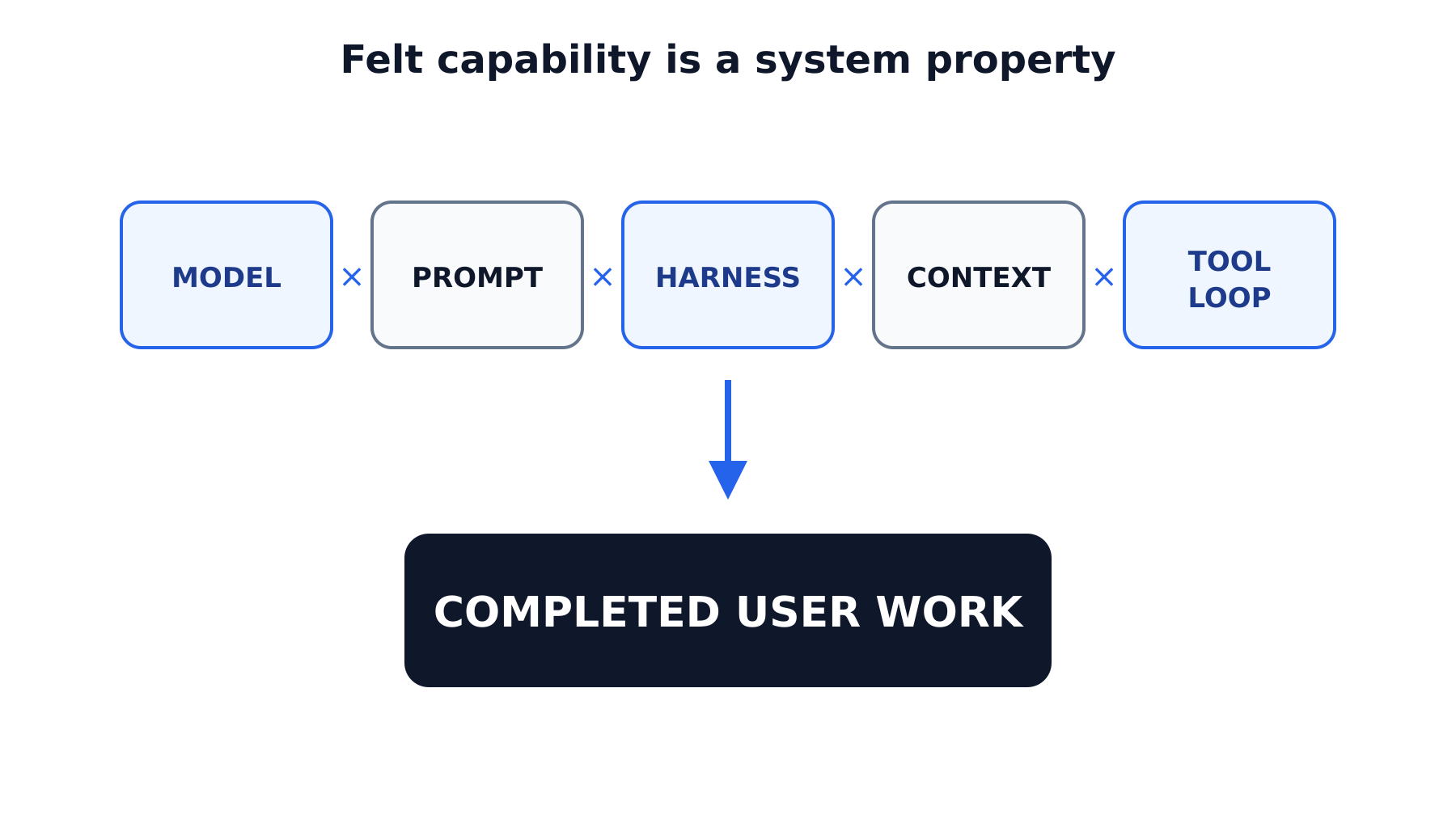
Felt capability = Model × Prompt × Harness × Context × Tool Loop
The multiplication sign matters. A weak factor can reduce the value of every other factor.
Figure 1.1 shows why a model upgrade does not automatically become a product upgrade. The weights determine potential capability, while the surrounding system determines how much of that capability reaches the user.
Figure 1.1: The five factors that determine felt capability.
Anthropic’s official Fable 5.1 prompting guide documents behavioral changes that can look like regressions when an integration carries old assumptions forward.
Anthropic recommends starting at the default high
effort and testing low
, medium
, xhigh
, and max
against your own evaluations. The labels survived the model transition, but the amount of thinking behind each label did not. Anthropic says medium
roughly matches Fable 5 at lower cost, while low
can compete with smaller Claude models on cost per task.
That makes effort a routing decision, not a quality badge. A support lookup, a repository migration, and a scientific literature review should not inherit the same setting simply because one setting won a benchmark.
Figure 2.1 turns that guidance into a product decision. Teams should select the lowest effort level that clears a task-specific quality threshold, then reserve higher levels for tasks that earn their latency and cost.
Figure 2.1: Route by measured task economics, not by effort label.
Fable 5.1 produces fewer visible updates during long tool chains than Fable 5, especially at higher effort. Anthropic also explains that progress arrives through thinking
blocks and remains invisible under the default thinking.display
value of omitted
. A product can therefore receive useful state and still show the user a blank screen.
The fix starts in the client: request display: "updates"
and render non-empty progress blocks. Prompting should come second. Anthropic offers a short instruction that asks for a one-line opening, brief updates during work, and a self-contained recap.
Figure 2.2 separates model behavior from interface behavior. This is important because adding more narration prompts cannot repair a client that discards the relevant blocks.
Figure 2.2: Progress must survive both the API configuration and the renderer.
The guide says Fable 5.1 usually batches calls when a request names several items. In coding and computer-use loops, however, it may issue implied independent calls one turn at a time. Quality can remain stable while latency and token use climb with each extra round trip.
Anthropic’s recommended nudge asks the model to identify what it needs and request every independent item in one response. The placement matters: append a fresh turn-scoped system message after tool results. Do not rewrite an earlier message to insert the reminder.
Figure 2.3 shows the economic difference. Three independent reads do not need three model round trips.
Figure 2.3: Batching independent calls removes avoidable round trips.
For accounts created on or after August 31, 2026, Anthropic binds Fable 5.1 thinking blocks to the exact conversation prefix that produced them. If a harness later edits the system prompt, tool list, or an earlier message, the API can return a bound to a different conversation
error. A beta option can drop the affected block instead, but that also discards useful state.
The safe rule is simple: append assistant turns exactly as returned, including thinking blocks, and keep the prior prefix byte-stable. Use mid-conversation or turn-scoped system messages for new instructions. If client-side compaction becomes necessary, replace the old history with a clean summary and a new user turn instead of replaying orphaned thinking blocks.
Figure 2.4 presents the two paths. The append-only path preserves cache and reasoning continuity. Prefix mutation breaks the relationship between stored thinking and the conversation that created it.
Figure 2.4: Thinking blocks depend on an unchanged conversation prefix.
These are not minor prompt preferences. They are product architecture decisions. They determine whether users see progress, whether agents waste round trips, whether long sessions remain valid, and whether cost settings match the work.
The paid section turns those observations into a five-step harness audit you can run this week. You can claim 50% off an annual subscription to continue with the implementation checklist.