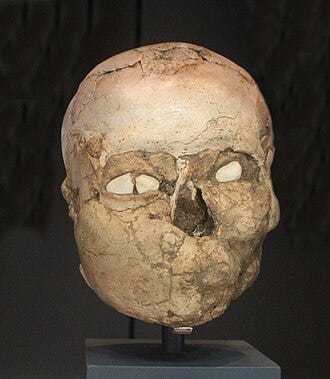
In 1953, on the last day of the dig, archaeologist Kathleen Kenyon found something extraordinary. She’d been digging in one of the oldest cities ever, Jericho. The city has been continuously inhabited for nigh on 12,000 years. If the name rings a bell, it is likely because of the Biblical event in which the Israelites gain an unlikely victory against the town’s inhabitants. God instructed the Israelites to surround the walled city with their horns. The heavy walled fortifications fell, and God’s munificence was proven (Hebrews 11:30).
The real Jericho did have extraordinary walls, often covered in fine plaster. It also had a storied tower, whose purpose remains unknown. Kenyon excavated these age-old built spaces, digging through foundations. She worked meticulously and kept going deeper, each dig taking her farther away from the present day. On the last day of her research, when she reached the level of Jericho's Neolithic inhabitants, she found something no one had seen for millennia.
The object was a human skull encased in plaster. Shells replaced the eyes; plaster had recreated much of the face. The top of the skull was still visible. The sophistication surprised scholars, as this period was before pottery, which is usually a hallmark of advanced culture. Ceramics were used to store food, cook in, and decorate, all elements of civilization that require organized effort. The technology to fire clay to a useful hardness also implies a level of societal sophistication. So these ancient people created these goods despite often having to work much harder to store and cook food than future generations with ceramics. This gives a sense of how important these skulls were for them.
Since that original find, researchers have found 50 plaster-covered skulls from this era throughout the Levant and into Anatolia. While all of them have plaster encasing the skull, their surface finishes differ. Some of the figures have approximations of eyebrows and noses. Other others have a rough surface. Most have shells for eyes. A few have some surviving color. Many really seem to evoke a finished figurative sculpture.
Who were these figures? Sadly, without writing, we will never truly know what they were for. Science suggests many were men somewhere, women somewhere, children. While all of them have a cranium, some lack a lower mandible. Research also indicates that these figures would have been dead and decomposed before the skull was encased in plaster. Other research shows some of the figures had cranial modifications during life, like the reconstruction of the man who was the original Jericho skull. He likely had his head tightly bound as an infant, resulting in a deformed head in adulthood.
This scant evidence does not help us understand their purpose. Because they were found buried within an architectural space, some people suggest they were part of ancestor rituals held in communal worship settings. The earliest societies with writing often exhibit ancestor veneration, so this hypothesis is fairly possible.
Some scholars have suggested these could have been made by people who remember the dead, and so they could, in fact, be portraits. The ones in good condition feel extremely realistic, with eyelids and bridges on their noses. If you ignored the obvious skull features, you’d think it was just a plaster sculpture.
One counterargument for these being true portraits, i.e., likenesses of a person, is whether this society was sophisticated enough to capture a person’s look. I personally find that counterargument slightly pejorative. I suspect prehistoric people were fairly similar to us and could see differences among people, as well as feel the joy of knowing an individual.
That said, it’s hard to conclude whether these objects were meant to be portraits or rather generalized human figures. Many of the figures seem to be handled often, as if used in a ritual. Could they be ancestor rituals or instead more generalized ones? It’s very unlikely we'll ever know whether these are portraits, but it offers us a chance to remember that People have a long history of celebrating each other, and that the desire to create is equally long.
For my mind, while the function is hard to know, the form is exquisite. Thousands of years ago, someone spent considerable effort to render the human form so exquisitely that we, in a completely different era, can get an idea of his look.
This is part of a series about skulls, skeletons, and things spooky. Follow for more.